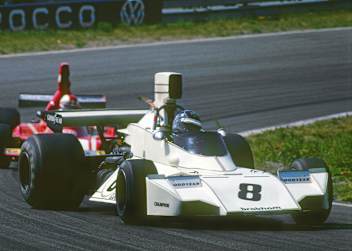
15 October 1983: Nelson Piquet, the first turbo World Champion in a Brabham-BMW
Please forgive me for recalling, once again today, the second World Championship title won by the Brazilian Nelson Piquet. But what happened back in 1983 was, after all, a real game-changer.
This article is an automatically generated English version. The


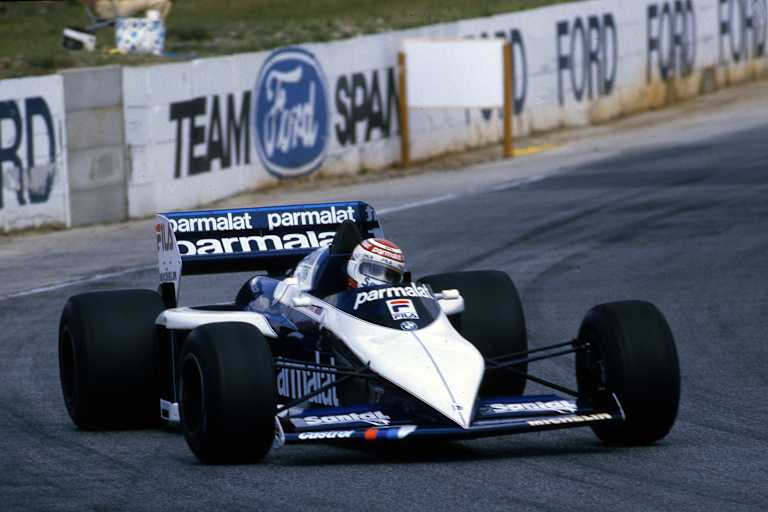
Nelson Piquet 1983 in Südafrika auf dem Weg zum WM-Titel
Foto: XPB
Nelson Piquet 1983 in Südafrika auf dem Weg zum WM-Titel
© XPB
That 15 October 1983, when Nelson’s Brabham-BMW sputtered across the finish line in third place at Kyalami, ranks among the great moments that I was, so to speak, able to experience first-hand.
For the sake of completeness: Nelson had won his first World Championship title in 1981 in a Brabham-Cosworth, and he was to add a third in 1987 in a Williams-Honda.
As BMW’s press spokesman, I never tired of pointing out time and again that this was the first title won with a turbocharged engine – our BMW Turbo. And, as I’ve hinted, once you’ve witnessed moments like that, you never forget them.
Recommendations
Mentioned in this article
Of course, it is pure coincidence that Piquet’s 1983 World Championship victory fell, to the day, 63 years after the date on which Albert Einstein first publicly presented his groundbreaking theory of relativity. Einstein’s discoveries revolutionised our understanding of the physical world, and these became the foundation for modern technologies.
It would be presumptuous to claim that the little Bavarian marvel, with which BMW racing engine guru Paul Rosche made his decisive contribution to Piquet’s success, was of similar significance to Einstein’s wisdom.
Topic of the week
Topic of the week: MotoGP’s new schedule proved highly controversial
In 2027, MotoGP will also enter the 850cc era with a new schedule. It was not so much the changes themselves as the way the decisions were reached that caused a stir. A prime example of: ‘Talking helps’.
TV Program
Yet: who would have bet at the outset that an ordinary four-cylinder engine could one day become a world-championship-winning power unit? Initially, it was just Paul Rosche himself and a handful of technicians in his circle.
BMW: Winning the Formula 1 World Championship with a production engine block
The story leading up to the decisive day at Kyalami has been told often enough, so here it is once more in brief: a production four-cylinder engine block, four-valve technology, Formula 2, turbocharging, and a partnership with Brabham.
For once, politeness prevents the singer from dwelling on the endless political – and, admittedly, understandable – technical adversities, for the only thing that mattered was the goal; setbacks of one sort or another simply had to be overcome.
When the remaining three potential title contenders – Alain Prost in the Renault, René Arnoux in the Ferrari and Nelson Piquet in the Brabham-BMW – gathered on the grid for the finale at Kyalami, all that was forgotten. Now the decision had to be made.
The worries caused by the faulty part during practice had also been pushed aside. What remained was hope, confidence in their own technology and the drivers’ nerves.
And then came the all-deciding race: Piquet indeed simply pulled away from everyone else at the start, as if it were the most natural thing in the world. No one stood the slightest chance against the perfectly tuned Brazilian, his brilliantly balanced Brabham and the four-cylinder engine that ran as magnificently as it roared.
The only one who can still keep up with him to some extent in his ever-lengthening slipstream is his team-mate Riccardo Patrese, the unlucky driver who had only stood on the podium once all season (finishing third at Hockenheim).
A moment of shock: why is Piquet slowing down?
The pair are in control of the field; Nelson sets the race’s fastest lap as early as the sixth lap and remains in the lead even after his pit stop. Nothing, absolutely nothing, suggests any drama – until it suddenly becomes clear to everyone that the leader is slowing down. A problem? No signal from the cockpit, and all is calm in the Brabham pit too. What’s going on?
Rosche explains to the journalists rushing over: “Nelson has turned the boost all the way up – but down!”
The engine sounds so dreadful that, lap after lap, you find yourself marvelling anew as car number 5 keeps powering past.
Piquet’s lap times eventually stabilise again. Gradually, it dawns on everyone what the Brazilian is up to: On lap 35, his only remaining rival (Arnoux, the third in the trio of title contenders, had already retired his Ferrari with engine failure on lap nine) – Prost – had climbed out of his Renault in full view of his team.
No wonder, then, that Piquet took it easy, letting his team-mate cruise to his first win of the season and, with a light heart, also letting Andrea de Cesaris in the Alfa take the lead. The points for third place were more than enough for him.
When he later presented himself as the new world champion, beaming with joy and bathed in champagne and sweat, everyone understood: “I didn’t want to take the slightest risk. I could easily have won. But just imagine if I’d driven faster and something had broken. I’d never have forgiven myself for that for the rest of my life.”
Once it was all over, and the champagne had dried on his racing suit and hair, no one wanted to speculate on how much longer the battered engine might have lasted.
In any case – not for much longer. How did that quote from the great Colin Chapman go again? ‘The best racing car is the one that crosses the finish line in victory and then breaks down.’
15 October 1983, forever one of the most significant dates in the history of Bayerische Motoren Werke.
Seen already?
Don't miss out on any highlights: The Speedweek newsletter, sent out twice a week, delivers the latest news, exclusive commentary and all the important dates from the world of motorsports - directly into your inbox
Championship Standings
Full Standingsorg-location for [2026] 2026
2026
2025
2024
2023
Pos
Driver
Team
Points
1


340
2

238
3


229
4


221
5

215
6


201
7

138
8

97
9


75
10


41
Highlight Videos
ServusTV Media Library
Der Schweige-Code von Singapur!
12. Okt. | 3:27 Min
Sprint, Pole und Sieg für Verstappen?
11. Okt. | 3:09 Min
10. Okt. | 3:06 Min
10. Okt. | 4:06 Min
Peinlicher Software-Fehler & Schleich-Modus!
5. Okt. | 3:05 Min
„Alonso hat noch eine Rechnung offen!“
2. Okt. | 16:27 Min
Neu: Neongelbe Audi-Abdeckungen! | Klien erklärt
2. Okt. | 4:30 Min
Trotz Verstappen-Befehl: Hadjar macht Druck!
27. Sept. | 1:44 Min
Events
All Formula 1 Events


Formula Cars News
All News