FIA Master of Ceremonies: The woman who organises the Formula 1 podium
Behind the traditions and rituals of Formula 1 – with the Parc Fermé and the podium – lies a huge amount of work. SPEEDWEEK.com met FIA Master of Ceremonies Linda Boudabous. A look behind the scenes.
This article is an automatically generated English version. The
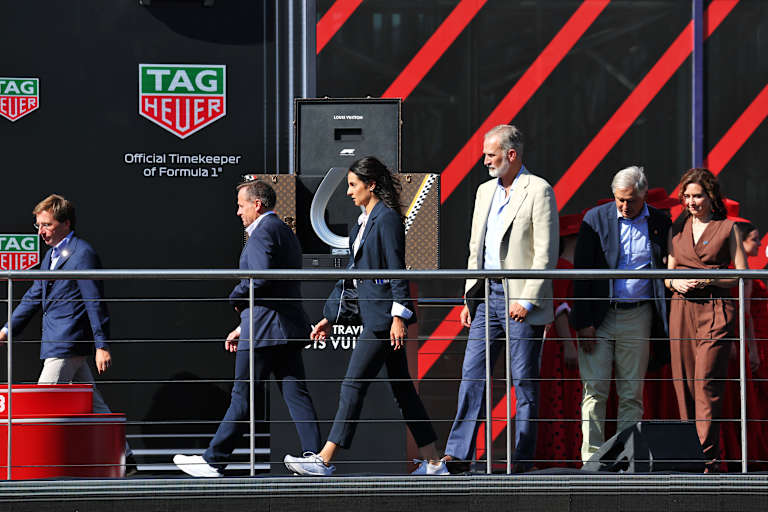
Linda Boudabous (M.) vor König Felipe von Spanien auf dem Madrid-Podium
Foto: XPB
Linda Boudabous (M.) vor König Felipe von Spanien auf dem Madrid-Podium
© XPB


Once the excitement of Formula 1 has died down, the winner has been decided and the cars have been parked away, that’s when the real work begins behind the scenes. An entire team ensures that everything runs smoothly in the Parc Fermé, where the cars are inspected, and on the podium. Ideally, the spectators are completely unaware of everything that goes on behind the scenes.
Linda Boudabous coordinates the Parc Fermé and the podium
SPEEDWEEK.com met Linda Boudabous, the FIA’s Master of Ceremonies, during the race weekend in Madrid. Together with a large team, she organises the smooth running of proceedings after the race. Regular Formula 1 viewers will certainly have seen her on television before: Wearing a headset in the Parc Fermé, busy coordinating the drivers, or standing at the edge of the podium during the trophy presentation. Behind those few minutes shown on TV lie days of work with a large team.
Boudabous, who grew up in Monaco, is at the circuit from Thursday onwards. If a circuit is new, such as in Madrid, she has to take a particularly close look around and familiarise herself with the conditions. After qualifying or the race, Boudabous is the one who tells the drivers where they need to go. So she has to know the venue inside out and have the schedule firmly in her head. Formula 1 relies on her.
Recommendations
Mentioned in this article
Extensive preparation, a large team
Preparations for the ceremonies begin days before the Grand Prix, with many people involved: staff from the media, technical, Formula 1 management, security, TV and many other departments are part of the team; Boudabous is the face we see on television.
The weekend’s schedule is planned down to the minute and metre. The task is to coordinate the technical checks on the cars, media commitments and the official celebrations. And all this in a bustling environment: people everywhere, cameras everywhere, all eyes on her. The sprint weekends are particularly intense. As well as Formula 1, Boudabous and her team also look after the junior series, Formula 2 and Formula 3.
Topic of the week
Spanish Grand Prix at the new Madring: track – hit or miss?
The people of Madrid had set their sights high for their city’s first Formula 1 World Championship race since 1981. But have the high expectations for the new Madring mixed-circuit track really been met?
TV Program
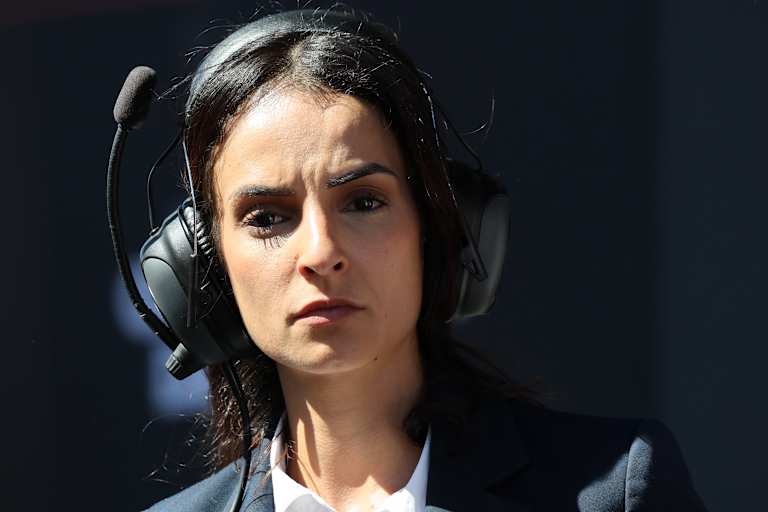
FIA-Zeremonienmeisterin Linda Boudabous
Foto: XPB
FIA-Zeremonienmeisterin Linda Boudabous
© XPB
In the Parc Fermé, the drivers follow Boudabous’s commands. It took a bit of getting used to at first. Boudabous: “It’s difficult for the drivers when they don’t know you. They’re constantly being spoken to all weekend, so they naturally tend to turn to the people they know. I think it took a whole season before they realised I’m the one who provides the information. And once they recognise your face, they come to you quite naturally.”
She’s in constant radio contact with her team. “We talk a lot with the technical team, because the checks in the Parc Fermé are the most important thing and we don’t want to disturb them whilst they’re doing them. We also receive information from race control there, for example. We talk to each other a lot, and that’s the key.”
Because the hectic atmosphere is no mean feat: “There’s so much going on in the Parc Fermé. The drivers are here, the cars are there, the mechanics come to collect the cars, and the TV is broadcasting live. You have to keep so many things in mind.” On top of that, there are lots of little details that play a part in ensuring all the cogs in the wheel mesh together. The FIA has to provide water and towels (which are occasionally snatched up by celebrities afterwards – see Kim Kardashian in Monaco). Champagne and trophies are provided by the organiser or contractual partners. Boudabous and her team simply have to ensure that everything is ready. And that everyone involved is in the right place at the right time.
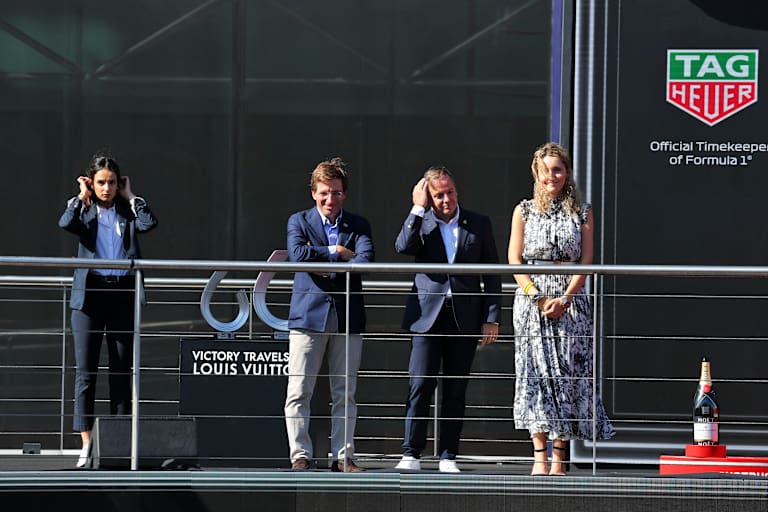
Linda Boudabous (l.) auf dem Podium in Madrid
Foto: XPB
Linda Boudabous (l.) auf dem Podium in Madrid
© XPB
Preparation is everything. Boudabous learns faces and roles, and does a lot of research in advance. She also makes preparations for every eventuality: ‘We’ve got all the national anthems, flags and everything else ready.’ Just in case a driver who isn’t necessarily a regular ends up on the podium or wins. Boudabous: “We prepare for every possible scenario, even the weather. In Miami, for example, we once had a weather forecast that was extremely unfavourable for the awards ceremony schedule. That’s why we’d already found an alternative in case the weather turned bad during the ceremony. So we always try to anticipate as much as possible.’
As well as the drivers, she also looks after, for example, heads of state who present the trophies after the race. Boudabous: “There’s a big difference in how we speak to different people and how we deal with them. We have heads of state; we have various kinds of very high-ranking dignitaries, including kings. Naturally, there’s a whole set of protocol rules to follow. These are often people I’m meeting for the first time. The drivers, on the other hand, are with me all weekend, and that happens 24 times a year. Naturally, the relationships are quite different.”
Successful drivers often become regulars on the podium and eventually get to know the routine. However, Boudabous observes: ‘At the end of the race, they always need a bit of a breather.’ The drivers know what’s coming and what their obligations are, for example, towards the media. Nevertheless, even the seasoned veterans rely on Boudabous and her team: “We always have to give them the latest information, especially at sprint weekends, where the format is slightly different. They know what they have to do, but they also know that we’ll guide them through the process. I think they rely on us and perhaps think, ‘They’ll tell us what to do anyway.’ Every circuit is laid out differently, so the routes and routines vary accordingly.
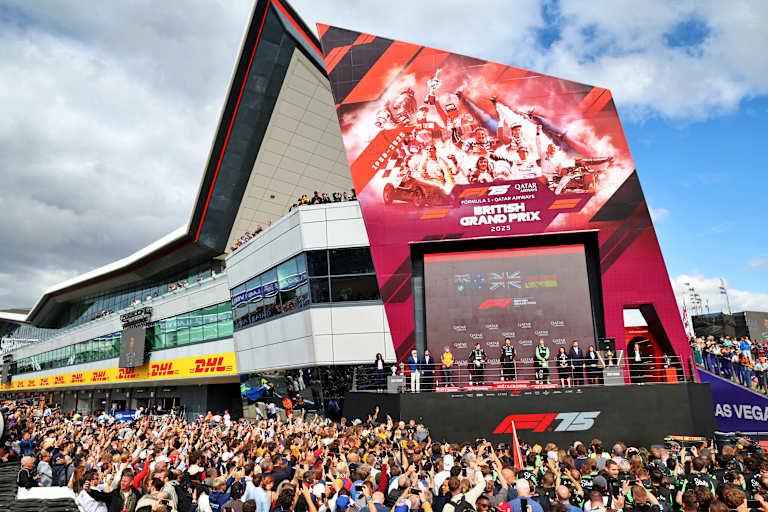
Nico Hülkenbergs erstes Podium 2025 in Silverstone
Foto: XPB
Nico Hülkenbergs erstes Podium 2025 in Silverstone
© XPB
Every now and then there are newcomers too, such as Nico Hülkenberg last year at Silverstone on his first podium in his 239th (!) Grand Prix. Boudabous: “It was funny because he had absolutely no idea where he was supposed to go. It’s nice to have some new faces every now and then and to guide them through the whole procedure. They listen very carefully because they’re not familiar with it yet.” The same goes for Pierre Gasly, who secured the first pole position of his career at Monza: “He waited and asked: ‘What do I do next?’ So our job – including that of the media liaison – is very important, because we can guide them through the whole process.”
Whether on or beside the podium, Boudabous experiences those pole position moments first-hand: “Sometimes you can really feel the tension on the podium – you can tell they’ve truly given it their all in the race.” In moments like these, every Formula 1 fan would surely love to swap places with her…
Seen already?
Don't miss out on any highlights: The Speedweek newsletter, sent out twice a week, delivers the latest news, exclusive commentary and all the important dates from the world of motorsports - directly into your inbox
Results
Full StandingsPos
Driver
Driver
Team
Start No.
Rounds
Time
Fastest Lap
Points
01

Mercedes-AMG Petronas Formula One Team
12
57
1:34:23,754
1:36,030
25
02

Oracle Red Bull Racing
3
57
+4,351
1:36,760
18
03

McLaren Formula 1 Team
1
57
+5,089
1:36,680
15
04

Scuderia Ferrari HP
16
57
+29,116
1:36,063
12
05

Mercedes-AMG Petronas Formula One Team
63
57
+29,829
1:35,587
10
06

Oracle Red Bull Racing
30
57
+1:26,746
1:36,846
8
07

BWT Alpine Formula One Team
43
57
+1:34,281
1:37,321
6
08

McLaren Formula 1 Team
81
57
+1:35,839
1:37,226
4
09

Visa Cash App Racing Bulls Formula One Team
41
56
+1 round
1:38,211
2
10

Audi Revolut F1 Team
27
56
+1 round
1:38,114
1
Highlight Videos
ServusTV Media Library
50-Meter-Drama von WM-Maschine eiskalt ausgenutzt!
14. Sept. | 1:36 Min
13. Sept. | 3:13 Min
Mercedes in Monza: Funk verrät Stimmung
7. Sept. | 1:15 Min

4. Sept. | 4:58 Min
Hat Hamilton Mercedes-Heimweh?
24. Aug. | 1:54 Min
Liam Lawson: Markantes Style-Detail!
23. Aug. | 7:14 Min
Paddock-Tour: Weite Wege in Zandvoort
22. Aug. | 7:08 Min
Keine Bitterballen für Andrea & Christian
21. Aug. | 6:00 Min
Events
All Formula 1 EventsPast Italian Grand Prix
 04.–06.09.2026
Past Spanish Grand Prix
 11.–13.09.2026
Next up Azerbaijan Grand Prix
 24.–26.09.2026
Next up Bahrain Grand Prix
 02.–04.10.2026
Singapore Grand Prix
 09.–11.10.2026
Past Italian Grand Prix
Past Spanish Grand Prix
Next up Azerbaijan Grand Prix
Next up Bahrain Grand Prix
Singapore Grand Prix
Formula Cars News
All News
Newest Articles
All ArticlesNew New New New New New New New