
Michael Schumacher’s trick: How Lando Norris wanted to win at Silverstone
Following the turbulent British Grand Prix, it emerged that Lando Norris had toyed with the idea of winning the traditional Silverstone Grand Prix with a trick – just as Michael Schumacher had done years ago.
This article is an automatically generated English version. The

Skurriles Ende des britischen Grand Prix 1998: Schumi gewinnt – an der Box
Foto: Grand Prix Photo
Skurriles Ende des britischen Grand Prix 1998: Schumi gewinnt – an der Box
© Grand Prix Photo


Formula 1 fans at Silverstone missed out on a breathtaking finale: most spectators had hoped that a safety car period shortly before the end (due to Max Verstappen’s crash) would conclude in such a way that one final lap could be driven at full throttle.
But that didn’t happen: the classic race ended under yellow flags, with Charles Leclerc winning his first Grand Prix since October 2024 in Texas in his Ferrari.
As the cars rolled around the circuit behind Bernd Mayländer’s safety car, world champion Lando Norris – running in fourth place – had an idea.
Recommendations
The Englishman came on the radio: “Can I come into the pits? Can I win the race like this?”
His race engineer, Will Joseph: “No, you can’t.” – Norris: “What a shame…”
Before the start of the season, critical voices dominated, but the World Championship rounds so far have shown that the rule changes are delivering exactly what was hoped for: excitement right up to the final lap.
TV program
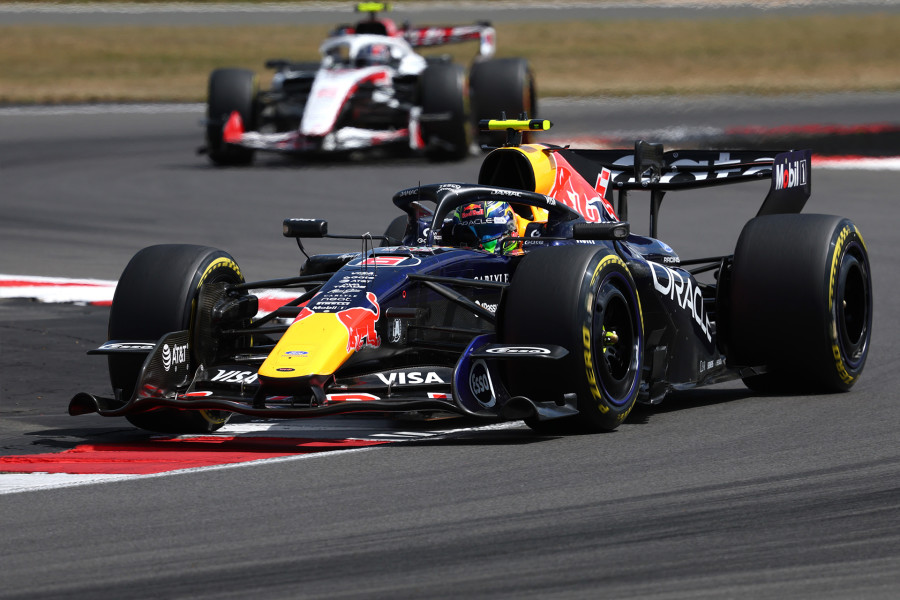
Norris had recalled an astonishing trick pulled off by German racing legend Michael Schumacher. And this is how it went.
Silverstone 1998: The seeds of the race’s most extraordinary conclusion were sown on lap 43. Ferrari superstar Michael Schumacher overtook Benetton driver Alexander Wurz. Unfortunately, in doing so, the German star drove through a yellow flag.
At that point, race control was busy monitoring the weather – one lap later, the safety car had to be deployed because it had started to pour with rain. As a result, a good twenty minutes passed before they could look into Schumi’s offence.
At 3.46 pm, or two laps before the end of the historic Grand Prix, Ferrari was informed that Michael Schumacher would receive a 10-second penalty.
But the race organisers made a blunder. Not only was the handwritten (!) note handed over to the Ferrari pit crew too late (the information about a penalty should have been provided within 25 minutes), but it was also worded in a vague and ambiguous manner – it was not clear from the note whether these ten seconds had to be served during the race or whether they would be added to Schumi’s race time.
The then Ferrari team principal Jean Todt (later FIA President) called Schumacher into the pits on the final lap of the race following consultation via radio. However, the start/finish line was located before the point where the Ferrari pits were situated. So when Schumi served his penalty, the race was effectively over, even though the German had not been shown the chequered flag. The race stewards now had no choice but to add the ten seconds to Michael’s race time.
However, as Schumi was 22 seconds ahead of Mika Häkkinen, he was the winner even without moving – something he would hardly have managed had he served the penalty normally during the race. You couldn’t have played it any more cunningly than Ferrari did. Schumi and his team had been handed an opportunity, which they gladly seized.
The case had repercussions at two levels within the International Automobile Federation (FIA): Nazir Hoosein (India), Roger Peart (Canada) and Howard Lapsley were forced to surrender their race commissioners’ licences (though they were later pardoned).
The precise procedure for defining a penalty and communicating it was subsequently amended – since then, everything has been handled by the Formula 1 race director, who sends the information electronically to the teams’ command centres.
Furthermore, it was enshrined in the regulations that crossing the finish line in the pit lane at the end of the race does not count as crossing the finish line.
Furthermore, years later, the Silverstone circuit layout was altered: the start/finish line is now in a different location.
Seen already?
Don't miss out on any highlights: The Speedweek newsletter, sent out twice a week, delivers the latest news, exclusive commentary and all the important dates from the world of motorsports - directly into your inbox
Highlight videos
ServusTV media library
Antonelli verweigert Toto-Befehl!
6. Juli | 1:29 Min
Russell-Dusel nach Safety-Car-Fehler
5. Juli | 3:22 Min
4. Juli | 4:10 Min
Überhol-Festival bei Premieren-Erfolg!
4. Juli | 3:03 Min
„Das war der Höhepunkt des Duells“
3. Juli | 2:02 Min
60 Grad, Trinkflasche hin: Russells Ruhe-Geheimnis
29. Juni | 1:07 Min
28. Juni | 7:46 Min
Hammer-Qualifying, Hammer-Challenge!
27. Juni | 8:15 Min
Formula racing News
All news



Newest articles
All articlesNeu Neu Neu


