
Approval, but also criticism: Jorge Martinez on the new standardised Moto3
Since the Assen GP, it has been officially confirmed how Moto3 will develop for the 2028 season. GP icon and Moto3 team owner Jorge Martinez is not only delighted with the revolutionary one-make formula.
This article is an automatically generated English version. The

Jorge Martinez: Kaum jemand kennt das GP-Fahrerlager besser
Foto: Gerhard Schiel
Jorge Martinez: Kaum jemand kennt das GP-Fahrerlager besser
© Gerhard Schiel


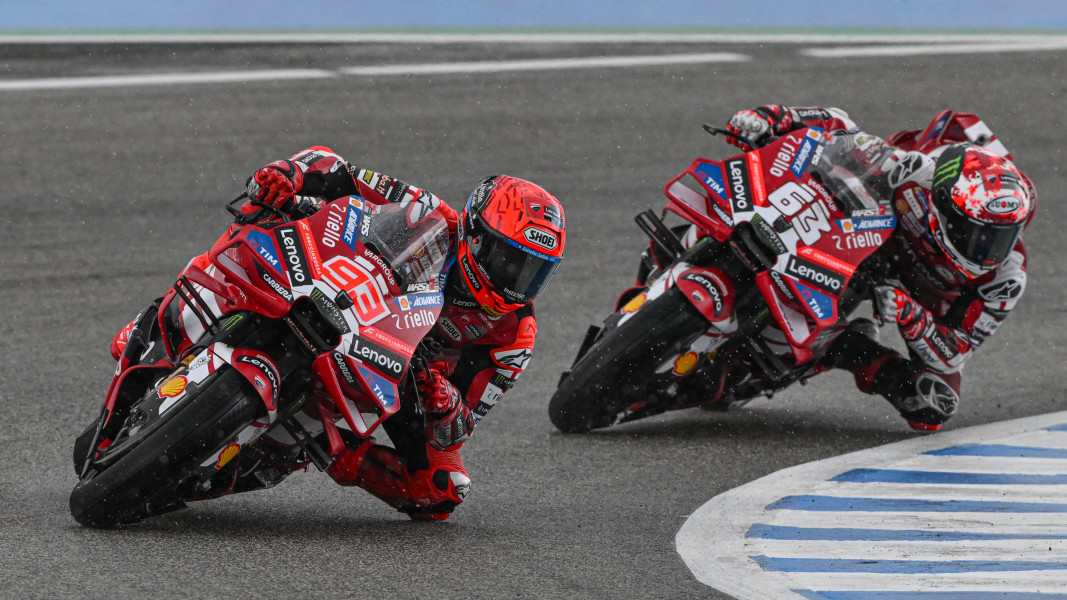
It has long been clear that the current Moto3 World Championship, featuring mini-prototypes that are extreme in every respect, has an expiry date. During the MotoGP event at Assen, the MotoGP sporting director finally stepped up to the microphones to update the public on the future development of the smallest World Championship class. Carlos Ezpeleta was not alone, and for good reason. Yamaha’s head of racing, Paolo Pavesio, joined him as a partner.
Moto3 revolution: engine capacity to almost triple by 2028
One of the leading figures in the Grand Prix paddock is Jorge Martinez. Following a long World Championship career as a rider in the smaller displacement classes, which was crowned by the 125cc title, the Spaniard used his network to make a name for himself as a team owner too. A MotoGP team also ran under the Martinez banner.

Martinez mit seiner erfolgreichen Moto3-Einheit um WM-Leader Quiles
Foto: instagram Aspar Team
Martinez mit seiner erfolgreichen Moto3-Einheit um WM-Leader Quiles
© instagram Aspar Team
However, following a change in strategy, ‘Aspar’ Martinez is now focusing on developing young talent. His team, based in Valencia and equipped with its own racetrack, is involved in all asphalt-based series. The Moto3 and Moto2 programmes serve as the spearhead – with the aim of then passing the most talented riders on to MotoGP. Current examples include Moto2 race winners David Alonso and Dani Holgado.
With Maximo Quiles, Martinez also has another exceptional talent in the Moto3 line-up. In 2027, the commanding World Championship leader will move up through the ranks internally. SPEEDWEEK.com spoke to Jorge Martinez to understand the GP veteran’s perspective on the development of the completely new Moto3 series from 2027 onwards. ‘Aspar’ got straight to the point. “It was time to do something. I, too, believe that further development wouldn’t do the current series any harm. A great deal has changed in recent years, but not in Moto3.”
The 2027 MotoGP grid will feature five new regular riders, with at least three of those dropped set to move to the World Superbike Championship. The ones to suffer as a result are Alvaro Bautista and Danilo Petrucci.
TV Program
Two cylinders and 450 cc – that was the original plan
Martinez continued: “Consequently, there was a great deal of interest when discussions on the matter began. That was just over a year ago, and alongside CFMOTO, KTM, Aprilia, Honda and Yamaha were also involved. For a long time, there was talk of moving towards a 450 cc twin-cylinder engine. I, too, believe that would have been a good capacity and a sensible step.”

Ende 2027 werden die filigranen 250er-Moto3-Renner ausgemustert
Foto: Gold and Goose
Ende 2027 werden die filigranen 250er-Moto3-Renner ausgemustert
© Gold and Goose
As we know, things turned out differently. Jorge Martinez: “I can’t say what reasons led to the current decision – but from my point of view, the step that’s been taken is too big. At the moment, we’re talking about a 250cc single-cylinder engine, where the engine weighs only around 18 kilos, produces around 65 PS and has a kerb weight of under 100 kilos. By 2028, it will then be around 700 ccm, perhaps 90 PS and 125 kilos.”
For Martinez, however, one thing is also clear: “For me, this development means that we’ll then have to follow suit when it comes to the classes below Moto3. You have to look at the whole picture, including the Rookies’ Cup and Moto4, when it comes to rider development.”
The fact is: currently, 750 ccm separates the smallest and largest GP categories. Even in the last major GP era with two-stroke prototypes, a bike in the premier class had four times the displacement of the smallest World Championship class, which from 1990 onwards was 125 ccm. With the start of the new MotoGP era in 2027 and the Moto3 revolution in 2028 featuring Yamaha spec bikes, the ‘smallest’ and ‘largest’ classes in MotoGP will still be separated by a good 150 cc in engine capacity.
Seen already?
Don't miss out on any highlights: The Speedweek newsletter, sent out twice a week, delivers the latest news, exclusive commentary and all the important dates from the world of motorsports - directly into your inbox
Highlight Videos
ServusTV Media LibraryMisano: Die Tops & Flops des Wochenendes
13. Sept. | 6:15 Min
13. Sept. | 4:26 Min
13. Sept. | 31:59 Min
13. Sept. | 3:43 Min
Short Profile: So tickt Izan Guevara
13. Sept. | 3:07 Min
MotoGP-Titelkampf spitzt sich zu
13. Sept. | 4:22 Min
13. Sept. | 1:15 Min
Bezzecchi verliert die Nerven!
13. Sept. | 1:15 Min
Events
All Moto3 EventsPast British Grand Prix
Silverstone Circuit, Great Britain 07.–09.08.2026Past Gran Premio de Aragón
Motorland Aragón, Spanien 28.–30.08.2026Live
San Marino Grand Prix
Misano World Circuit Marco Simoncelli, Italien 11.–13.09.2026Next up Motorrad Grand Prix von Österreich
Red Bull Ring, Österreich 18.–20.09.2026Japanese Grand Prix
Twin Ring Motegi, Japan 02.–04.10.2026

Past British Grand Prix
Silverstone Circuit, Great Britain 07.–09.08.2026Past Gran Premio de Aragón
Motorland Aragón, Spanien 28.–30.08.2026Live
San Marino Grand Prix
Misano World Circuit Marco Simoncelli, Italien 11.–13.09.2026Next up Motorrad Grand Prix von Österreich
Red Bull Ring, Österreich 18.–20.09.2026Japanese Grand Prix
Twin Ring Motegi, Japan 02.–04.10.2026
MotoGP News
All News


Newest Articles
All ArticlesNew


