
Are starts safer following the holeshot ban? Here’s what the MotoGP riders have to say
The holeshot device has been banned in MotoGP since the Assen GP. The ban on the system is intended to improve safety during the start phase. Here’s what the riders had to say after the first race.
This article is an automatically generated English version. The

Marc Marquez
Foto: Gold & Goose
Marc Marquez
© Gold & Goose


When Ducati entered the 2019 season with the holeshot device, the concept was considered revolutionary. Yet Gigi Dall’Igna had simply drawn inspiration from the motocross scene, where the concept had already been in use for years. He had to resort to a loophole in the rules, as fully automatic suspension systems are prohibited under MotoGP regulations. Ducati therefore developed a purely mechanical-hydraulic system that the rider could activate manually via a rotary knob on the handlebars. The holeshot device later led to the ride-height device, which will also be banned from 2027.
2026 bikes are not designed to comply with the holeshot ban
The ban on the holeshot device, effective from the MotoGP event at Assen, was imposed following serious start-line accidents in Barcelona and Balaton Park, as safety concerns mounted. The problem is that the 2026 bikes are not designed to comply with this ban. There were fears that riders would now be more likely to perform wheelies on their motorbikes at the start. When the front wheel ‘lifts off’, a MotoGP bike is virtually impossible to control during that moment. As both the Sprint and the Grand Prix revealed, there were isolated instances of wheelies, but the manufacturers were able to adapt well.

Marco Bezzecchi
Foto: Gold & Goose
Marco Bezzecchi
© Gold & Goose
But what do the riders themselves have to say? Alex Rins is quite happy with the situation: “If it were up to me, we could ban all devices at the start.” His team-mate Fabio Quartararo has never experienced MotoGP without the holeshot device. In the Assen sprint, he was still struggling to adapt to it: “I need to get used to it first. With a full tank, we have fewer wheelies anyway.”
Positive conclusion after the Assen weekend: the ban makes the start safer
LCR Honda rookie Diogo Moreira was also able to come to terms with the ban: “I experimented with the rear brake and also with the clutch. All in all, it wasn’t too bad.” Franco Morbidelli reported that he struggled with wheelies at the starts. HRC rider Joan Mir believes the start procedure is now safer. His team-mate Luca Marini agrees: “You no longer have to make a strange, hard braking manoeuvre to release the front-wheel lock.”

Toprak Razgatlioglu
Foto: Gold & Goose
Toprak Razgatlioglu
© Gold & Goose
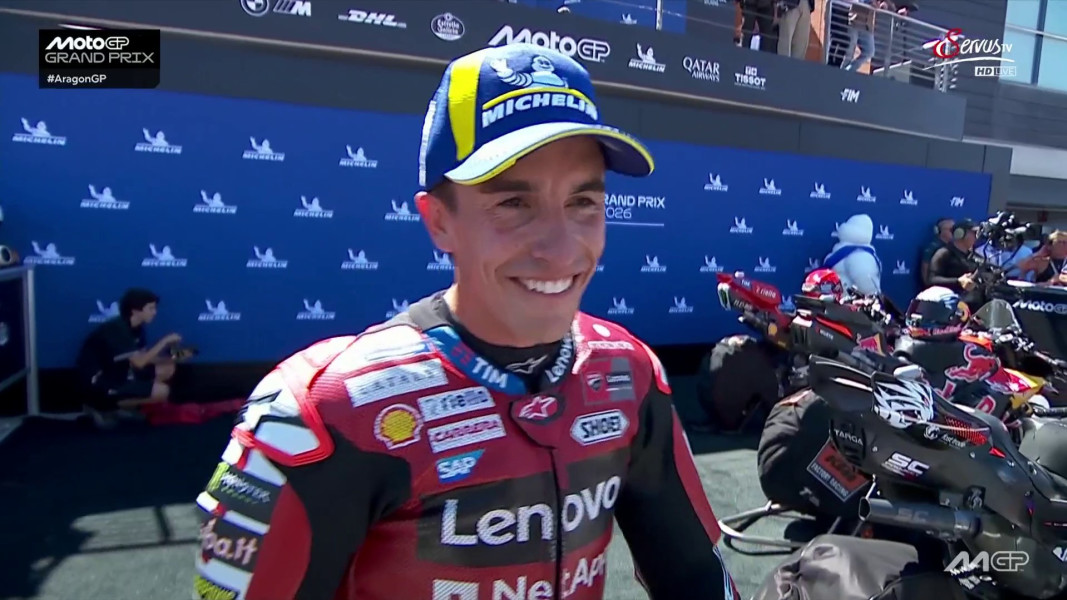
For MotoGP World Champion Marc Marquez, the ban has paid off. In particular, the phase leading up to the first corner has become significantly less tense as a result: “The braking point is safer. The transition from acceleration to braking is also much more natural,” the Spaniard concluded. Although the front wheel now lifts more quickly again during acceleration, braking has become noticeably safer.
The other riders share these views, though some want to wait and see how the upcoming races go before forming a final judgement. The overall verdict after Assen is generally positive. This gives the riders a taste of the 2027 season – the holeshot device would have been banned next year anyway. The ride-height device at the rear will also be a thing of the past by then, and aerodynamics will no longer play such a major role.
Seen already?
Don't miss out on any highlights: The Speedweek newsletter, sent out twice a week, delivers the latest news, exclusive commentary and all the important dates from the world of motorsports - directly into your inbox
Highlight videos
ServusTV media library30. Aug. | 6:28 Min
30. Aug. | 35:18 Min
30. Aug. | 4:59 Min
30. Aug. | 4:08 Min
Marquez gegen Bezzecchi um Platz 1!
30. Aug. | 2:06 Min
30. Aug. | 4:07 Min
Marquez jagt den nächsten Aragon-Triumph!
30. Aug. | 1:12 Min
30. Aug. | 0:58 Min
MotoGP News
All news


Newest articles
All articlesNew New New New New New


