
Tyre choice causes a stir: reaction from the promoter, announcement from Michelin
Partly due to the new tarmac at Motegi, the ever-prominent topic of tyres is raising even bigger questions. Supplier Michelin has answers ready, which will also bring changes on Sunday following the sprint race.
This article is an automatically generated English version. The

Michelin-Motorrad-Sportchef Piero Taramasso
Foto: Gold and Goose
Michelin-Motorrad-Sportchef Piero Taramasso
© Gold and Goose


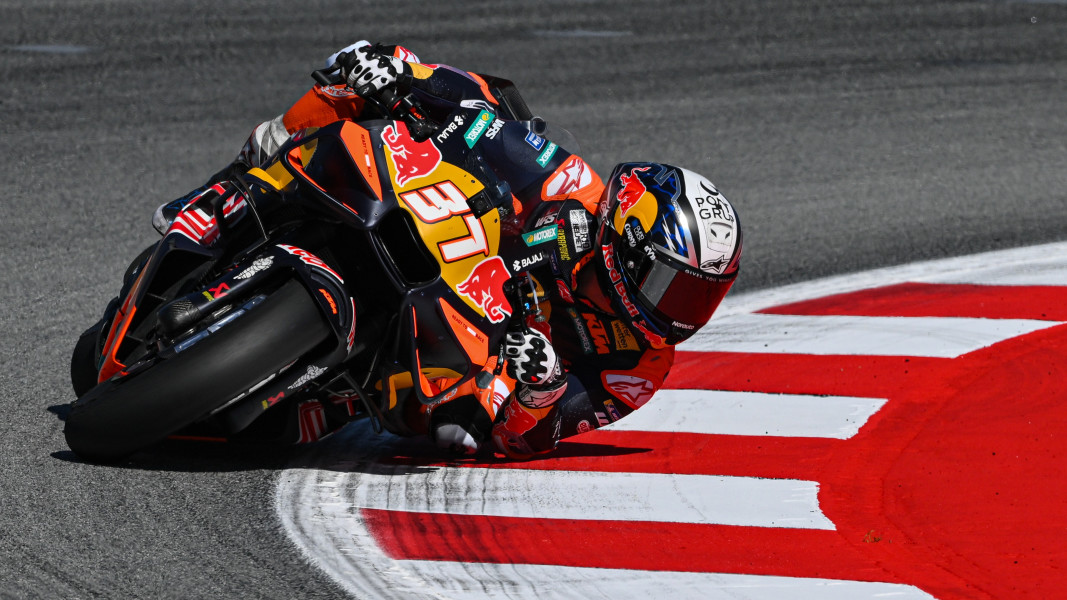
Tyres – a perennial topic. These sensitive, high-performance tyres play a key role in the paddock. These discussions are not popular amongst the majority of the MotoGP community, simply because the subject is also synonymous with overwhelming complexity and is, quite frankly, very difficult to grasp. For riders, however, the topic of tyres is an indispensable and ongoing subject of discussion in their exchanges with the technicians.
During the Japanese Grand Prix, the tyre debate got out of hand. Without exception, every rider spoke at great length before and after the sprint race about the all-important connection with the track surface. The track – and this is a key reason – has been redesigned for the 2026 event at the Motegi circuit. With little experience from testing, the challenge is to match the available tyre compounds to the bike, the track and the prevailing conditions.
Soft, medium, hard
Despite assumptions and a high level of technical expertise on the part of tyre and motorcycle manufacturers, the pitfalls of selection and set-up were evident at Motegi. The sprint race provided numerous examples, two of which stood out. Ducati factory rider Pecco Bagnaia, a serial winner at Motegi, had, like almost all the riders, opted with his crew for the softest of the three available compounds for the 12-lap race.

Pecco Bagnaia gab beim Motegi-Sprint vorzeitig auf
Foto: Gold and Goose
Pecco Bagnaia gab beim Motegi-Sprint vorzeitig auf
© Gold and Goose
After two-thirds of the race, the compound had heated up so much that continuing was out of the question – retirement following a tyre failure, according to the unfortunate news. Marco Bezzecchi, who was aware of the heat build-up, opted for the medium tyre right from the sprint after careful consideration. The result: Bezzecchi dropped back to 6th place and yet, after the race, also had the first signs of blistering on his rear slick tyre.
Topic of the week
Nicolo Bulega: Toprak’s successor will not fail in MotoGP
The Italian Nicolo Bulega is the first rider to have won the world title in both the Supersport and Superbike classes; from 2027, he will be racing in MotoGP. His performances this season are second to none.
TV Program
The situation becomes even more peculiar when tyre supplier Michelin is brought into the picture. Whilst teams and riders have evidently been constantly weighing up the choice between ‘soft’ and ‘medium’ tyres since Friday’s FP1, the French manufacturer has its own perspective.
Michelin was prepared
Speaking to SPEEDWEEK.com, Head of Racing Piero Taramasso explained in detail: “We are aware of the demanding nature of the Motegi circuit – and we knew there would be new tarmac. As we are unable to test, we have prepared specifically for the Japanese Grand Prix and made a third, harder compound available.”
Taramasso on the specific feature: “The hard specification, however, only has a harder base; the rubber compound is identical to that of the soft specification. We had already discussed this with all the teams on Thursday – and recommended this type, at any rate for the Grand Prix race.”

Der zerfetzte Hinterreifen von Pecco Bagnaia
Foto: motogp.com
Der zerfetzte Hinterreifen von Pecco Bagnaia
© motogp.com
The problems encountered with the ‘soft’ tyre therefore come as no surprise. Michelin’s sporting director Taramasso: “We knew that the soft tyre would be at its limit here in terms of temperature – and we communicated this even before the session.” In practice, however, the French manufacturer’s advice was ignored, with teams relying on their own findings.
To emphasise the safety aspect, Michelin manager Taramasso stressed: “The fact is: the tyres, in all specifications, are always safe insofar as the carcass is always sufficiently stable. It is only the rubber on the tread that reacts to thermal stress. If the tyre spins too much, the surface begins to crack.”
Whilst Michelin sees the medium tyres as the first choice for the sprint and the hard tyres (with a soft rubber compound) for the GP, the teams have been and continue to favour soft tyres for the sprint and medium tyres for the GP race, which is twice as long.
A logical decision: ‘soft’ tyres are out of the running for the GP
After three riders experienced massive problems with the soft tyre and even those who started on ‘medium’ tyres showed the first signs of surface degradation, Michelin spoke out. Taramasso: “We have agreed with the MotoGP group that the soft tyre is no longer permitted for the Grand Prix at all. To this end, we expressly recommend the tyre that we brought to Japan as a special variant. The final decision on whether to use the medium or hard tyre remains with the rider and the team.”
As a result, the MotoGP promoter responded by adjusting Sunday’s schedule. To give the riders the chance to familiarise themselves with the recommended (but hitherto ignored) tyre, the warm-up session was doubled in length. There are now 20 minutes available ahead of the Japanese Grand Prix.
Seen already?
Don't miss out on any highlights: The Speedweek newsletter, sent out twice a week, delivers the latest news, exclusive commentary and all the important dates from the world of motorsports - directly into your inbox
Highlight Videos
ServusTV Media Library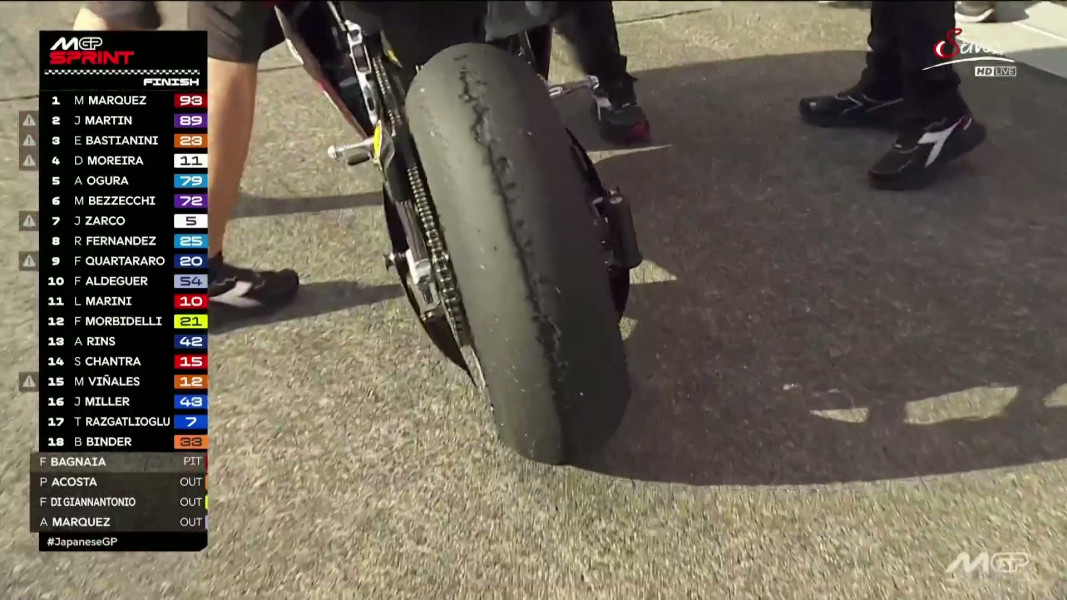
Hinterreifen löst sich förmlich auf!
3. Okt. | 1:35 Min
Track-Limits-Drama kurz vor Schluss!
3. Okt. | 5:15 Min
3. Okt. | 11:14 Min
Coming Up: Motegi - die Talking Points in Japan
3. Okt. | 1:30 Min
Acosta: Sein denkwürdiges Spielberg-Wochenende!
3. Okt. | 2:59 Min
Nächster Stopp: Motegi - die MotoGP in Japan!
3. Okt. | 1:17 Min

3. Okt. | 1:32 Min
3. Okt. | 8:48 Min
Events
All MotoGP EventsPast Gran Premio di San Marino Misano World Circuit Marco Simoncelli, Italien 11.–13.09.2026Past Motorrad Grand Prix von Österreich Red Bull Ring, Österreich 18.–20.09.2026Live
Grand Prix of Japan Twin Ring Motegi, Japan 02.–04.10.2026Next up Pertamina Grand Prix of Indonesia Mandalika International Street Circuit, Indonesien 09.–11.10.2026Australian Motorcycle Grand Prix Phillip Island Grand Prix Circuit, Australien 23.–25.10.2026

Past Gran Premio di San Marino Misano World Circuit Marco Simoncelli, Italien 11.–13.09.2026Past Motorrad Grand Prix von Österreich Red Bull Ring, Österreich 18.–20.09.2026Live
Grand Prix of Japan Twin Ring Motegi, Japan 02.–04.10.2026Next up Pertamina Grand Prix of Indonesia Mandalika International Street Circuit, Indonesien 09.–11.10.2026Australian Motorcycle Grand Prix Phillip Island Grand Prix Circuit, Australien 23.–25.10.2026
MotoGP News
All News


Newest Articles
All ArticlesNew New


