Formula 1 World Champion Alan Jones: The Australian ‘Bull’ turns 80
Alan Jones drove just as he looked: with iron will and total physical commitment, a racing driver from the other side of the world once achieved his goal – he became Formula 1 World Champion in 1980 with Williams.
This article is an automatically generated English version. The


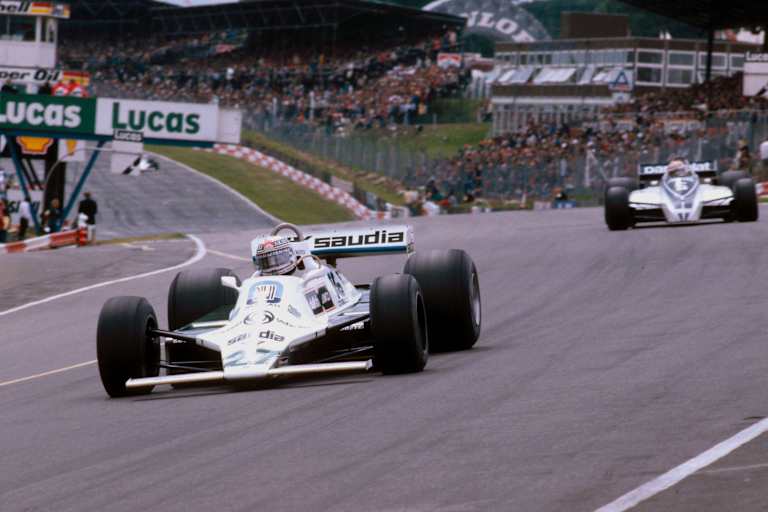
Alan Jones 1980 im Williams, vor seinem WM-Gegner Nelson Piquet im Brabham
Foto: XPB
Alan Jones 1980 im Williams, vor seinem WM-Gegner Nelson Piquet im Brabham
© XPB
Rumour has it that he wore red underpants as a lucky charm, usually raced in a straightforward manner and with iron will, and always defended his territory with determination. No wonder, as the Australian Alan Jones, who celebrates his 80th birthday on 2 November, did not have an easy start in motor racing.
Admittedly, the burly ‘Aussie’ came from a wealthy family; his father Stan was already a very good and well-known racing driver Down Under. He even had offers from BRM and Ferrari, but stayed in Australia to look after his family. His son Alan was also bitten by the racing bug; like many others, he began his career in a kart, later drove a Mini and eventually found himself behind the wheel of a Cooper Monoposto.
However, when his father’s car dealership went bust, Alan decided to travel to England to try his luck there; even back then, the island was the home of motor racing. To fund his racing, he and his girlfriend first sold minivans and later rented out rooms; eventually, he was able to buy an old Formula Ford car and later entered the British Formula 3 Championship. Here, he even clinched the championship title in 1973, moved on to the new Formula Atlantic series, and achieved respectable results there too.
Recommendations
Mentioned in this article
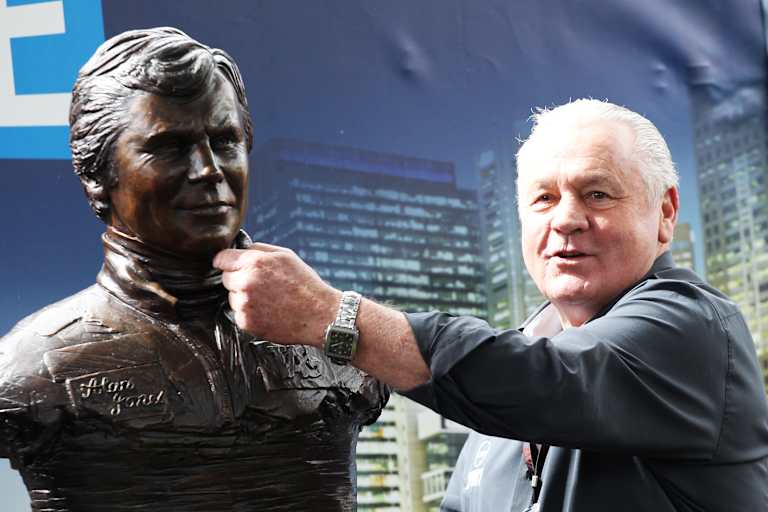
In seiner Heimatstadt Melbourne wurde Alan Jones mit dieser Büste geehrt
Foto: XPB
In seiner Heimatstadt Melbourne wurde Alan Jones mit dieser Büste geehrt
© XPB
These successes certainly did not go unnoticed by the domestic Formula 1 teams: first, Jones received an offer from the colourful Hesketh team, after which he drove for Graham Hill and John Surtees – albeit without achieving good results.
With his third-place finish at the Mexican Grand Prix, Kimi Antonelli has become the youngest of the 36 Formula 1 world champions to date. The 20-year-old Italian is on a record-breaking run. The Tifosi are dreaming of Antonelli in a Ferrari.
TV Program
In 1977, following Tom Pryce’s fatal accident at the South African Grand Prix, he was suddenly given the chance to drive a Shadow. He promptly repaid the favour a little later with a victory at the race in Austria, which took the race organisers there completely by surprise: as they hadn’t prepared the Australian national anthem for the podium ceremony – a trumpeter played the tune of ‘Happy Birthday’ instead. In a sense, however, Jones was also pleased about this, as it meant Ferrari got in touch with him.
As the Italians had suddenly opted for the Canadian Gilles Villeneuve in 1978, Jones asked Frank Williams and Patrick Head if he could drive their FW06. It was to their credit, as the fast Australian won four races and finished third in the 1979 Formula 1 World Championship.
A year later, Jones went one better, becoming champion with five wins – a substantial sum of money from Saudi Arabia had certainly helped in this regard.
Team co-owner Head once said of Jones that he admired him for his aggressive driving style and fighting spirit – “as long as even a single wheel on his car is still turning, he won’t give up”. He was regarded as a brutal driver, whom even a broken hand did not deter from going full throttle. In his private life, however, he seems to have fancied himself as something of a headstrong macho.
Although he went on to secure two more of his twelve Grand Prix victories, AJ – as he was always known at Williams – wanted to return to Australia. His great dream was to be a farmer, but that dream was by no means fulfilled.
And so he was only too happy to accept the Arrows team’s offer in 1983 to race once more at the United States Grand Prix; however, his lack of fitness proved to be his undoing.
Another attempt in 1985 with the newly formed Beatrice team also proved disappointing. Furthermore, there had been a scandal at the South African Grand Prix: in the opinion of human rights activists, the team’s sponsor had breached local regulations, and a factory strike loomed. In the end, Jones was unable to take part in that race and flew home disappointed.
Jones even competed twice – quite out of character – in the 24 Hours of Le Mans. In 1984, he finished sixth in a Porsche 956 alongside his compatriot Vern Schuppan and the Frenchman Jean-Pierre Jarier; in 1987, on his second attempt, he retired.
That year, he also received a surprise visit from a small tour group from Germany. As BMW’s press officer in my first year, I had invited a number of motoring journalists to two touring car races in Bathurst and Calder. And my colleagues were only too happy to take the opportunity to pay Alan Jones a brief visit. The unanimous opinion of the visitors at the time was that this man lived a dream life, right by the water, virtually carefree.
After all, he remained loyal to motor racing back home too, albeit on a smaller scale: he initially competed in touring car races, supported his adopted son Christian as he embarked on a career as a racing driver, and worked as a commentator for Australian television. After 2010, he worked occasionally as a consultant to the FIA at Formula 1 races.
Seen already?
Don't miss out on any highlights: The Speedweek newsletter, sent out twice a week, delivers the latest news, exclusive commentary and all the important dates from the world of motorsports - directly into your inbox
Championship Standings
Full Standingsorg-location for [2026] 2026
2026
2025
2024
2023
Pos
Driver
Team
Points
1


380
2


261
3


259
4

250
5

245
6


221
7

144
8

105
9


81
10


44
Highlight Videos
ServusTV Media Library
Mexico City: Highlights Rennen
2. Nov. | 3:47 Min
0,009 Sekunden Vorsprung! Erste Pole seit 3 Jahren
1. Nov. | 3:42 Min
Mexiko 1986: Eine Legende wurde geboren!
29. Okt. | 1:49 Min
27. Okt. | 3:15 Min
„Schallende Ohrfeige für gestandene Hersteller“
24. Okt. | 16:15 Min
Klien erklärt: Cadillacs cooles Texas-Design
23. Okt. | 4:24 Min
Der Schweige-Code von Singapur!
12. Okt. | 3:27 Min
Peinlicher Software-Fehler & Schleich-Modus!
5. Okt. | 3:05 Min
Events
All Formula 1 Events


Formula Cars News
All News



Newest Articles
All ArticlesNew