
Madrid GP: just like Melbourne in the past – what comes next after the protests?
On 13 September, the Spanish Grand Prix will take place at the Madring. There is growing opposition to the circuit at the IFEMA exhibition centre. This is reminiscent of the early years of the Melbourne GP.
This article is an automatically generated English version. The

Lewis Hamilton mit seinem Ferrari auf dem Madring
Foto: Madring
Lewis Hamilton mit seinem Ferrari auf dem Madring
© Madring


At the upcoming Madrid Grand Prix venue, the IFEMA (Institución Ferial de Madrid) exhibition centre, preparations are in full swing to ensure that the first Formula 1 race in the Spanish capital since 1981 is a resounding success.
As is often the case with a new street circuit, not everyone is thrilled about the Grand Prix circus coming to town. In Madrid’s case, Constantino Blanco represents the group ‘Stop F1 Madrid’, through which residents of the Hortaleza and Valdebebas districts are trying to oppose the race.
Blanco argues that the Formula 1 race is too loud and therefore breaches noise regulations, is a source of environmental pollution and disrupts the normal lives of local residents. He criticises the city for failing to invest more wisely in the infrastructure of the two districts mentioned (such as in schools) rather than in a motor race. The spokesperson for ‘Stop F1 Madrid’ even describes it as unlawful for the city to host a Grand Prix on the IFEMA site.
Recommendations
According to Blanco, the first GP weekend at the Madrid circuit is intended to gather evidence so that legal action can be taken against the race at a later date.
He cites as an example a legal dispute over the Santiago Bernabéu football stadium, where local residents successfully opposed the staging of music concerts.
Four weeks ago, Aprilia headed into the summer break from Germany with a badly injured Marco Bezzecchi. The response came from the heart of British motor racing: ‘Together we are strong!’
TV program
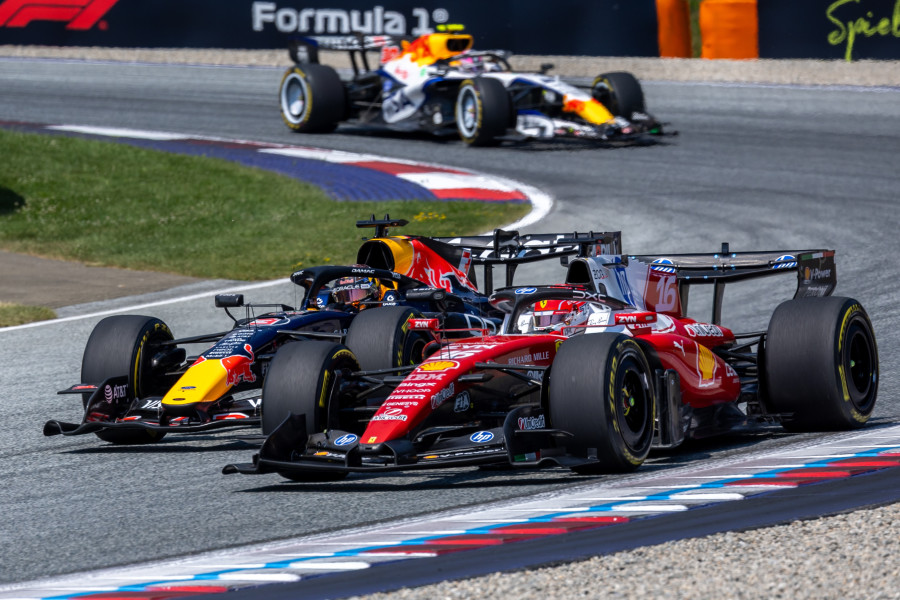
Melbourne GP: Where are the dead fish?
The protest in Madrid strongly reminds me of the early years of the Australian Grand Prix in Melbourne. With around 500,000 fans attending the GP weekend at Albert Park, the Formula 1 race has become Australia’s biggest sporting event.
This was not always the case, and particularly in the early years – from 1996 onwards – the race was highly controversial.
Environmentalists targeted the sporting event and didn’t hold back on imaginative protests. Just under 30 years ago, the activists from ‘Save Albert Park’ (SAP) came up with something new every year: opponents of the race blocked the access route to the circuit and shouted at the top of their voices at any recognisable foreigner, as if we were bringing the plague and cholera into the city.
The hard-working SAP members handed out leaflets, chained themselves to the pit lane railings, dumped dead fish onto the start-finish straight (no, really!), and there were no limits to their imagination.
I was always amazed and impressed by how calmly the Australian police handled the situation.
Later, the SAP activists claimed that the Grand Prix organisers were falsifying spectator figures and financial statements. They also alleged that the event encouraged excessive alcohol consumption and speeding.
The police remained unperturbed and pointed to the statistics: on an average GP weekend, there are fewer than half a dozen arrests on the premises. That’s hardly an alarming figure, nor is it above the average for a perfectly ordinary weekend in Melbourne, without Formula 1.
These days, things have quietened down around the Grand Prix: it is as much a part of life for Melburnians as the Australian Open tennis tournament or a trip to St Kilda Beach. And Albert Park – once a dilapidated eyesore before Formula 1 came along – has become a real gem.
SAP is still around: ahead of the most recent editions of the Formula 1 race, the organisation announced that the race costs the city of Melbourne and the state of Victoria – and therefore the taxpayer – 60 million Australian dollars (around 36 million euros) per year.
The revenue generated by the Grand Prix through visitors from home and abroad, as well as its role as a driving force for tourism in the city and the state, was only mentioned in passing. According to the Federal Department of Labour, the motor race brings more than 250 million dollars into the city, and the F1 event also creates more than 1,100 jobs.
Seen already?
Don't miss out on any highlights: The Speedweek newsletter, sent out twice a week, delivers the latest news, exclusive commentary and all the important dates from the world of motorsports - directly into your inbox
Highlight videos
ServusTV media library
„Ganz tolle Leistung von Arvid“
21. Aug. | 4:43 Min

„Jede Runde hier ist aufregend!"
21. Aug. | 3:05 Min
21. Aug. | 2:35 Min
21. Aug. | 4:44 Min
Übt Norris Weltmeister-Druck auf McLaren aus?
27. Juli | 1:16 Min
F1-Geschichtsstunde mit Andi Gröbl
19. Juli | 7:53 Min
Belohnung nach dem Qualifying!
18. Juli | 7:00 Min
Wrap-Up: Exklusive Einblicke ins Fahrerlager!
17. Juli | 9:28 Min
Events
All Formula 1 eventsPast Belgian Grand Prix
Circuit de Spa-Francorchamps, Belgien 17.–19.07.2026Past Hungarian Grand Prix
Hungaroring, Ungarn 24.–26.07.2026Live
Dutch Grand Prix
Circuit Zandvoort, Niederlande 21.–23.08.2026Next up Italian Grand Prix
Autodromo Nazionale Monza, Italien 04.–06.09.2026Spanish Grand Prix
Circuito de MADRING, Spanien 11.–13.09.2026

Past Belgian Grand Prix
Circuit de Spa-Francorchamps, Belgien 17.–19.07.2026Past Hungarian Grand Prix
Hungaroring, Ungarn 24.–26.07.2026Live
Dutch Grand Prix
Circuit Zandvoort, Niederlande 21.–23.08.2026Next up Italian Grand Prix
Autodromo Nazionale Monza, Italien 04.–06.09.2026Spanish Grand Prix
Circuito de MADRING, Spanien 11.–13.09.2026
Formula Cars News
All news


Newest articles
All articlesNew New New New New New New New New New


