
Ducati’s first MotoGP winglets: ‘Almost laughable today’
In 2010, two tiny wings were intended to solve a fundamental problem with the Ducati Desmosedici. Today, Marco Palmerini can’t help but smile when thinking back on those first aerodynamic experiments in MotoGP.
This article is an automatically generated English version. The

Valencia-Test 2010: Flügel an der Ducati Desmosedici von Valentino Rossi
Foto: Gold & Goose
Valencia-Test 2010: Flügel an der Ducati Desmosedici von Valentino Rossi
© Gold & Goose


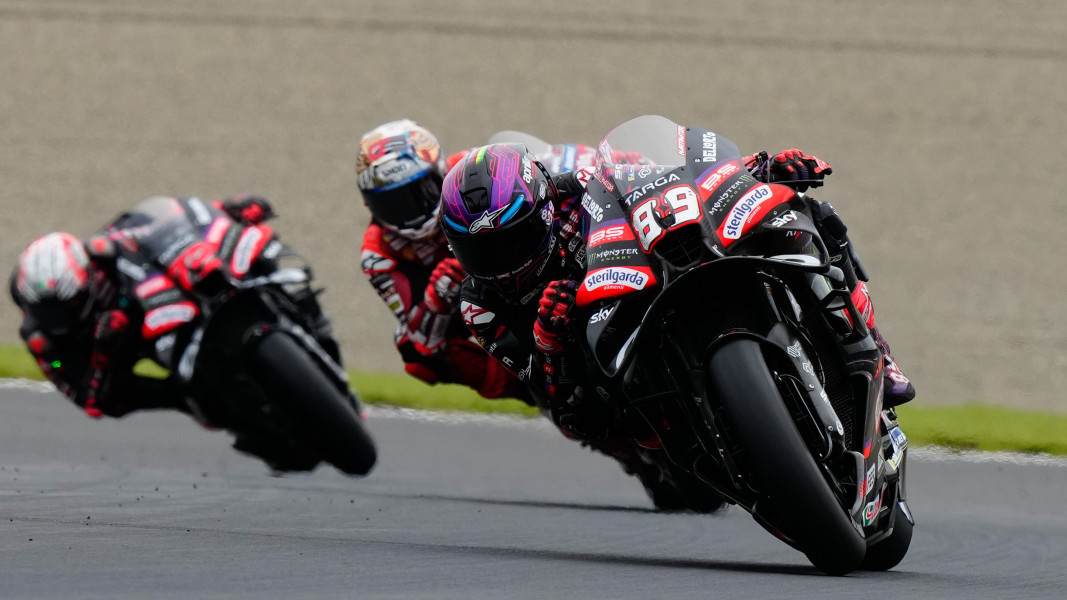
Winglets, side fairings and sophisticated air ducts characterise the appearance of modern MotoGP prototypes. Manufacturers invest enormous resources in wind tunnel testing and simulations in order to identify even the slightest aerodynamic advantages. Looking back at the early days of this development, however, the first attempts seem astonishingly primitive.
Ducati began exploring the potential of aerodynamic aids on the Desmosedici as early as 2010. At the time, the MotoGP prototype from Bologna was struggling with pronounced understeer. The engineers were therefore looking for a way to generate additional downforce on the front wheel.
16 years ago: Ducati experiments with wings for the first time
“In the 2010 season, we carried out our first experiments in the field of aerodynamics,” recalled Marco Palmerini from Ducati’s MotoGP vehicle development department in an interview with Bike World. What was considered an innovative solution at the time seems downright primitive when compared with today’s aero packages. “We had two small wings on the side fairing. Looking at it now, it seems almost ridiculous,” Palmerini admitted in hindsight. “These winglets produced very little downforce.”

Nicky Hayden auf der Ducati Desmosedici mit Flügeln
Foto: Gold & Goose
Nicky Hayden auf der Ducati Desmosedici mit Flügeln
© Gold & Goose
The creative mastermind behind the Ducati MotoGP project at the time was Filippo Preziosi. The objective of the initial trials was, at first, very simple. “To begin with, our aim was to press the front wheel down onto the ground,” explained Palmerini.
Topic of the week
Topic of the week: MotoGP’s new schedule proved highly controversial
In 2027, MotoGP will also enter the 850cc era with a new schedule. It was not so much the changes themselves as the way the decisions were reached that caused a stir. A prime example of: ‘Talking helps’.
TV Program
Yet these unassuming wings gave rise to a technical revolution. Ducati gradually realised that aerodynamics could achieve far more than simply keeping the front wheel on the ground during acceleration. “Later, we realised that aerodynamics has a major influence on the forces acting on the tyres. And this is the case during every phase of riding, not just during acceleration. It also helps with cornering speed and braking.”

Valentino Rossi beim Valencia-Test im November 2010
Foto: Gold & Goose
Valentino Rossi beim Valencia-Test im November 2010
© Gold & Goose
This also fundamentally changed the importance of aerodynamics within the development department. “The handling of the motorbike has changed fundamentally as a result of aerodynamics,” emphasised Palmerini. “We quickly realised that we needed to expand our knowledge, invest greater effort and allocate more engineers to the task in order to carry out more in-depth simulations.”
Luigi Dall’Igna stepped up aerodynamic development
With the appointment of Luigi Dall’Igna as head of racing at the end of 2013, the subject gained further importance at Ducati. The Italian drove development forward for years and caused a stir with a constant stream of new ideas. The two small wings from 2010 gave way to increasingly complex aerodynamic solutions, with which Ducati played a pioneering role for a long time.

März 2017: Ducati testete eine radikale Front, die sich als Flop erwies
Foto: Gold & Goose
März 2017: Ducati testete eine radikale Front, die sich als Flop erwies
© Gold & Goose
Meanwhile, the competitors have caught up considerably. Aprilia, in particular, has done outstanding work recently and is now at least on a par in terms of aerodynamics. What began as comparatively simple experiments in the early years has thus become one of the most important areas of development in the entire MotoGP series.
Consequently, the process from an initial idea to its implementation on the racetrack is now extremely complex. “Ideas emerge during brainstorming sessions. Then we carry out initial calculations,” explained Palmerini. “Next, we head to the wind tunnel. The test runs then consist of two phases: first, we measure the data, and then we carry out a performance test with the rider.”

Casey Stoner mit Ing. Marco Palmerini
Foto: Gerhard Schiel
Casey Stoner mit Ing. Marco Palmerini
© Gerhard Schiel
For Palmerini, developments since 2010 highlight just how important aerodynamics has become. “It is an area in which we are very committed. Ducati has made a major contribution to the development of aerodynamics in motorbikes. We have not only ensured that performance could be improved, but have also optimised safety as a result.”
What is now a highly complex science involving numerous engineers, simulations and wind tunnel tests began at Ducati with two small winglets, the effect of which seems almost negligible from today’s perspective – and which even the pioneers of that era can now smile about.
Seen already?
Don't miss out on any highlights: The Speedweek newsletter, sent out twice a week, delivers the latest news, exclusive commentary and all the important dates from the world of motorsports - directly into your inbox
Highlight Videos
ServusTV Media Library
Phillip Island: Analyse Sprint
24. Okt. | 14:42 Min
Phillip Island: Analyse Qualing
24. Okt. | 11:19 Min
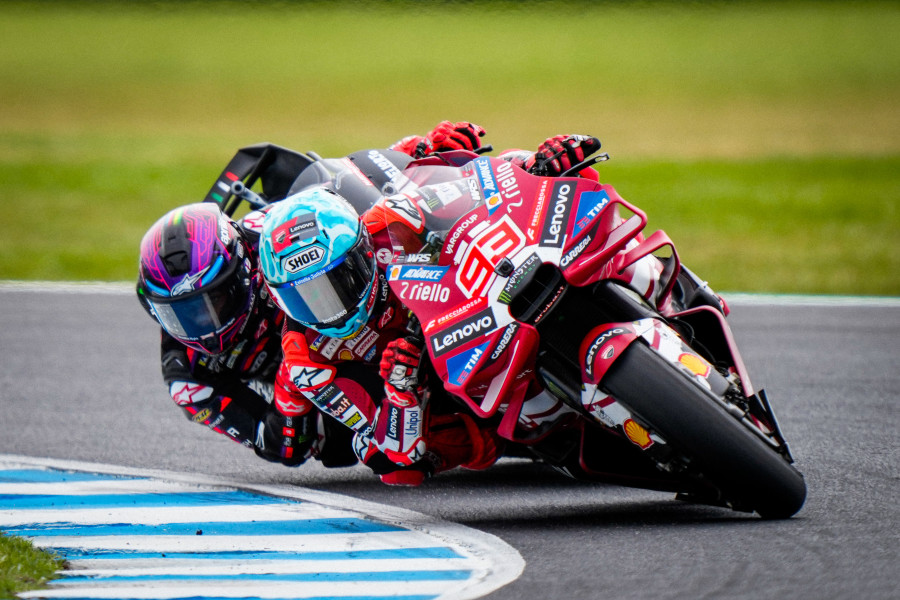
Dieses Duell nimmt ein bitteres Ende
24. Okt. | 2:31 Min
Erst harter Fight, dann Schreckmoment!
24. Okt. | 7:54 Min
Letzter Tanz auf Phillip Island
24. Okt. | 3:39 Min
Senna Agius 1on1: So tickt der Moto2-Star
23. Okt. | 2:59 Min
Freitags-Update: Die heißesten Themen der MotoGP
23. Okt. | 7:47 Min

KTM zwischen Palmen und Vollgas!
20. Okt. | 10:42 Min
Events
All MotoGP EventsPast Grand Prix of Japan Twin Ring Motegi, Japan 02.–04.10.2026Past Pertamina Grand Prix of Indonesia Mandalika International Street Circuit, Indonesien 09.–11.10.2026Live
Australian Motorcycle Grand Prix Phillip Island Grand Prix Circuit, Australien 23.–25.10.2026Next up Petronas Grand Prix of Malaysia Sepang International Circuit, Malaysia 30.10. – 01.11.2026Next up Grand Prix of Qatar Losail International Circuit, Katar 06.–08.11.2026

Past Grand Prix of Japan Twin Ring Motegi, Japan 02.–04.10.2026Past Pertamina Grand Prix of Indonesia Mandalika International Street Circuit, Indonesien 09.–11.10.2026Live
Australian Motorcycle Grand Prix Phillip Island Grand Prix Circuit, Australien 23.–25.10.2026Next up Petronas Grand Prix of Malaysia Sepang International Circuit, Malaysia 30.10. – 01.11.2026Next up Grand Prix of Qatar Losail International Circuit, Katar 06.–08.11.2026
MotoGP News
All News


Newest Articles
All ArticlesNew New


