
Analysis: The pros and cons of Toprak’s MotoGP breakthrough in 2027
Toprak Razgatlioglu is learning the hard way in his first MotoGP season. In 2027, the rules, tyres and bikes will change fundamentally. Will this help the three-time Superbike World Champion achieve a breakthrough?
This article is an automatically generated English version. The

Toprak Razgatlioglu in der MotoGP: Platzt 2027 der Knoten?
Foto: Gold & Goose
Toprak Razgatlioglu in der MotoGP: Platzt 2027 der Knoten?
© Gold & Goose


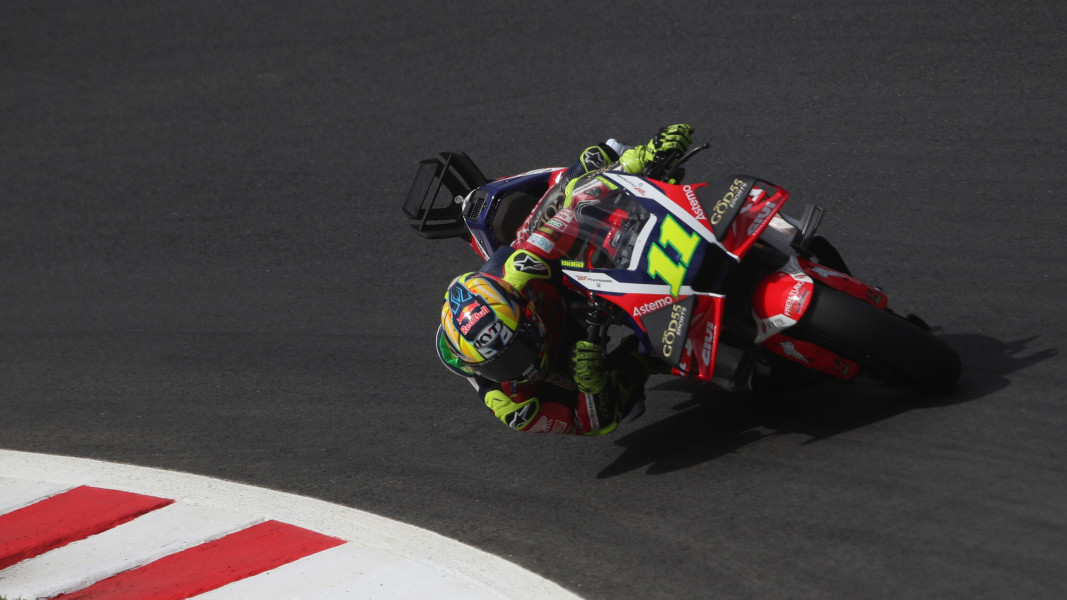
Toprak Razgatlioglu’s first MotoGP season has been a sobering experience so far. Following his switch from the BMW Superbike to the Yamaha M1, the three-time Superbike World Champion has come to realise just how great the differences between the two categories actually are. After the Grand Prix at Silverstone, the Turkish rider lies in 21st place in the World Championship standings with just 14 points.
The fact that the Yamaha M1 is not currently among the most competitive bikes on the grid puts Razgatlioglu’s results into perspective, at least to some extent. However, his team-mate Fabio Quartararo is demonstrating that more is possible with the current package. The Frenchman has already scored 55 points, putting him in 14th place in the World Championship standings. And his Pramac Yamaha team-mate Jack Miller, whose MotoGP career is set to come to an end in November, has also managed to produce more highlights so far.
Razgatlioglu’s fans are wondering whether the 2027 season might bring the breakthrough they’ve been hoping for. The timing could hardly be more favourable: MotoGP is switching to 850 cc, ride-height devices are being banned and Pirelli is replacing Michelin as the sole tyre supplier. Some of the biggest difficulties Razgatlioglu faces in 2026 could thus disappear. At the same time, there are compelling reasons to doubt that the Yamaha rider will make a major leap forward.
Pirelli could give Toprak a decisive boost
Perhaps the greatest hope for Razgatlioglu lies in the change of tyres. The Turkish rider knows the characteristics of Pirelli tyres inside out from his many years in the World Superbike Championship. It was with these tyres that he developed his extreme riding style and, in particular, his spectacular braking manoeuvres.

Toprak Razgatlioglu freut sich auf die Pirelli-Rückkehr
Foto: Gerhard Schiel
Toprak Razgatlioglu freut sich auf die Pirelli-Rückkehr
© Gerhard Schiel
Topic of the week
Topic of the week: MotoGP’s new schedule proved highly controversial
In 2027, MotoGP will also enter the 850cc era with a new schedule. It was not so much the changes themselves as the way the decisions were reached that caused a stir. A prime example of: ‘Talking helps’.
TV Program
It is precisely in this area that the Michelin front tyre has caused him difficulties in MotoGP. Razgatlioglu cannot fully execute his usual style because the Michelin front tyre tends to lock up during his extremely hard braking manoeuvres.
Switching back to the Pirelli tyres he is familiar with could therefore make a big difference. However, the 2027 Pirelli tyres will not simply be copies of the Superbike tyres. Nevertheless, Razgatlioglu is familiar with the manufacturer’s fundamental characteristics – giving him an edge in experience over many established MotoGP riders.
The 850cc bikes might suit his riding style better
The new technical regulations should also work in Razgatlioglu’s favour. With the ban on ride-height devices, the MotoGP machines will lose some of the technical complexity that characterises the handling of the current 1000cc bikes.
The motorbikes will feel more natural to ride again. At the same time, the rider’s influence is likely to increase. Without the sophisticated systems designed to lower the bike during acceleration, for example, it will once again depend more heavily on how well a rider can control the power coming out of corners and transfer it to the tarmac.

Toprak Razgatlioglu auf der 850er-Yamaha in Brünn
Foto: David Ulrich
Toprak Razgatlioglu auf der 850er-Yamaha in Brünn
© David Ulrich
This could suit a rider like Razgatlioglu, who repeatedly benefited in the Superbike World Championship from making a difference with his exceptional feel for the bike.
There is also another factor to consider: by 2027, he will no longer be a rookie. Razgatlioglu is now familiar with how MotoGP works, the procedures of a Grand Prix weekend and the circuits. Many of the additional challenges he faced in his debut season will therefore no longer be an issue.
The biggest question mark is Yamaha
But even if the tyres and regulations suit Razgatlioglu better, one crucial factor remains beyond his control: Yamaha must provide him with a competitive bike.
At present, the M1 is the weakest bike in the MotoGP field. And, at least from an outside perspective, there is so far little reason to believe that Yamaha will automatically make a big leap forward with the new regulations.

Lernt: Pramac-Yamaha-Pilot Toprak Razgatlioglu
Foto: Gold and Goose
Lernt: Pramac-Yamaha-Pilot Toprak Razgatlioglu
© Gold and Goose
Whilst other manufacturers have had race-ready 850cc prototypes for months, Yamaha experimented with an 850cc engine in the existing 1000cc chassis at the crucial Pirelli test in Brno. This raises questions. Shouldn’t the focus have been entirely on the new bike long ago?
From Yamaha’s point of view, the 2026 season is already a lost cause. This naturally raises the question of why all available resources aren’t being concentrated on the 850cc project, which is crucial for the future. Viewed from the outside, Yamaha’s approach currently appears, at the very least, less focused than that of its competitors.
The competition isn’t getting any weaker
At the same time, Razgatlioglu cannot hope that his rivals will falter in 2027. Six Ducatis and four Aprilias alone present a formidable hurdle on the path to regular top-10 finishes.
Ducati’s new 850cc prototype has made a very strong impression in tests so far. Aprilia, too, should remain among the frontrunners given its current strength. In Noale, a formidable team of engineers has emerged in recent years, one that now fully understands what is required to develop a modern MotoGP bike.

Luca Marini mit der 850er-Honda beim Brünn-Test
Foto: David Ulrich
Luca Marini mit der 850er-Honda beim Brünn-Test
© David Ulrich
Then there’s Honda. HRC shifted its focus to the 850cc project at an early stage and will also be fielding a top-class line-up of riders in 2027. Fabio Quartararo is moving from Yamaha to Honda. Joining him are two young talents, David Alonso and Diogo Moreira, as well as the experienced Johann Zarco.
Even a significantly improved Razgatlioglu could therefore regularly find himself outside the top 10 should Yamaha continue to lag behind Ducati, Aprilia and Honda in technical terms. And KTM must not be overlooked either. The Austrians were the first manufacturer to put an 850cc prototype on the track, and with Pol Espargaro and Dani Pedrosa they have two extremely experienced and fast test riders. Added to this is a strong line-up of riders for 2027, combining experience with talent and youthful potential.
The strong rookies will pose an additional hurdle
The numerous newcomers could also pose a problem for Razgatlioglu. With David Alonso, Daniel Holgado, Senna Agius and Izan Guevara, highly promising riders are making the step up from Moto2 to the premier class. They are joined by Nicolo Bulega, another Superbike star.
Normally, MotoGP rookies have to catch up on a lot of technical knowledge and get used to the nuances that established riders have been familiar with for years. In 2027, this disadvantage will be significantly smaller.
The entire field will have to adapt to new motorbikes and Pirelli tyres, whilst the ride-height devices are also being phased out. The riders moving up from Moto2 and Superbike are already familiar with Pirelli’s DNA and, at the same time, will face a smaller leap in performance than was previously the case when switching to the 1000cc MotoGP bikes. Razgatlioglu will therefore by no means automatically find it easier to hold his own against the newcomers. Especially not if he is technically outclassed by them on the Yamaha.
Age, height, an uncertain future and significantly more pressure
Added to this are factors that cannot be resolved through technical means. Razgatlioglu will be celebrating his 30th birthday in less than two months, making him one of the older riders in the MotoGP field. Unlike many young riders, he does not have several years to establish himself step by step.
His prospects beyond 2027 are likely to depend directly on his performances in his second MotoGP season. Other manufacturers have so far shown no discernible interest in the Turkish rider. Should Yamaha also fail to be convinced after two years, his MotoGP adventure could come to an end as early as November 2027.
His height could also play a role under the new regulations. At 1.85 m, Razgatlioglu, along with Luca Marini, is one of the tallest riders in the field. On the smaller and less powerful 850cc bikes, a tall stature could be a greater factor than it was on the previous 1000cc machines.
The pressure will inevitably be greater in 2027. In his rookie season, Razgatlioglu can still point to the enormous adjustment required and the Yamaha’s weaknesses. In his second year, a three-time Superbike World Champion will be expected to show a significant improvement.
And how long will his motivation last?
Another point was recently hinted at by Razgatlioglu himself. At both the Sachsenring and Silverstone, the Yamaha rider suggested that it becomes more difficult to maintain motivation when the hoped-for results fail to materialise. That is understandable. Razgatlioglu arrived in MotoGP as a three-time Superbike World Champion and celebrated superstar. Instead of fighting for victories, he currently has to settle for positions at the back of the field.
Should it become apparent as early as the start of the 2027 season that the new Yamaha is also uncompetitive, this could create a difficult dynamic. A full season at the back of the field would be an enormous mental challenge for a rider who, for years, has fought almost exclusively for victories and world championship titles.
Conclusion: Toprak will improve – but will that be enough for a breakthrough?
There are good reasons to believe that we will see a stronger Toprak Razgatlioglu in 2027. The switch to Pirelli could alleviate one of his biggest current problems. The removal of the ride-height devices is likely to suit his natural riding style, and no one can take away the experience he gained during his rookie season.
A personal leap in performance therefore seems likely. Whether this will actually lead to his big MotoGP breakthrough is another matter entirely. The decisive factor will not only be Razgatlioglu’s own development, but above all the question of what bike Yamaha puts on the track for the new regulations.
With a competitive M1, Razgatlioglu would have a good chance of moving considerably closer to the MotoGP front-runners in 2027. If, on the other hand, Yamaha remains at the bottom of the manufacturer rankings, even Pirelli tyres, the new technical regulations and a significantly stronger Toprak might not be enough.
That is precisely the dilemma: the conditions for Razgatlioglu’s personal progress will improve in 2027 – whether this will also lead to a sporting breakthrough lies, to a large extent, in Yamaha’s hands.
Seen already?
Don't miss out on any highlights: The Speedweek newsletter, sent out twice a week, delivers the latest news, exclusive commentary and all the important dates from the world of motorsports - directly into your inbox
Highlight Videos
ServusTV Media Library
Senna Agius 1on1: So tickt der Moto2-Star
23. Okt. | 2:59 Min
Freitags-Update: Die heißesten Themen der MotoGP
23. Okt. | 7:47 Min

KTM zwischen Palmen und Vollgas!
20. Okt. | 10:42 Min

Japan läuft nicht nach Plan für KTM!
17. Okt. | 10:33 Min

17. Okt. | 13:26 Min

Aufwärtstrend bei KTM bestätigt!
17. Okt. | 11:57 Min

Nach Durststrecke: KTM ist zurück am Podium!
17. Okt. | 15:23 Min

Erfreuliches Wochenende für KTM in England!
17. Okt. | 17:26 Min
Events
All MotoGP EventsPast Grand Prix of Japan Twin Ring Motegi, Japan 02.–04.10.2026Past Pertamina Grand Prix of Indonesia Mandalika International Street Circuit, Indonesien 09.–11.10.2026Live
Australian Motorcycle Grand Prix Phillip Island Grand Prix Circuit, Australien 23.–25.10.2026Next up Petronas Grand Prix of Malaysia Sepang International Circuit, Malaysia 30.10. – 01.11.2026Next up Grand Prix of Qatar Losail International Circuit, Katar 06.–08.11.2026

Past Grand Prix of Japan Twin Ring Motegi, Japan 02.–04.10.2026Past Pertamina Grand Prix of Indonesia Mandalika International Street Circuit, Indonesien 09.–11.10.2026Live
Australian Motorcycle Grand Prix Phillip Island Grand Prix Circuit, Australien 23.–25.10.2026Next up Petronas Grand Prix of Malaysia Sepang International Circuit, Malaysia 30.10. – 01.11.2026Next up Grand Prix of Qatar Losail International Circuit, Katar 06.–08.11.2026
MotoGP News
All News


Newest Articles
All ArticlesNew New New New New New


