
36 wins for Aruba-Ducati: How similar are the customer bikes really?
36 wins for Aruba-Ducati: Sam Lowes sees differences between factory and customer bikes. In an exclusive interview, the Marc-VDS rider shares his observations – and the limitations of his assessment.
This article is an automatically generated English version. The

Superbike-WM 2026: Die beiden Aruba-Ducatis fuhren dem Feld davon
Foto: Gold & Goose
Superbike-WM 2026: Die beiden Aruba-Ducatis fuhren dem Feld davon
© Gold & Goose


The 2026 Superbike World Championship ended with an unprecedented record for Aruba-Ducati: Nicolo Bulega won 32 races, whilst his team-mate Iker Lecuona won the remaining four. In 31 of the 36 races, the two factory riders finished first and second. With 744 points, Ducati secured the maximum possible haul in the manufacturers’ championship.
Even the Ducati privateer riders were unable to find a way to counter this dominance. But just how big is the difference between the bikes, really? In an exclusive interview with SPEEDWEEK.com, Sam Lowes expressed his doubts that the conditions on the track are identical.
When it comes to world champion Bulega, Lowes initially explicitly acknowledges an advantage in riding ability. “I’d say that Bulega is a step ahead, regardless of the bike,” the Briton clarified.
A defining moment at Magny-Cours
Nevertheless, one encounter with Lecuona at Magny-Cours remained particularly memorable for him. “When I was battling with Iker there, you could see quite clearly how easily he overtook me again after he’d made a mistake. That was a bit discouraging, even for me. I had the feeling that with a bit more acceleration and slightly finer-tuned electronics, he could overtake me so easily,” explained Lowes.

Sam Lowes
Foto: Gold & Goose
Sam Lowes
© Gold & Goose
He finds it difficult to analyse his impressions from the outside in technical terms. However, given his experience, the statements coming from the factory camp do not entirely convince him. “When you speak to them, they always tell you that everything is the same. But if you look at riders who’ve switched from a factory bike to a customer bike, things have always gone significantly worse. I look at Rinaldi or Bautista: the difference is huge,” argued the Ducati privateer.
The results alone, however, do not prove what role the equipment plays. The team environment and set-up work also influence performance. For his part, Lowes emphasised that his criticism did not imply any fundamental dissatisfaction with his own bike. “I’m happy with my package. But this class isn’t like MotoGP. There, they’re all factory bikes. In the worst-case scenario, you’ve got the previous year’s factory bike. That’s a completely different category,” he noted.
Sam Lowes is convinced: the Aruba bikes accelerate better
He did not question the principle that the motorbikes should be fundamentally the same. “In theory, they should probably be the same, yes,” replied the Briton. Ducati takes the view that customers can also purchase the factory team’s equipment for a fee. Lowes would therefore prefer to answer the question with a direct comparison on the track.

Nicolò Bulega, Iker Lecuona, Sam Lowes
Foto: Gold & Goose
Nicolò Bulega, Iker Lecuona, Sam Lowes
© Gold & Goose
“I think if you stuck my number 14 on their bike and let me do a lap, I wouldn’t set the same lap time as I do on my own bike. That’s my opinion,” he explained. Lowes was able to briefly pinpoint where he perceives the difference: “Speed and acceleration,” said the Marc VDS rider.
He deliberately left open whether this was down to more traction, more engine power or a combination of various factors. “I don’t know. It’s impossible to say,” admitted Lowes, who finished the season fourth in the World Championship and was thus, on balance, the second-best Ducati privateer.
Seen already?
Don't miss out on any highlights: The Speedweek newsletter, sent out twice a week, delivers the latest news, exclusive commentary and all the important dates from the world of motorsports - directly into your inbox
Highlight Videos
ServusTV Media Library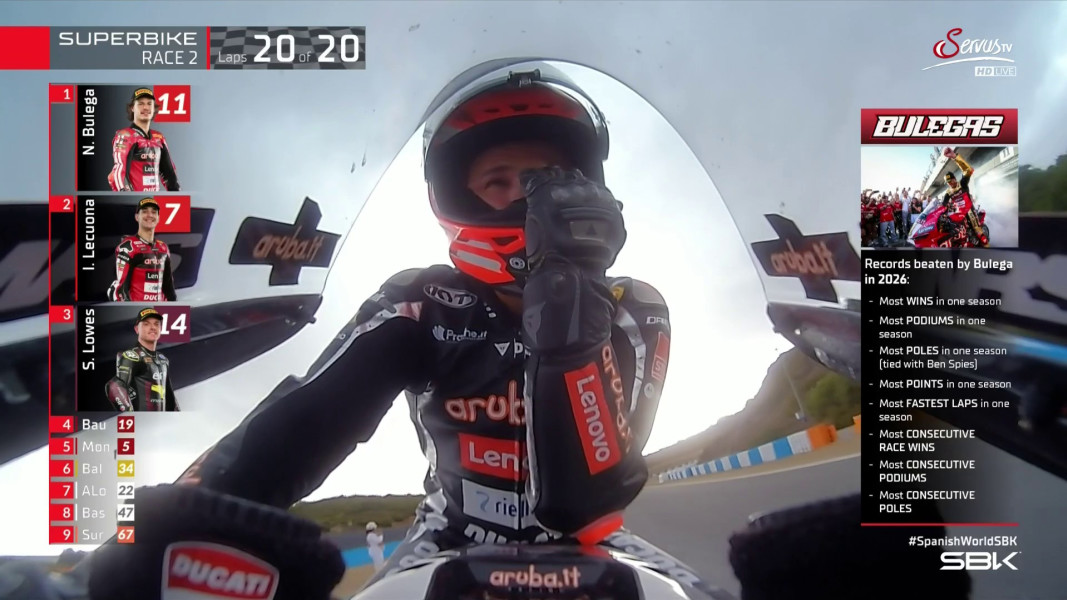
Bulega mit emotionalem Abschied
18. Okt. | 1:48 Min
Bautista verpasst Podium knapp
18. Okt. | 2:55 Min
„Habe die gesamte Auslaufrunde geweint“
18. Okt. | 5:12 Min
18. Okt. | 17:42 Min
Rekorde & Abschieds-Drama zum Saisonabschluss
18. Okt. | 1:32 Min
18. Okt. | 56:55 Min
18. Okt. | 54:36 Min
18. Okt. | 49:28 Min
WorldSBK News
All News


Newest Articles
All ArticlesNew New New New


