Engines were stuck in Dubai! – What is the deadline for an F1 Grand Prix?
Before the start of the season in Australia, Formula 1 engines were stuck in the Middle East. How the problem was solved – and by when, at the very latest, the freight consignments for a Grand Prix must be dispatched.
This article is an automatically generated English version. The
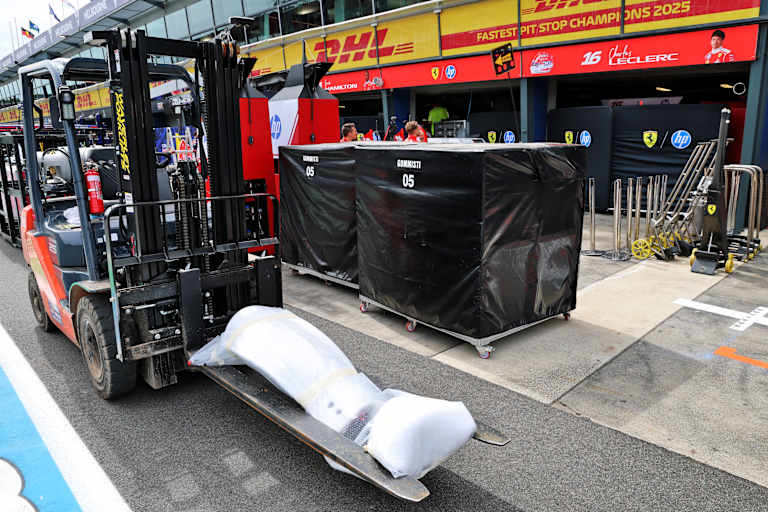
Die F1-Fracht kommt auf unterschiedlichen Wegen ins Paddock (Symbolbild)
Foto: XPB
Die F1-Fracht kommt auf unterschiedlichen Wegen ins Paddock (Symbolbild)
© XPB


World events are also having an impact on Formula 1. In 2020, in the midst of the coronavirus pandemic, Formula 1 was forced to cancel the start of the season at short notice, completely overhaul the calendar and repeatedly reschedule events flexibly in the months that followed. The war in the Middle East is also demanding a great deal of flexibility this season. The two races in Bahrain and Saudi Arabia in April were cancelled or postponed. The Bahrain Grand Prix will take place in Malaysia in just over two weeks’ time. The season-opening Australian Grand Prix was also under threat at one point because key components, including engines, were stranded in the Middle East.
James Boughton, Deputy Head of Transport, Logistics and Freight at Formula 1, told selected media outlets, including SPEEDWEEK.com, on the sidelines of the Madrid race: “When the conflict in the Middle East began in the spring, we were in the process of transporting a lot of air freight to Australia, partly from Bahrain and partly from Europe.” Winter testing had, after all, still taken place in Bahrain in mid-February. The Australian Grand Prix was scheduled for 8 March, with the first cars due to take to the track on Friday, 6 March. The attacks in the Middle East began on 28 February.
Engines for Melbourne were stranded
Boughton: “Just as airspace in the Middle East was being closed, we had a fair amount of freight that was due to come to Melbourne via the Middle East. However, the aircraft couldn’t get any further from there. And these were parts that were critical to the race. Our Formula 1 logistics department then worked very closely with DHL, because we absolutely had to get these components – including engines and other urgently needed parts – out of the region, as we needed them to power the cars in Australia. We then very quickly drew up an action plan together with DHL on how to get this freight out of a warehouse in Dubai and transport it to Australia on a charter flight, so that the Grand Prix could go ahead.’ It was a close call, but as we know, everything worked out. The start of the season went smoothly.
What will become of the 2026 Middle East Grands Prix?
At the moment, there are still huge question marks hanging over the last two races of the 2026 season. The calendar lists Qatar at the end of November and Abu Dhabi on 6 December. Officially, they’re still sticking to the plans, but behind the scenes preparations are underway for a Plan B at Imola. The paddock is currently bracing itself for a trip to Italy on St Nicholas’ Day. However, nothing has been decided yet – even though there are just over two months to go.
From a logistical perspective, what is the deadline for a Formula 1 Grand Prix? Boughton: “The question is how sustainable you want to be. You can put it off for a very long time, but then you have to fly everything in.” Formula 1 usually combines transport by lorry, ship (the most sustainable) and aeroplane (the least sustainable). In the spring, a lot of transport between Miami and Montreal was also carried out by rail.
Topic of the week
Spanish Grand Prix at the new Madring: track – hit or miss?
The people of Madrid had set their sights high for their city’s first Formula 1 World Championship race since 1981. But have the high expectations for the new Madring mixed-circuit track really been met?
TV Program
Air freight also possible at short notice
Boughton: “Air freight allows for a great deal of flexibility. However, as we want to be more sustainable, we would normally send sets by sea freight. To do this, you take the day of the race, work backwards and say, ‘OK, the sea freight must be dispatched by this date.’” Of course, this depends on which routes are available and where the freight is being dispatched from. If you need to be spontaneous, however, it could also be arranged at shorter notice: “You could fly everything if you wanted to. It would, of course, involve a lot of aeroplanes. But theoretically, it would be possible.”
“There’s no deadline”
Sitting alongside Boughton on the panel at the “Madring” was Jake Rowe, a representative from DHL (F1’s logistics partner). The Briton added succinctly, with a laugh: “There’s no deadline.” So it remains to be seen where this year’s final Formula 1 freight shipment will be headed in late autumn.
Seen already?
Don't miss out on any highlights: The Speedweek newsletter, sent out twice a week, delivers the latest news, exclusive commentary and all the important dates from the world of motorsports - directly into your inbox
Results
Full StandingsPos
Driver
Driver
Team
Start No.
Rounds
Time
Fastest Lap
Points
01

Mercedes-AMG Petronas Formula One Team
12
57
1:34:23,754
1:36,030
25
02

Oracle Red Bull Racing
3
57
+4,351
1:36,760
18
03

McLaren Formula 1 Team
1
57
+5,089
1:36,680
15
04

Scuderia Ferrari HP
16
57
+29,116
1:36,063
12
05

Mercedes-AMG Petronas Formula One Team
63
57
+29,829
1:35,587
10
06

Oracle Red Bull Racing
30
57
+1:26,746
1:36,846
8
07

BWT Alpine Formula One Team
43
57
+1:34,281
1:37,321
6
08

McLaren Formula 1 Team
81
57
+1:35,839
1:37,226
4
09

Visa Cash App Racing Bulls Formula One Team
41
56
+1 round
1:38,211
2
10

Audi Revolut F1 Team
27
56
+1 round
1:38,114
1
Highlight Videos
ServusTV Media Library
50-Meter-Drama von WM-Maschine eiskalt ausgenutzt!
14. Sept. | 1:36 Min

Mercedes in Monza: Funk verrät Stimmung
7. Sept. | 1:15 Min

4. Sept. | 4:58 Min
Hat Hamilton Mercedes-Heimweh?
24. Aug. | 1:54 Min
Liam Lawson: Markantes Style-Detail!
23. Aug. | 7:14 Min
Paddock-Tour: Weite Wege in Zandvoort
22. Aug. | 7:08 Min
Keine Bitterballen für Andrea & Christian
21. Aug. | 6:00 Min
21. Aug. | 4:44 Min
Events
All Formula 1 EventsPast Italian Grand Prix
 04.–06.09.2026
Past Spanish Grand Prix
 11.–13.09.2026
Next up Azerbaijan Grand Prix
 24.–26.09.2026
Next up Bahrain Grand Prix
 02.–04.10.2026
Singapore Grand Prix
 09.–11.10.2026
Past Italian Grand Prix
Past Spanish Grand Prix
Next up Azerbaijan Grand Prix
Next up Bahrain Grand Prix
Singapore Grand Prix
Formula Cars News
All News





Newest Articles
All ArticlesNew New New New New New New New New