Azerbaijan Grand Prix in Baku: It all began with a bad joke
Ten years ago, the GP circus travelled to Baku with plenty of question marks hanging over it. Nobody really knew what to make of the new street Grand Prix. Since then, we’ve become a little wiser.
This article is an automatically generated English version. The
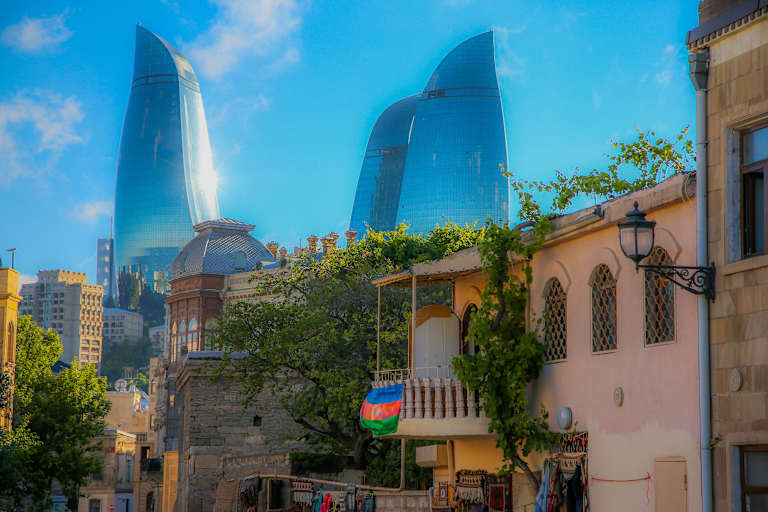
Baku ist eine faszinierende Mischung aus alt und neu
Foto: XPB
Baku ist eine faszinierende Mischung aus alt und neu
© XPB


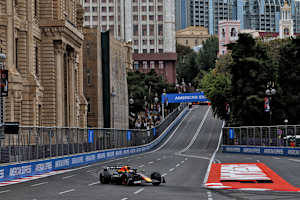
The Grand Prix at the ‘Baku City Circuit’ got off to a bad start in 2016 with a poor joke: the race was actually called the European Grand Prix – for goodness’ sake!
Shortly after the highly successful debut, the organisers submitted a request to the FIA, the international motor racing governing body, that from 2017 onwards the race should be correctly named the Azerbaijan Grand Prix. No sooner said than done.
When it was announced years ago that Formula 1 was heading to the Caspian Sea, I must admit – my knowledge of Azerbaijan was embarrassingly limited: I could only vaguely recall that the ‘Eurovision Song Contest’ – formerly known as the ‘Concours d’Eurovision’ – had taken place in Baku in 2012; which seems a more fitting name to me, as many of the songs amount to an acoustic declaration of bankruptcy.
Recommendations
I couldn’t rely on my school days for much, because when I was at school, Azerbaijan didn’t exist in its current form; everything had been lumped together under the Soviet Union umbrella. So let’s refresh our knowledge a little about Azerbaijan, the Land of Fire, and about Baku, the City of Winds.
The country is a republic with a population of just under 10.4 million, 90 per cent of whom are Azeris (a Turkic people). The country’s area is roughly the same as that of Austria.
Topic of the week
Spanish Grand Prix at the new Madring: track – hit or miss?
The people of Madrid had set their sights high for their city’s first Formula 1 World Championship race since 1981. But have the high expectations for the new Madring mixed-circuit track really been met?
TV Program
Azerbaijan borders Armenia, Iran, Georgia, Russia and Turkey. So much for the European Grand Prix.
Of the population, 92 per cent are moderate Muslims, with five per cent Christians and three per cent following other religions.
Baku officially has a population of 2.3 million (unofficially, and including the surrounding area, the figure is almost double that); it is reportedly the lowest-lying capital city in the world, 28 metres below sea level (I admit, I haven’t measured it myself).
Ilham Aliyev has been President since 2003; the 64-year-old had the term-limit abolished, meaning he can theoretically remain in power indefinitely. He is continuing his father’s pro-Western policy. However, that is by no means to say that everything is in perfect order in this country.
The national currency (a question for crossword enthusiasts) is the manat.
Baku is an exciting blend of the ancient and the modern: Tradition is represented by a UNESCO-protected old town featuring the Maiden’s Tower, which is said to have got its name because it was as impregnable as a maiden; modernity is represented by the 190-metre-high ‘Flaming Towers’, a new landmark of the city.
Finding my way to these towers proved not entirely straightforward on my first visit to Baku: most taxi drivers didn’t speak English. My basic knowledge of Azerbaijani (which is related to Turkish) still leaves something to be desired. But you can get by with hand gestures and body language, just as you can anywhere else in the world.
Baku certainly has a few dodgy neighbourhoods, but it’s considered an extremely safe city. The Azerbaijanis are also exceptionally hospitable. On my first visit, I found myself rather at a loss in a metro station: the ticket machines were all operated in the local language. Before I knew it, someone spoke to me in English, and in the end the helpful man even paid for my ticket! “It’s a matter of honour – after all, you’re a guest in my country,” he said.
Let’s be honest: in how many European cities has something like that ever happened to you?
At first glance, Baku itself is a blend of oriental charm and Western building frenzy. Add to that the imposing Soviet-era buildings. It’s a mix that really comes into its own once night falls. Some describe Baku as the new Dubai: between 2000 and 2008, 800 high-rises were built in the city centre alone. Amidst all the pride, however, the fact that entire old neighbourhoods were razed to the ground to make way for them is glossed over.
A curious sight on the streets: the classic London taxi, albeit in a colour that has earned the vehicles the nickname ‘aubergines’.
After two races in June in summery conditions, the race was moved to April; in 2018 it was damp and extremely windy (which makes sense, as we shall see in a moment). Rain cannot be ruled out either – the country is home to nine of the eleven climate zones found worldwide, ranging from arctic-alpine to, indeed, Mediterranean. In 2024, the race took place in September for the first time.
Baku lies on the Caspian Sea, another of the many contradictions in this country. This is because the salty water used to be directly connected to the world’s oceans; today it is connected indirectly via the Volga–Don Canal. The lake (covering 370,000 square kilometres) is home to sturgeon, whose beluga caviar is regarded as a delicacy throughout the world.
Why is Baku known as the City of Winds? Because the name Baku is derived from the Persian ‘bad kube’. It might just as well be called the ‘City of Cats’: the old town is teeming with felines, which are lovingly fed and cuddled by the entire population.
And why is Azerbaijan known as the ‘Land of Fire’? Even the Persians valued the oil reserves and called the country ‘Aderbaidjan’, from which the present-day name is derived – namely, the ‘Land of Fire’.
An oil hill that burns all year round is one of the biggest tourist attractions. Without oil, modern Baku would not exist; without oil, there would be no Formula 1 in Baku.
Here’s an example to illustrate the scale of the oil industry we’re talking about: in 1898, the Abseron fields accounted for 95 per cent of Russian oil production and half of the world’s total! In 1863, Baku had a modest population of 14,000. By the time of the First World War, that figure had increased twentyfold.
Oil was first extracted in 1844; investors and speculators flocked to the country from all over the world, and even today, the magnificent palaces of the oil barons in Baku bear witness to their wealth. They would certainly have thought the ‘Flame Towers’ were a marvellous landmark.
Today, Azerbaijan accounts for less than one per cent of global oil production, with its reserves estimated at 0.6 per cent of the world’s total. Norway can boast similar figures. And yet the country expects to generate revenue of 150 billion US dollars from oil and gas by 2035.
The money from oil is being channelled into infrastructure: whilst Baku is making rapid progress, the rest of the country is moving at a somewhat slower pace.
Azerbaijan faces the same problem as the United Arab Emirates: its oil reserves will eventually run out, so the country must set a course towards other sources of income at an early stage.
And so Azerbaijan aims to attract more tourists: in 2016, only one in four race-goers came from abroad to watch the Grand Prix. By 2017, this had risen to a third; today, half of all Baku race-goers are tourists.
Seen already?
Don't miss out on any highlights: The Speedweek newsletter, sent out twice a week, delivers the latest news, exclusive commentary and all the important dates from the world of motorsports - directly into your inbox
Championship Standings
Full Standingsorg-location for [2026] 2026
2026
2025
2024
2023
Pos
Driver
Team
Points
1


292
2

211
3


191
4


186
5

167
6


145
7

120
8

71
9


59
10


41
Highlight Videos
ServusTV Media Library„Der GRÖSSTE Bock von Hamilton"!
22. Sept. | 1:53 Min
50-Meter-Drama von WM-Maschine eiskalt ausgenutzt!
14. Sept. | 1:36 Min
Mercedes in Monza: Funk verrät Stimmung
7. Sept. | 1:15 Min

4. Sept. | 4:58 Min
Hat Hamilton Mercedes-Heimweh?
24. Aug. | 1:54 Min
Liam Lawson: Markantes Style-Detail!
23. Aug. | 7:14 Min
Paddock-Tour: Weite Wege in Zandvoort
22. Aug. | 7:08 Min
Keine Bitterballen für Andrea & Christian
21. Aug. | 6:00 Min
Events
All Formula 1 EventsPast Italian Grand Prix
 04.–06.09.2026
Past Spanish Grand Prix
 11.–13.09.2026
Next up Azerbaijan Grand Prix
 24.–26.09.2026
Next up Bahrain Grand Prix
 02.–04.10.2026
Singapore Grand Prix
 09.–11.10.2026
Past Italian Grand Prix
Past Spanish Grand Prix
Next up Azerbaijan Grand Prix
Next up Bahrain Grand Prix
Singapore Grand Prix
Formula Cars News
All News

Newest Articles
All ArticlesNew New New New New New