Power Triple: What the new Moto2 engine means for Triumph’s road models
The current Triumph Street Triple provides the power unit for the Moto2 World Championship. We examine the implications of the new three-cylinder engine for the British manufacturer’s future road models from next season onwards.
This article is an automatically generated English version. The
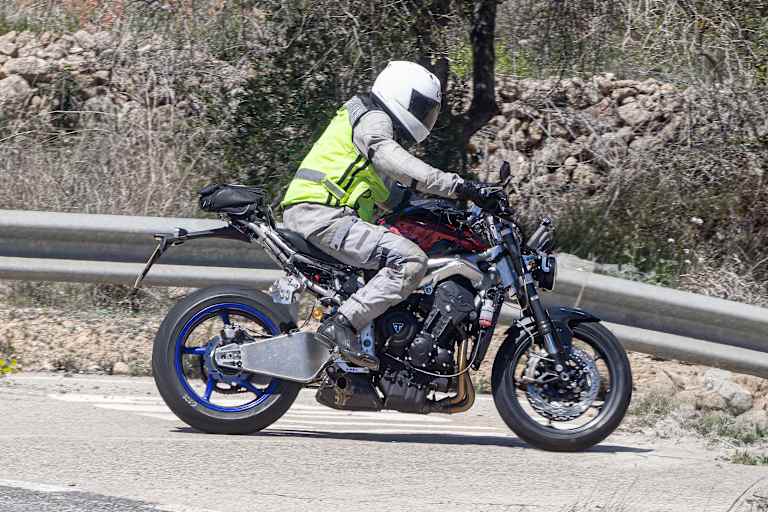
Mit altem Motor, aber neuen Chassis-Teilen: Street Triple bei Testfahrten
Foto: BMHoehne
Mit altem Motor, aber neuen Chassis-Teilen: Street Triple bei Testfahrten
© BMHoehne


For around fifteen years, Triumph’s Street Triple was the backbone of the British manufacturer’s range. Launched in 2007 as the Daytona 675, the naked bike was initially sold for almost ten years with the eponymous 675 cc engine capacity and, together with the Tiger 800 and the classic Bonneville, accounted for the majority of the British manufacturer’s global sales figures. This was later followed by the development of the Street Triple 765, with the crowning achievement of the engineers in the Midlands being the conversion of the 765cc triple into the standard engine for the Moto2 series. Since the 2019 season, Triumph has been the exclusive engine supplier to the FIM Moto2 World Championship, equipping all teams with tuned 765-cc three-cylinder engines based on the Street Triple RS. An unorthodox move for the British manufacturer – after all, since production of the Daytona 675 ceased, there had been no genuine sports motorbike that could directly benefit from the image boost derived from top-level sport. The British manufacturer made a makeshift attempt to remedy this with a brief revival of its sporting flagship, which was re-released for a short time as the Daytona 765.
The next stage of evolution will follow from 2027, as SPEEDWEEK.com has reported on several occasions in recent weeks: from 2027, the British manufacturer will be equipping Moto2 bikes with a newly developed three-cylinder engine. The new racing engine is set to feature a new cylinder head, along with intake ports offering higher flow rates and a new combustion chamber design, as well as a newly engineered valve train. These measures are intended to improve airflow into the combustion chamber and enable a higher compression ratio. The engine has a displacement of around 800 cubic centimetres. The result: six per cent more peak power, greater torque across the entire rev range and a weight reduction of two kilograms. This was achieved by taking the opposite approach to the previous development strategy: rather than adapting a production engine for racing, a modified version of the racing engine is being put into series production. The sports engine was initially the priority. However: “Whatever we develop for Moto2 will also form part of a production motorbike. We have always said that the development of the Moto2 and production engines go hand in hand,” says Triumph’s Chief Product Officer Steve Sargent.
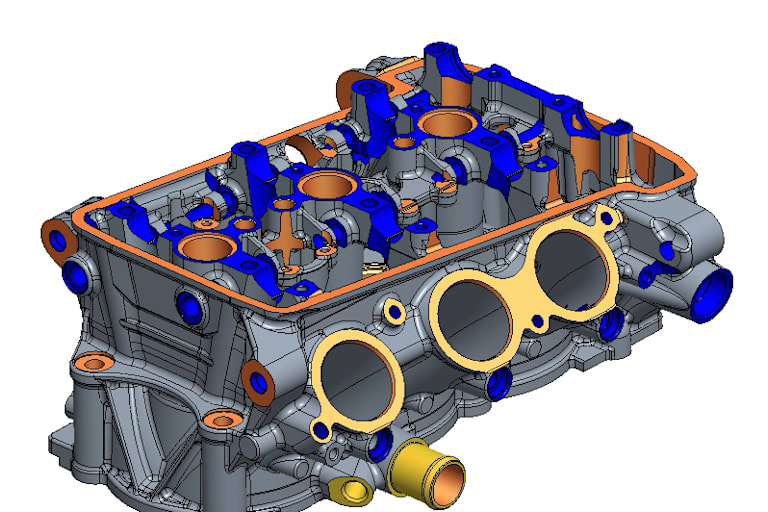
Der Zylinderkopf als einziges Motor-Detail, auf das die Briten zeigen
Foto: Triumph Motorcycles
Der Zylinderkopf als einziges Motor-Detail, auf das die Briten zeigen
© Triumph Motorcycles
For the engineers behind the customer motorcycles from Hinckley, however, the question arises: what to do with the Moto2 engine? After all, the British manufacturer produces a relatively new three-cylinder engine in precisely this displacement category for the Trident 800 and Tiger Sport 800. Yet this engine prioritises everyday rideability and relatively moderate sportiness; it can be manufactured more cost-effectively, thereby leaving a gap in the British manufacturer’s model range for a higher-revving, decidedly sporty power unit. It is an open secret that this will be used for the first time in the upcoming generation of the Street Triple, further emphasising its character as a sporty streetfighter. Even the current generation of the flagship roadster from Hinckley is more focused, more rev-hungry and caters more to sporty riders than its predecessors – a shift that has been emphasised more strongly with every model update and every additional variant. The higher-priced Moto2 Edition and RX, introduced last year, were the culmination of this trend to date.
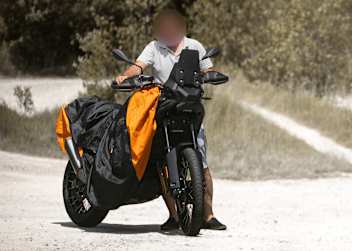
The upcoming Street Triple will continue this development, thereby appealing to an even more sport-oriented customer base than before. It will also fill a gap in the model range that the British manufacturer has largely neglected until now. There is a significant gap in terms of engine power and price between the most affordable Street Triple R and the Speed Triple 1200. Around two years ago, SPEEDWEEK.com was already able to give its readers a glimpse of the direction in which the British manufacturer was taking its iconic model. Images of a test bike used by test engineers for chassis tuning and ergonomics tests on the upcoming mid-range streetfighter from Hinckley provided a glimpse of what was to come. Development of the upcoming Street Triple was still in its early stages at that point, but individual chassis components were already offering clues as to the future design: The prototype’s aluminium bridge frame resembled that of the current generation, but even the swingarm showed parallels with the Moto2 series racing bikes. The motorbike was still powered by the current-generation 765cc triple; the new production engine is said to have been at too early a stage of development. An interesting detail: The test bike also featured mounting points for a full fairing – an indication that the British manufacturer was experimenting with a new version of the Daytona early on in the development process. It is unclear whether this will be launched alongside the upcoming Street Triple, but the British manufacturer certainly has room in its model range for such a model: At present, Triumph offers only the Daytona 660 in the fully faired sportsbike segment. However, the importance of this market segment – characterised by a minimum level of everyday practicality – is growing; the Aprilia RS 660, KTM 990 RC, Yamaha R7 and R9, amongst others, bear witness to this. Either way, the new Moto2 engine is laying the foundations in Hinckley for future flagship models and profit drivers.
Four weeks ago, Aprilia headed into the summer break from Germany with a badly injured Marco Bezzecchi. The response came from the heart of British motor racing: ‘Together we are strong!’
Seen already?
Don't miss out on any highlights: The Speedweek newsletter, sent out twice a week, delivers the latest news, exclusive commentary and all the important dates from the world of motorsports - directly into your inbox
Produkte News
All news

Newest articles
All articlesNew New New