New sports cars & greater exclusivity: Porsche unveils new strategy
New sports cars, greater exclusivity, stronger profitability: at its Capital Markets Day, Porsche AG presents the ‘35’ sports car strategy, with a focus on medium-term ambitions.
This article is an automatically generated English version. The
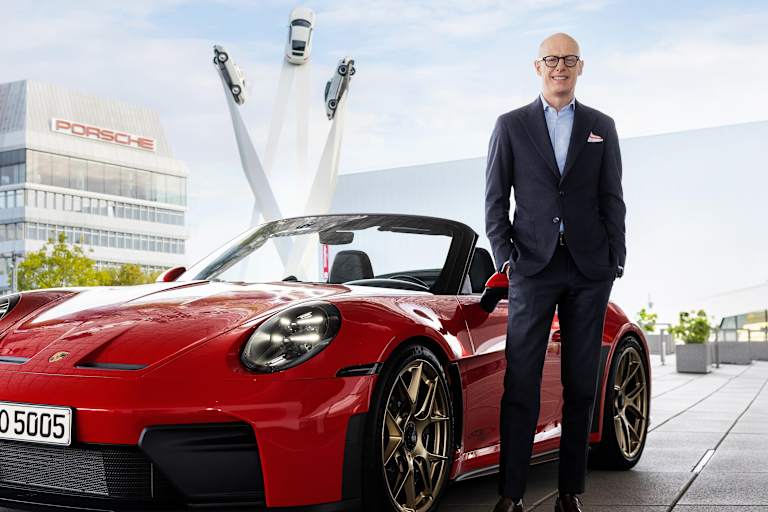
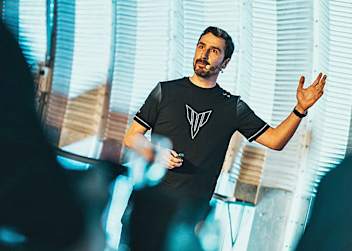
Dr. Michael Leiters, Vorstandsvorsitzender Porsche AG
Foto: Porsche
Dr. Michael Leiters, Vorstandsvorsitzender Porsche AG
© Porsche


New sports cars, greater exclusivity, stronger profitability: At its Capital Markets Day, Porsche AG is presenting its ‘35’ sports car strategy, with a focus on its medium-term ambitions. The iconic brand from Zuffenhausen aims to further sharpen and expand its sports car identity with new products and technologies. Improved price-volume positioning of the product portfolio, combined with a cost-saving programme and a leaner, more agile organisation, is expected to lead to attractive profitability and a net cash flow margin whilst reducing capital intensity.
Sports car manufacturer ‘35 – Driven by the love for sports cars: Under this heading, Dr. Ing. h.c. F. Porsche AG is today presenting its strategic realignment as part of a Capital Markets Day at the Weissach Development Centre. The overarching aim is to strengthen Porsche’s position as one of the most sought-after sports car manufacturers. The basis for this is the brand’s unique positioning. With products catering to both the sports luxury segment and the top-tier sports premium segment, the sports car manufacturer can achieve high returns in the top segment whilst scaling up its operations. In doing so, the company will continue to be guided by its ‘Value over Volume’ principle. Combined with a leaner, faster and more flexible organisation, as well as more efficient processes, Porsche is aiming for a significantly lower break-even point, which is to be achieved at fewer than 200,000 units. In the medium term, the company is targeting an operating return on Group sales of 10 to 15 per cent and a net cash flow margin for the Automotive division of 9 to 12 per cent. The long-term strategic target is a 15 per cent consolidated operating return on sales and a 12 per cent net cash flow margin for the automotive division.
“With our ‘Sportwagenschmiede ’35’ strategy, we are pursuing a clear plan. The overriding objective is to further strengthen our unique sports car brand – across all model ranges and with new, highly desirable models in particularly high-margin segments,” says Dr Michael Leiters, Chairman of the Executive Board of Porsche AG. “With our strategy, we are creating the conditions to make Porsche significantly more efficient, productive and profitable in three phases. At present, the main focus is on reducing costs and making the company financially more robust. We have already achieved important milestones.”
A ‘future package’ has been agreed with the staff representatives, which, in addition to a socially responsible reduction of around 9,000 jobs, also includes a commitment to secure the long-term future of the core workforce at the company’s sites until 2035. Significant measures have also already been implemented as part of the focus on the core business: including the sale of shares in Rimac and Bugatti Rimac, the signing of the agreement to sell the consultancy subsidiary MHP, and the planned closure of the development and production activities of the Cellforce Group, as well as Porsche eBike Performance and Cetitec.
Furthermore, Porsche will benefit from an expanded product portfolio. This begins with the all-electric 718 Boxster and Cayman models, which are expected to boost sales in their first full year of production in 2028. Also in 2028, a new B-segment SUV will be launched, which is to be offered alongside the current all-electric Macan. The new vehicle, featuring internal combustion and plug-in hybrid powertrains, is expected to make a significant contribution to revenue and profitability in 2029, following the ramp-up of series production in 2028. This will be followed by further new product launches, primarily in the particularly high-margin D and E segments, which are expected to further improve earnings.
Topic of the week
A stuttering start to the Bahrain Grand Prix: the FIA narrowly avoids a fiasco like the one in Indianapolis in 2005
Fans could hardly believe their eyes at what they witnessed at the Bahrain Grand Prix: cars crawling along, racing cars that simply came to a standstill. The FIA narrowly avoided a fiasco like the one at Indy in 2005.
Dr Michael Leiters: “Our strategy focuses very strongly on our medium-term ambition, so that the measures and associated results take effect as early as possible. The term ‘sports car manufacturer’ has been chosen deliberately, as it encompasses everything that is to characterise Porsche in the future: our commitment to offering the sportiest vehicles in every segment, but also craftsmanship, a down-to-earth approach and entrepreneurial, business-minded action. Our aim is to be attractive to all stakeholders: our customers, our workforce, our partners and our investors.”
The ‘Sports Car Manufacturer ’35’ strategy is outlined in five chapters at the Capital Markets Day: Brand & Customer, Products & Technologies, Company & Value Creation, as well as the Fundamentals of the Strategy and Financial Ambitions. Below are the key statements and facts regarding the various chapters:
Brand & Customer
Porsche is further sharpening its identity as a sports car brand. In doing so, the company remains true to its guiding principle of ‘Value over Volume’. Quality is the indispensable foundation of Porsche’s commercial success – in both products and service. After all, this is what resonates directly with customers.
The Porsche brand is characterised in particular by design, exclusivity, performance, heritage and driving pleasure. These values form the basis of Porsche’s unique positioning.
Like no other manufacturer, Porsche occupies a unique position between top-tier premium sports cars and sports luxury. This positioning is to be consistently developed further in order to continue offering customers an attractive entry point into the brand, whilst at the same time expanding in a targeted manner into more exclusive and higher-margin segments.
Porsche plans to position the brand at a higher level, amongst other things through expanded personalisation options and an extension of the product portfolio into higher-value segments. In this way, the sports car manufacturer aims to increase the average selling price of its top-of-the-range models by around 20 per cent in the medium term, underpinned by corresponding product substance.
Porsche intends to systematically expand its personalisation offering with the aim of significantly increasing option revenue per vehicle in the medium term. Through its Special Requests programme, Porsche plans to expand its range of highly customised vehicles. In the medium term, Porsche aims to increase revenue from this business sixfold. This is intended to help further enhance the brand’s appeal and exclusivity.
In future, Porsche will group its activities under the umbrella term ‘Home of Sports Cars’ across the three areas of Performance (including Manthey), Exclusiveness (Special Requests and Exclusive Manufaktur) and Heritage. At the forefront of the company is the established Special Requests range, which is set to be scaled up further.
As part of this, Porsche is strengthening its performance business by increasing its stake in Manthey Racing GmbH to 67 per cent. This will deepen the successful collaboration with the sports car division at the Nürburgring. The joint offering is to be further expanded – from performance kits and exclusive track experiences to complete vehicle concepts in the few-off segment.
In addition, Porsche aims to achieve two objectives with a quality initiative: to further enhance the quality of products and services as perceived by customers, whilst simultaneously reducing warranty costs by up to 45 per cent in the medium term.
Products & Technologies
Porsche’s aim is to make its vehicles even more exclusive and desirable. To achieve this, the sports car manufacturer is focusing on the number of its variants and aligning its portfolio more closely with attractive high-end segments. The clear objective: Porsche aims to offer the sportiest vehicle in every segment in which it competes, whilst emphasising the DNA of the 911 even more strongly across all model ranges.
Greater portfolio focus and higher efficiency: Porsche is reducing the complexity of its portfolio by aiming to cut the number of model variants by around 20 per cent. This is expected to increase sales volume per model variant by around 30 per cent in the medium term.
Shift towards high-margin D/E segments: Porsche intends to strengthen its presence in the upper and more resilient D/E segments – with the medium-term aim of increasing the share of D/E models in the overall portfolio by around 45 per cent.
More exclusive flagship products and top-end variants: Porsche has announced the development of a mid-engine super sports car platform, which will enable a model range above the iconic 911 sports car.
Furthermore, the 911 range in the D-segment will be strengthened with highly emotive 911 variants.
Porsche is also exploring the possibility of an SUV in the D-segment positioned above the Cayenne. All of this is aimed at enhancing the appeal, exclusivity and profitability of the portfolio.
An extremely attractive product portfolio: by 2030, Porsche plans to launch at least one new, brand-defining product every year. Together with the additional product enhancements across the existing model ranges, this will lay the foundation for a portfolio that, more than ever, stands for an exclusive, emotional and unmistakable Porsche sports car experience.
Porsche is sticking to its three-pronged powertrain strategy, placing the customer even more firmly at the centre and further developing its powertrain strategy. Porsche has announced investments in brand-defining internal combustion engine and PHEV powertrains, as well as the next generation of battery technology.
The sportiest car in every Porsche-relevant segment thanks to brand-defining technologies: Porsche is strengthening its sports car DNA across all two- and four-door model ranges and across all powertrain concepts.
A resilient platform strategy with strong partners: Porsche is intensifying its collaboration with Audi through the use of the PPE and PPC platforms. This ensures that development resources are utilised more efficiently whilst preserving the unique character of each brand through specific brand technologies and features.
Company & Value Creation
The following medium-term objective applies to the company and value creation: Porsche is lowering its break-even point and becoming more resilient by making its organisation and processes faster, more flexible and more productive. The company is shortening development times and utilising synergies in procurement. Porsche is reducing its production costs and optimising its sales structure.
Porsche aims to reduce its development costs for future model ranges by up to 20 per cent. This is to be achieved primarily through significantly shorter development times, expanded internal capacities, a more modular development process and reduced complexity across the model ranges.
The subsidiaries Porsche Engineering and Porsche Digital are to be merged to form Porsche Technologies: the merger is intended to strengthen Porsche’s global development capabilities with the aim of making even better use of global expertise at lower cost.
Porsche plans to reduce its manufacturing labour costs by up to 30 per cent in the medium term. Further potential for savings arises from process optimisations, production-oriented product design and the flexible manufacture of different models on the same production line.
Sales and distribution costs are to be reduced by 20 per cent in the medium term, partly through a more efficient organisation – for example, by reducing the number of sales regions from five to four, implementing more cost-efficient sales processes, and improving efficiency within the distributor and dealer network.
A comprehensive materials cost programme aims to reduce direct material costs for new vehicle projects by around 10 per cent compared with previous plans. This is to be achieved in particular by increasing the proportion of common parts, focusing on features that differentiate the brand, and making greater use of synergies within the partner and Group network.
Foundations of the Strategy
These fundamentals form the basis for the three pillars of the ‘35 Sports Car Manufacturer’ strategy. Key elements include a focus on the core business and streamlining the organisation. The ‘Future Package’ plays a key role in this. The measures agreed within it will help to reduce staff costs and increase productivity. Lean management structures and faster decision-making are intended to make the company more agile and effective. In this regard, Porsche plans, amongst other things, the following:
Management positions will be reduced by 40 per cent in the medium term.
Overall, the workforce in both direct and indirect functions will be reduced by 25 per cent in the medium term – with a strategic target of 30 per cent.
Personnel costs will also be reduced by approximately 10 per cent as a result of the measures included in the ‘Future Package’.
Porsche rewards performance, personal responsibility and contributions to collective success. Bonuses and special payments will therefore be more closely linked to individual contributions to the company’s financial success. Furthermore, Porsche plans to propose the introduction of an employee share scheme to the relevant committees for 2028.
Financial ambitions
With its ‘35’ sports car strategy, Porsche aims to strengthen its competitiveness, sharpen its focus on value creation (‘value over volume’) and further increase capital efficiency and cash generation. Porsche’s ambition is as follows: revenue growth is to exceed sales growth, earnings growth is to exceed revenue growth, and cash generation is to increase at a disproportionately high rate. “The targeted improvement in profitability and cash generation is based on a higher value per vehicle, a more attractive product mix and a sustainably more efficient cost and capital base,” explains Dr Jochen Breckner, Member of the Executive Board responsible for Finance and IT. The medium- and long-term strategic financial ambitions are a direct consequence of these priorities.
The ‘Sportwagen-Schmiede ’35’ strategy is driving Porsche’s profitability, capital efficiency and cash generation. In the medium term, Porsche confirms its ambition of an operating return on Group revenue of 10 to 15 per cent.
In addition, Porsche has now set itself the medium-term target of a net cash flow margin for the Automotive division of 9 to 12 per cent. This is based not only on sound planning, which already takes into account the headwinds currently known, but also on the combination of rising profitability and falling capital intensity, which structurally improves cash conversion.
To reach the upper end of these targets, a more favourable macroeconomic, geopolitical and regulatory environment is required – and/or the successful implementation of further value-creation initiatives.
In terms of Group revenue, Porsche is aiming for between 41 and 45 billion euros in the medium term.
As a long-term strategic target, Porsche is aiming for an operating return on Group revenue of 15 per cent and a net cash flow margin for the Automotive segment of 12 per cent.
Strong cash generation creates additional strategic and financial flexibility for investment in the core business, strengthening the balance sheet through potential further pension contributions and attractive distributions to shareholders. The dividend policy provides for a payout ratio of 50 per cent or more of consolidated profit after tax.
The ‘35’ sports car strategy is intended to make Porsche structurally more resilient. The break-even point is expected to be reached with sales of fewer than 200,000 vehicles. This is based on very conservative projections for China.
With a target net liquidity of 15 to 20 per cent of automotive revenue, Porsche is ensuring a strong balance sheet.
Following the expected peak in investment in 2026, investment and expenditure on research and development are set to decline significantly in the medium term. The aim here is not merely a lower level of investment, but a more focused approach with greater spending discipline.
Seen already?
Don't miss out on any highlights: The Speedweek newsletter, sent out twice a week, delivers the latest news, exclusive commentary and all the important dates from the world of motorsports - directly into your inbox
Produkte News
All News



Newest Articles
All ArticlesNew New New New New New New New