Superbike homologation and conformity: FIM optimises measurement procedures
The FIM and measurement technology provider Hexagon have entered into a partnership to improve and standardise the homologation and compliance processes for the World Superbike Championship.
This article is an automatically generated English version. The
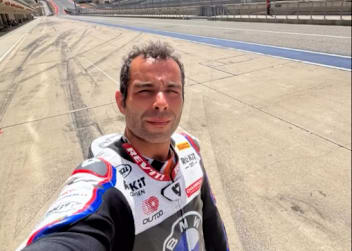
Ludovic Reignier, FIM WorldSBK Technical Director
Foto: Hexagon
Ludovic Reignier, FIM WorldSBK Technical Director
© Hexagon


For the 2026 racing season, the FIM will be using portable equipment from Hexagon for measurement and homologation work on road-legal production motorbikes in the Superbike World Championship. All bikes must comply with strict regulations designed to ensure that the machines are modified in accordance with the design guidelines and tight tolerances set out in the FIM’s technical regulations. The regulations set out the limits for modifications to production motorcycles for use in the production-based World Championship.
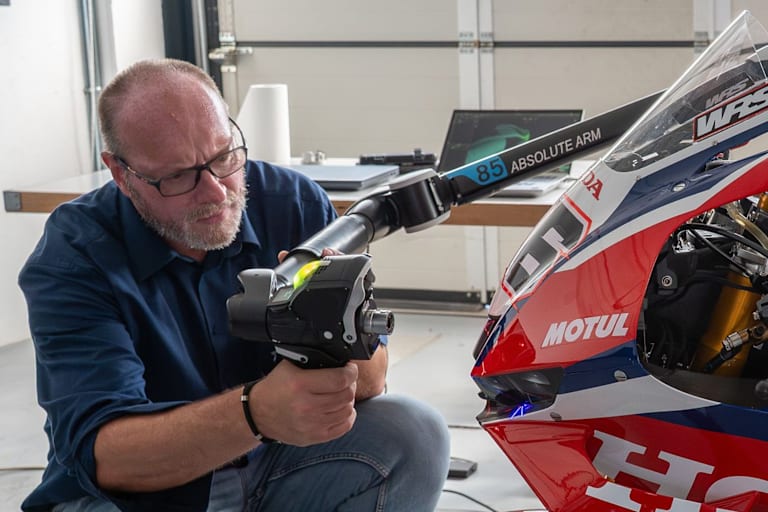
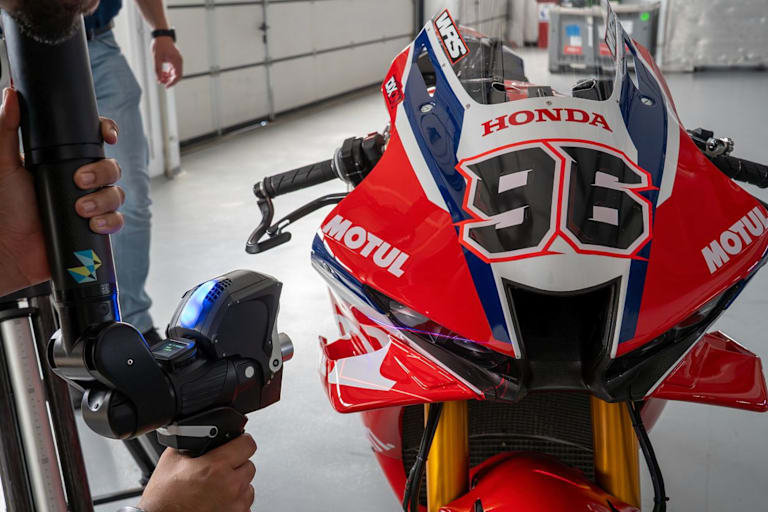
To simplify and professionalise the measurement and homologation processes, the FIM sought to achieve faster and more precise assessment of motorcycles using the latest portable testing and digitisation technologies. The FIM’s technical inspectors rely on Hexagon’s portable 7-axis measuring arm, the ‘Absolute Arm’, and the ‘Absolute Scanner AS1’ laser scanner to measure motorbikes and individual parts and to verify compliance with the applicable FIM regulations.
«Absolute Arm» mit AS1-Scanner
Foto: Hexagon
«Absolute Arm» mit AS1-Scanner
© Hexagon
‘We have an urgent and growing need for state-of-the-art measurement technology to improve the testing and inspection of motorbikes. Deciding on conformity or non-conformity using conventional methods was extremely time-consuming, and for some components – particularly aerodynamic surfaces with complex geometries – it was simply impossible,” emphasised Dominique Hebrard, Technical Director of the FIM CTI. “This partnership takes us to the next level. Using the Hexagon measuring arm provides the accuracy, speed, user-friendliness and mobility we need to check all dimensions – including the conformity of a motorbike’s entire aerodynamic package as well as individual parts – against very specific tolerances, regardless of whether we are at our technical headquarters, visiting a manufacturer or at the racetrack during a FIM event. They have really made our work easier by simplifying our technical approval procedures, making them faster and less complicated. Using the same equipment across all locations ensures consistent, reliable results and helps to strengthen manufacturers’ confidence in our processes. We are very much looking forward to working with Hexagon as we drive forward the introduction and further expansion of this technology.’
“We are delighted to be working with the FIM to bring our advanced portable measurement technology into the competitive, high-precision world of motorbike racing. This partnership builds on Hexagon’s extensive experience in measurement technology within high-performance motorsport and supports racing teams and technical regulatory bodies worldwide in digitising their vehicle development and testing processes,” said Stephan Amann of Hexagon. “It is exciting to see that digitalisation is not only helping the FIM in its work – the increasing use of precise 3D models is also helping motorcycle manufacturers to build more competitive machines quickly, without breaching the FIM’s technical regulations. This contributes to the professionalisation of the entire digital design process – from design through to manufacturing, testing and homologation – whilst ensuring fair competition at FIM events.”
Topic of the week
Spanish Grand Prix at the new Madring: track – hit or miss?
The people of Madrid had set their sights high for their city’s first Formula 1 World Championship race since 1981. But have the high expectations for the new Madring mixed-circuit track really been met?
TV Program
The FIM has begun rolling out the new homologation procedure at its technical laboratory at FIM headquarters in Mies (Switzerland) and has implemented it on a factory-by-factory basis as part of the rigorous WorldSBK pre-season tests. During the 2026 Superbike season, FIM inspectors will use Hexagon’s portable measurement solution to carry out spot checks during the remaining four events. On-site inspectors can set up the portable measuring arm in any pit to measure a wide range of components – from small engine parts through to complete frames and chassis, right up to the entire aerodynamic package.
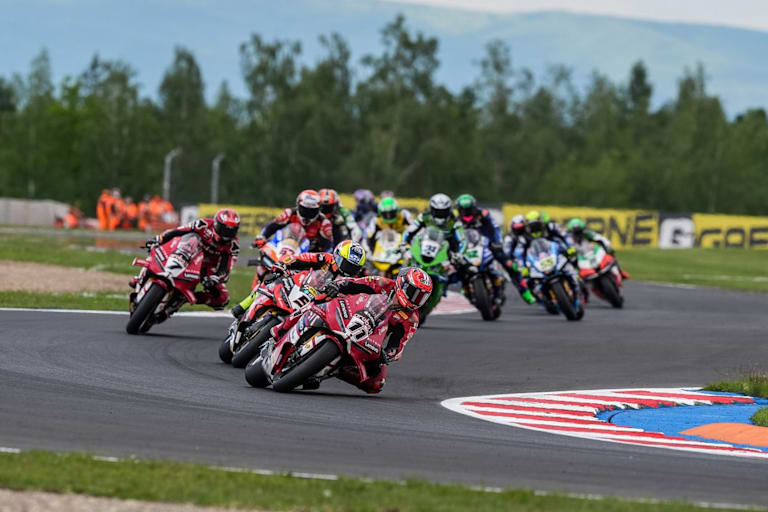
Optimierung der Messmethoden in der Superbike-WM
Foto: Hexagon
Optimierung der Messmethoden in der Superbike-WM
© Hexagon
Over the coming months, the FIM will also use the measurement equipment to homologate several upgraded Superbikes for 2026 and to begin the FIM homologation process for motorcycles for the 2027 season.
Following the full roll-out of its new WorldSBK homologation procedure in collaboration with the manufacturers, the FIM will extend the use of Hexagon’s portable measurement solution to other circuit-based championships under its jurisdiction, such as the FIM Endurance World Championship (EWC) and the World Supersport Championship.
Seen already?
Don't miss out on any highlights: The Speedweek newsletter, sent out twice a week, delivers the latest news, exclusive commentary and all the important dates from the world of motorsports - directly into your inbox
Championship Standings
Full Standingsorg-location for [2026] 2026
2026
2025
2024
2023
Pos
Driver
Team
Points
1


553
2

407
3


247
4


201
5


198
6


171
7

169
8


126
9


120
10

119
Highlight Videos
ServusTV Media Library
6. Sept. | 25:42 Min
Ducati-Festspiele in Magny-Cours!
6. Sept. | 1:33 Min
6. Sept. | 53:19 Min
Vierfach-Triumph mit Rundenrekord!
6. Sept. | 1:30 Min
5. Sept. | 1:33 Min
5. Sept. | 13:39 Min
Lecuona: „Rote Flagge war für mich ein Pech“
5. Sept. | 4:00 Min

5. Sept. | 4:10 Min
Events
All WorldSBK EventsPast Donington Park/Großbritannien
 10.–12.07.2026
Past Magny-Cours/Frankreich
 04.–06.09.2026
Next up Cremona/Italien
 25.–27.09.2026
Estoril/Portugal
 09.–11.10.2026
Jerez/Spanien
 16.–18.10.2026
Past Donington Park/Großbritannien
Past Magny-Cours/Frankreich
Next up Cremona/Italien
Estoril/Portugal
Jerez/Spanien
WorldSBK News
All News



Newest Articles
All ArticlesNew New New New New New