
Acropolis Rally Greece: 12 Rally1 cars in the top class on the starting grid
The entry list for the 70th Acropolis Rally Greece features 58 teams, including 12 Rally1 cars. This marks their strongest showing yet this season.
This article is an automatically generated English version. The

Ott Tänak im Hyundai Sieger bei der Akropolis 2025
Foto: Red Bull
Ott Tänak im Hyundai Sieger bei der Akropolis 2025
© Red Bull


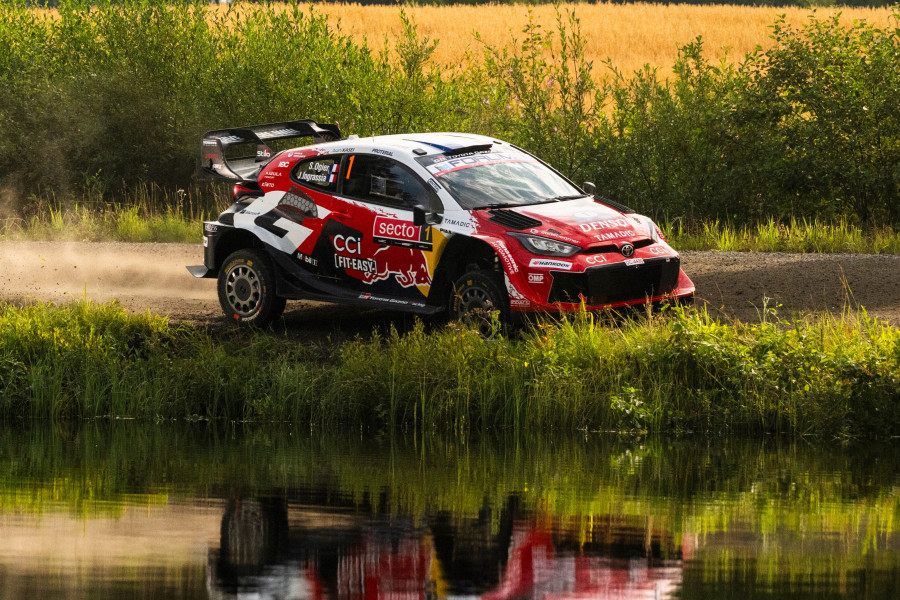
This year’s Acropolis Rally returns as the eighth of 14 World Championship rounds with a new look and a series of changes that further emphasise its unique character within the World Championship calendar. A new central rally base, challenging special stages being held for the first time, a duel-format super special stage at Ellinikon Sports Park, and a ferry crossing for the teams all combine to give the event its new character. The sporting intensity is combined with the image of a modern, cosmopolitan Greece.
The rally returns to the Gulf of Corinth for the first time in over a decade. Although the move brings the World Rally Championship circus closer to the capital, Athens, the challenge remains as gruelling as ever.

Super-Sonderprüfung im Duellformat im Ellinikon Sports Park
Foto: Akropolis-Rallye
Super-Sonderprüfung im Duellformat im Ellinikon Sports Park
© Akropolis-Rallye
The 2026 route is a blend of tradition and daring innovation, comprising 17 special stages totalling 323.31 special stage kilometres. They wind through the rugged mountains of the Peloponnese and across the technically demanding gravel of the Isthmus of Corinth.
On the sporting front, all the big names in the World Rally Championship feature on the entry list. Toyota Gazoo Racing WRT is travelling to Greece with five GR Yaris Rally1 cars. Elfyn Evans, the championship leader and winner of Rally Japan, will be supported by Takamoto Katsuta, Oliver Solberg and Sami Pajari, all of whom have already made a great impression this season. They will also be joined by nine-time world champion Sébastien Ogier, who is competing in a reduced WRC programme.
Ferrari came away empty-handed at the Dutch Grand Prix: Lewis Hamilton finished fourth, Charles Leclerc fifth. Afterwards, both drivers were angry, and team principal Fred Vasseur found himself having to explain the situation.
TV program
The Hyundai team returns to an event it has won in each of the past two years. Three i20 N Rally1 cars are entered for Adrien Fourmaux, Thierry Neuville and returnee Dani Sordo. The rough gravel stages of the Acropolis Rally traditionally suit the Korean manufacturer well, which does indeed give the team a chance of victory.
The M-Sport Ford World Rally Team is also fielding a strong line-up, sending no fewer than four Puma Rally1 cars into the race. Irish regulars Jon Armstrong and Josh McErlean will be supported by part-time driver Martins Sesks and local hero Jourdan Serderidis.
The Rally2 field is equally impressive in terms of both quantity and quality. No fewer than 34 Rally2 cars will cross the starting ramp, with many of the leading contenders in the WRC2 championship making their way to Greece.

Vor dem Wechsel in den Monoposto: Kalle Rovanperä im Sonnenblumenfeld
Foto: Red Bull
Vor dem Wechsel in den Monoposto: Kalle Rovanperä im Sonnenblumenfeld
© Red Bull
Among them, Lancia’s return to the Acropolis Rally stands out. The Italian marque last took part in the event in 1993, when Carlos Sainz and Andrea Aghini drove the legendary Delta Integrale. This year, Lancia is returning to the World Rally Championship via the WRC2 category, with Yohan Rossel among the leading title contenders.
The battle in WRC2 is set to intensify further with the participation of Leo Rossel, Roope Korhonen, Andreas Mikkelsen and Gus Greensmith, making this field one of the strongest of the entire season in this category.
As always, Greek teams are an integral part of the Acropolis Rally’s identity. A total of 13 entrants will be flying the Greek flag, with particular interest focused on the Rally2 category. Plagos/Kouzionis, the highest-placed Greek team at the 2025 Acropolis Rally, are returning in a Škoda Fabia RS. The 2024 winners, Roustemis/Bakloris, will line up in an identical car. Athanassoulas/Soukoulis will be driving a Hyundai i20 N Rally2, whilst the strong teams of Karanikolas-Kakavas (Ford Fiesta Mk II) and Chalkias-Tsaousoglou (Škoda Fabia Evo) will take up the national challenge.

Auch Rallye Griechenland 2025: Thank you very Matsch
Foto: Red Bull
Auch Rallye Griechenland 2025: Thank you very Matsch
© Red Bull
The 2026 Acropolis Rally begins on Thursday 25 June with the spectacular EKO Super Special Stage at Ellinikon Sports Park, which is part of a huge leisure park near Athens. Later that evening, the teams will head to the port of Corinth, where they will board the Superfast IV ferry to cross over to Itea. From the following morning, a further 16 special stages await the competitors in what is considered the toughest event in the entire World Rally Championship.
The move to Loutraki marks a strategic reorientation for the Acropolis Rally: the high-altitude forests of Central Greece are being swapped for the sun-baked, rocky routes of the south. This move means that the route for 2026 will be largely redesigned, whilst retaining classic stages in Central Greece. The technical focus remains on heat management and mechanical durability in temperatures that often exceed 40 degrees Celsius. Hard tyre compounds are essential to withstand sharp-edged volcanic rock, which can shred the rubber in a matter of seconds.
Seen already?
Don't miss out on any highlights: The Speedweek newsletter, sent out twice a week, delivers the latest news, exclusive commentary and all the important dates from the world of motorsports - directly into your inbox


Newest articles
All articlesNew


