Anniversary of Enzo Ferrari’s death: Unrivalled, incredible, unforgettable, unapproachable
On 14 August 1988, the heart of company founder Enzo Ferrari stopped beating, at the age of – hang on a moment, how old was the great Ferrari actually then? Even his birth is the stuff of legend.
This article is an automatically generated English version. The
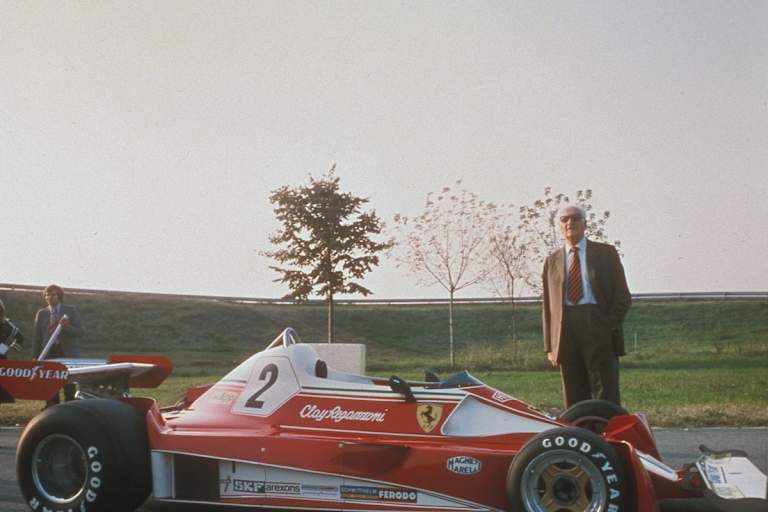
Enzo Ferrari Anfang 1976 auf der firmeneigenen Testbahn Fiorano
Foto: Grand Prix Photo
Enzo Ferrari Anfang 1976 auf der firmeneigenen Testbahn Fiorano
© Grand Prix Photo


Thirty-eight years ago, a nation was plunged into collective mourning: Enzo Ferrari passed away on 14 August 1988. Numerous obituaries around the world stated that the world-famous sports and racing car manufacturer had been born on 20 February 1898, whilst others cited 18 February. It was typical of Ferrari that his fabulous career began with an unusual story – as unusual as the life the sports and racing car manufacturer led throughout his lifetime.
Enzo Anselmo Ferrari was born on 18 February 1898, but because a fierce snowstorm was raging in the region around Modena, his father, Alfredo Ferrari, did not make his way to the town hall until 20 February to register the arrival of his distinguished offspring.
So the legend goes, at any rate. Until a few years ago, when a weather expert took the trouble to look through old newspapers: he could find no mention of a snowstorm in the region.
One thing is certain: the sports car manufacturer lived to the age of 90. His son Piero says: “Even after so many years, the many messages marking the anniversary of his death still move me deeply.”
The great Ferrari himself felt it was unnecessary to make a fuss about his birthday. A quote from Enzo Ferrari: “How do I want to be remembered? I would prefer silence.”
Four weeks ago, Aprilia headed into the summer break from Germany with a badly injured Marco Bezzecchi. The response came from the heart of British motor racing: ‘Together we are strong!’
TV program
Enzo Ferrari detested idleness
I found it a curious twist of fate that the death of the great Enzo Ferrari should fall, of all times, during ‘Ferragosto’ – Italy’s traditional summer holidays and, today, the Formula 1 summer break – for idleness was abhorrent to him.
Piero Ferrari smiles: “My father would be turning in his grave. He hated ‘Ferragosto’. And he’d be as happy as a child if he could schedule a test at Fiorano for mid-August.”
August and September are highly emotional months for Ferrari: in August 1988, the company’s founder, Enzo Ferrari, passed away; just a few weeks later, Gerhard Berger and Michele Alboreto secured an unexpected one-two victory at Monza; and, as is customary, the home race at Monza is due to take place in early September. It was unexpected because, in 1988, McLaren-Honda was even more dominant than Mercedes-Benz had been in the early years of the turbo-hybrid era.
The pairing of Ayrton Senna and Alain Prost completely outclassed the competition in 1988 with the McLaren MP4/4-Honda. Although Alain Prost retired at Monza, Senna led effortlessly, and it looked as though McLaren were set for their twelfth victory in the twelfth race of the season.
Pure magic at Monza
In the stands, the Tifosi had all but fallen silent: with two laps to go, the Ferraris of Gerhard Berger and Michele Alboreto were in second and third place, but a long way behind. The first spectators began rolling up their yellow flags and heading home.
Senna was closing in on Jean-Louis Schlesser’s Williams. The Frenchman had stepped in for Nigel Mansell, who hadn’t even made the trip due to chickenpox. Senna closed in quickly – so quickly that Schlesser hesitated for a moment. That was enough for him to miss his braking point and mess up his line. Senna overtook on the outside and then stumbled over one of the Williams’ wheels – the Tifosi couldn’t believe their eyes!
Less than 120 seconds later, the Ferraris crossed the finish line to secure an unexpected one-two victory. The excitement knew no bounds.
I was standing in the pit lane at the end of the race; the cheering swept over everything like a mighty wave, then the frenzied crowd stormed the track, the police sealed off the rear exits of the pits in a flash, and it took a considerable amount of Swiss physical effort to escape the chaos and make it back to the drivers’ paddock.
Memories like a treasure
Enzo Ferrari’s son Piero, now 81 years old, says: ‘Even after so many years, I am deeply moved by all the messages I receive every August, on the anniversary of my father’s death. It’s lovely to know that one’s own father is still loved and respected. I cherish my memories of him like a treasure.’
“It’s not easy to share something as personal as the anniversary of one’s own father’s death with the public. And yet I’m happy to do so, because even today, people still contact me every day to tell me how important Enzo Ferrari was in their lives. It’s not just about customers or fans; it’s about people who admired my father’s daring and his ability to strive for his goals – that’s what inspired them.”
Thanks to Enzo Ferrari, Ferrari has not only become one of the world’s most famous car brands; it has also left its mark on Formula 1. The Italians hold almost all the major records in Grand Prix racing; no other team in the world has such a devoted following.
Journalist, opera singer, racing driver
Enzo Ferrari actually wanted to become a journalist, then an opera singer, and finally a racing driver. He took part in 47 races and won more than a dozen times for Alfa Romeo. But he realised he would never reach the calibre of the truly great drivers. Instead, he founded Scuderia Ferrari in 1929.
He only ever sang in the bath; as a sort of quasi-colleague, he kept a close eye on the journalists and thoroughly teased them at the traditional Ferrari end-of-year dinner.
Perhaps the most famous Formula 1 emblem is, of course, emblazoned on the Ferrari: the ‘cavallino rampante’, the prancing horse.
The history of the logo
According to legend, the Italian fighter pilot Francesco Baracca displayed the horse on his aeroplane because he belonged to the ‘Piemonte Cavalleria’ cavalry regiment. Other sources claim that Baracca took the horse from a fighter pilot from Stuttgart whom he had shot down.
In any case, following the death of the flying ace, Baracca’s mother, Contessa Paolina Biancoli, met the young racing driver Enzo Ferrari and suggested painting the horse on the car as a good-luck charm. Enzo did more than that – he set the black horse against the yellow of his hometown, Modena, and made this logo world-famous. A horse for the brand with plenty of horsepower – it was a perfect fit.
The Ferrari logo first appeared in 1932 on the Alfa Romeo 8C 2300 MM driven by the driver pairs Antonio Brivio and Eugenio Siena, and Piero Taruffi and Guido d’Ippolito, at the race in Spa-Francorchamps.
What even many Ferrari fans don’t know is that the logo had already appeared on a motorbike before the car race in Belgium! Specifically, at the motorcycle race on the Circuito di Pontedera in the province of Pisa on 3 July – on a British Rudge machine that was fielded by the Scuderia in the Italian Championship from 1932 to 1934.
With Alfa Romeo’s withdrawal, Ferrari became an independent racing team. The destruction of the Modena factory in 1943 forced a move to Maranello. The first Ferrari was launched in 1947.
When Ferrari beat Alfa Romeo for the first time, he said: “It’s as if I’d murdered my own mother.”
The world’s most famous car brand
An unprecedented success story began. Ferrari became world-famous; even small children immediately associate red sports cars with Ferrari. The boss was both loved and feared; people called him ‘commendatore’, after an order of merit awarded to him in 1927.
He himself preferred ‘ingegnere’, even though he had never trained as an engineer. Behind his back, people whispered about ‘drago’, the dragon.
Enzo Ferrari was a master of manipulation, unscrupulous when it came to achieving a goal, but also as soft as butter – he never got over the death of his son Dino, from his first marriage, in 1956. He loved the Canadian Gilles Villeneuve like a son and suffered accordingly when the master behind the wheel lost his life in 1982.
Enzo Ferrari’s weakness for beautiful women is legendary. Ferrari employees either thrived under his domineering style or were broken by it. Ferrari was feared for the way he pitted drivers against one another to get the best out of them. It was rarely elegant, sometimes fatal, but in his view, the end justified the means.
Enzo Ferrari is laid to rest at the Cimitero di San Cataldo in his hometown of Modena.
Seen already?
Don't miss out on any highlights: The Speedweek newsletter, sent out twice a week, delivers the latest news, exclusive commentary and all the important dates from the world of motorsports - directly into your inbox
Championship Standings
Full standings2026
2026
2025
2024
2023
Pos
Driver
Team
Points
1


219
2


169
3

160
4

138
5


128
6


109
7

92
8

68
9


43
10


42
Highlight videos
ServusTV media library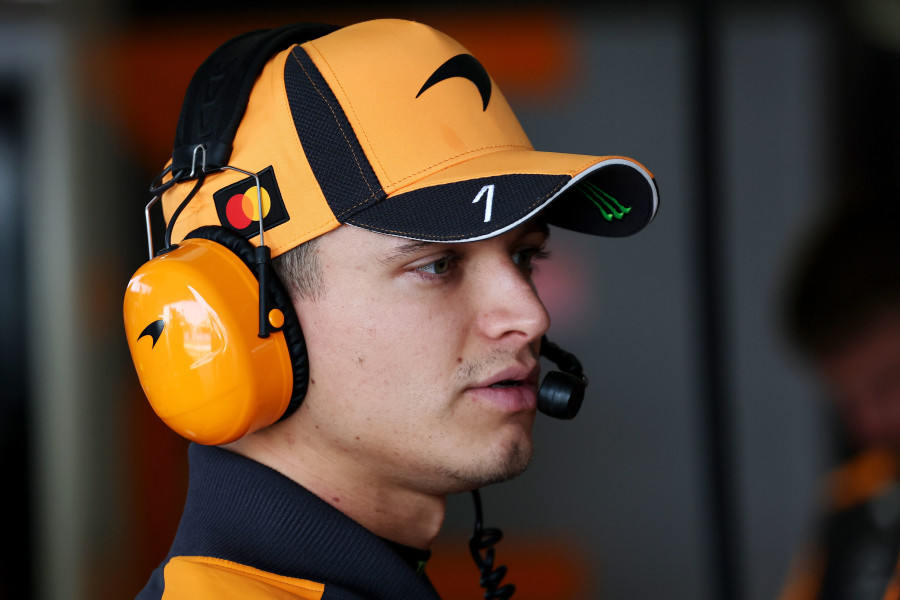
Übt Norris Weltmeister-Druck auf McLaren aus?
27. Juli | 1:16 Min
F1-Geschichtsstunde mit Andi Gröbl
19. Juli | 7:53 Min
Belohnung nach dem Qualifying!
18. Juli | 7:00 Min
Wrap-Up: Exklusive Einblicke ins Fahrerlager!
17. Juli | 9:28 Min
17. Juli | 5:50 Min
60 Grad, Trinkflasche hin: Russells Ruhe-Geheimnis
29. Juni | 1:07 Min
28. Juni | 7:46 Min
Win2Day & Allwyn: Innovation im Wetten
27. Juni | 0:51 Min
Events
All Formula 1 eventsPast Belgian Grand Prix
 17.–19.07.2026
Past Hungarian Grand Prix
 24.–26.07.2026
Next up Dutch Grand Prix
 21.–23.08.2026
Italian Grand Prix
 04.–06.09.2026
Spanish Grand Prix
 11.–13.09.2026
Past Belgian Grand Prix
Past Hungarian Grand Prix
Next up Dutch Grand Prix
Italian Grand Prix
Spanish Grand Prix
Formula Racing News
All news
Newest articles
All articlesNew New New