Kinigadner on injuries in off-road sport – what needs to change
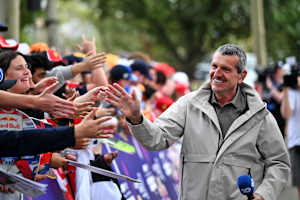
At the Red Bull Erzbergrodeo, off-road legend Heinz ‘Kini’ Kinigadner took the time to chat with SPEEDWEEK.com, a conversation that quickly went beyond the scope of mere sporting small talk.
This article is an automatically generated English version. The
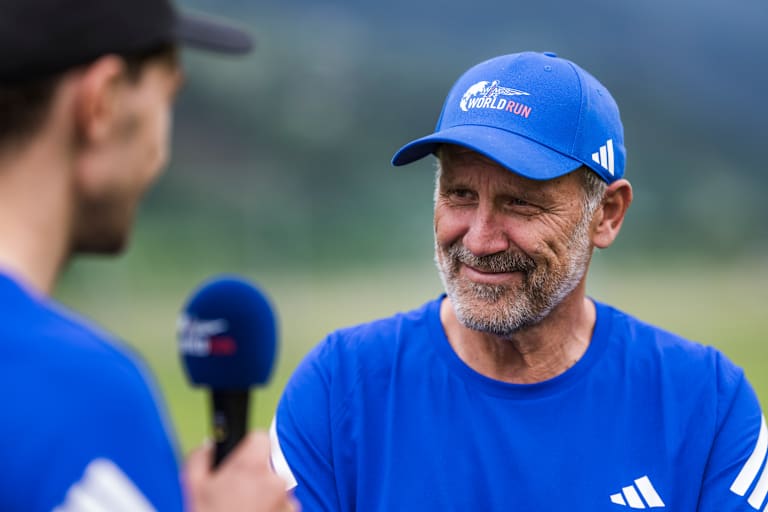
Heinz Kinigadner
Foto: Wings for Life
Heinz Kinigadner
© Wings for Life


Heinz Kinigadner, two-time Motocross World Champion and co-founder of the ‘Wings for Life’ Foundation, spoke candidly to SPEEDWEEK.com writer Carsten Steffen about what has been on his mind for years: The question of why off-road sport lags so far behind when it comes to dealing with serious injuries, and what needs to change.
“Off-road is still a real sport” – and is grossly underestimated
For Heinz Kinigadner, off-road sport was and remains the supreme discipline to this day, because it’s all down to the rider and not just the technology. Yet he believes it is precisely this fascination that also blinds him to what happens in an emergency.
“Off-road sport is still my world; I love it more than anything else. I enjoy being involved in MotoGP because it’s simply technology at the very highest level. Off-road is still a truer sport because it depends first and foremost on the rider. But we’re still incredibly amateurish when it comes to off-road sport. I’ve seen and experienced so many terrible situations. Yet many years ago we already launched initiatives such as the one in Supercross, where we brought all the managers together and Prof. Jan Schwab showed them how to treat injured riders correctly – including following the protocol used in ice hockey in the USA. We’re simply still worlds away from that in off-road sport. The difference is that, to be honest, in off-road motorcycling it isn’t seen as relevant if someone is injured so badly that they might end up paraplegic.”
Recommendations
Mentioned in this article
When everything fails in an emergency: the Benistant case
Kinigadner highlighted just how far reality falls short of this ideal by referring to an incident that occurred only recently in France. For him, it is a case study of how a system fails when it really matters.
“Even in the Motocross World Championship, where the top five riders have contracts worth millions, there is no helicopter on standby at the World Championship rounds. Just recently in France, Thibault Benistant once again lay by the track for four hours before he could be taken to hospital. And at the hospital, no neurologist had been informed in advance that this event was taking place and that injured riders might arrive. The race wasn’t stopped, even though the situation was obvious to everyone. The man didn’t receive critical treatment overnight and only underwent surgery a day later – even though it’s well known that, in the case of a spinal cord injury, the most important thing is to make room for the swelling, otherwise the nerve fibres will die off.”
Summertime, holiday season, the silly season: these are the weeks when the most outrageous driver changes are usually discussed. The big news for the 2027 season is yet to materialise.
Who bears responsibility: the FIM, organisers and insurers
For Kinigadner, this individual case quickly became a fundamental question of responsibility. He holds the world governing body just as accountable as the organisers, teams and managers.
“I’ve heard that Thibault Benistant’s management intends to sue the organiser and the FIM. If they need support, I’ll be happy to provide it. We’ve been saying for years what needs to be done. I hope that the FIM will eventually be hit with heavy fines, so that it wakes up and takes action. And even in these areas of the sport, there are repeated calls for donations to cover the costs. Everyone has a role to play here – from the FIM through to the organisers, the teams and the managers – to ensure that comprehensive insurance cover is in place. Everyone is walking straight into a trap with their eyes wide open. And every time it happens, there’s a huge fuss. The FIM clearly needs to be held accountable here too. During my active career, the licence still guaranteed that first aid and transport to hospital were covered.”
Kinigadner gave an example where it does work. “Why is it that Karl Katoch, at the Erzbergrodeo, manages to make insurance compulsory and also ensures that at least first aid, transport and basic hospital care are covered? It’s certainly a big difference, at least here in Austria, whether you’re riding privately or have had an accident at work. That’s why riders who are reasonably well-established often run a sort of sole trader business, so they’re covered in that respect too. You should also take a look at your existing insurance to see if you can optimise and top it up where necessary.”
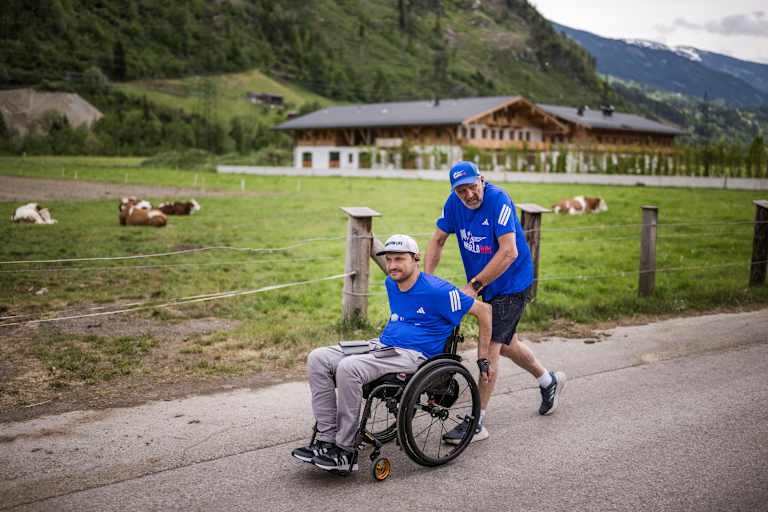
Heinz Kinigadner mit Sohn Hannes beim Wings for Life World Run
Foto: Wings for Life
Heinz Kinigadner mit Sohn Hannes beim Wings for Life World Run
© Wings for Life
‘I was one of those idiots myself’
As strongly as Kinigadner criticised the associations, he looked back on his own career with self-criticism. His change of heart only came when he experienced the consequences at first hand.
“Thanks to Wings for Life, we’re now contacted about almost every incident of this sort. And you only really wake up to the reality when you see someone lying there who can no longer move their legs. I was a bit of an idiot myself and used to love riding without any protective gear – just short sleeves, the great freedom. When you then realise what the consequences can be if the worst happens, you have to admit in hindsight: that was just incredibly stupid. We now want to get this message across to riders – not to be as daft as we ourselves were.”
From the Leatt Brace to the mandatory airbag
The fact that things have moved forward technically is also down to Kinigadner’s persistence. He recalls a series of serious accidents that forced him to take action – and draws a clear conclusion from them.
“At the moment, unfortunately, it’s still the case that once you’ve had an accident, you have to live with the consequences for the rest of your life. We’re working with Wings for Life to change that. I’m convinced that we’ll eventually succeed. Back then, we set up a working group involving, amongst others, BMW, Ortema, the hospital in Murnau and the helmet manufacturer Schuberth. That’s where the Leatt Brace was developed, for example. Before that, Fabrizio Meoni, amongst others, had broken his neck in the Dakar Rally and died. Within two years, there were so many serious accidents – involving my son Hannes and also Pit Beirer – that I said: ‘Things cannot stay this way.’ Now it’s the airbag. Nobody in our rallying community drives without an airbag anymore. Companies like Alpinestars are constantly developing the technology further and now offer quite good protection. This must become compulsory – because if it isn’t compulsory, almost nobody will wear one. It must be included in the regulations and be mandatory for every driver. The sport will never be 100 per cent safe. But if you have such means of protection available, then you should make use of them. Because every person we can save from such an injury is worth it!”
The current state of research
As well as prevention, Kinigadner is focused on a cure. For over two decades, Wings for Life has been investing tens of millions into spinal cord research – making progress, but without making false promises.
“With Wings for Life, we’ve been going full throttle for 22 years and are investing 10 to 15 million euros in further development every year. The Wings for Life World Run provides us with excellent sources of income; things are moving in a very positive direction. We currently have around 45 projects underway, eight of which are clinical trials, and one or two of these will be successful. I’m confident of that. That doesn’t mean there’ll be a jab and you’ll be back on your feet. Step by step – perhaps control of the bowel or bladder will return, or you’ll be able to move your fingers again. There’s also a project currently underway focusing on acute injuries, where a specific procedure is carried out on the very first night to create space for the swelling. In a large number of cases, this could prevent patients from ending up in a wheelchair. But expectations should be realistic. Once the study is completed in one and a half to two years’ time, it will take a further five to seven years before this becomes standard practice in hospitals. Research into stroke has shown that the vagus nerve can be therapeutically stimulated, for example to improve finger mobility. This project in Texas, which we have been supporting for years, is very successful, and we have also received official approval there. A lot has happened in this area over the last 30 years, but in research, that timeframe is relative. Nevertheless, the fact remains: it is not a question of if, but when we will find a way.”
The mind plays a part: Hannes and Hansi
Finally, Kinigadner turned to a factor that no study or set of rules can capture – one’s inner attitude. Two people from his own family spring to mind.
“In my experience, personal mental attitude certainly plays a major role too. I’ve seen the whole spectrum. One person writes everything off and gives up. The other tells themselves: This is how it is now, and I must and will make the best of it. Hannes is a very good example for me: in these 23 years, he hasn’t let his head drop for a single day – at least not visibly. My brother, Hansi, has been in a wheelchair since 1984 and has experienced just about every setback you can imagine. But he has such a strong will to live – and probably such a strong heart too – that he’s coped with every situation. So yes – attitude certainly plays a major role.”
Seen already?
Don't miss out on any highlights: The Speedweek newsletter, sent out twice a week, delivers the latest news, exclusive commentary and all the important dates from the world of motorsports - directly into your inbox
Motocross News
All news


Newest articles
All articlesNew