A journey through time: 30 years of World Championship marketing from Action Group to Youthstream
Thirty years ago, Giuseppe Luongo’s team acquired the global marketing rights to the Motocross World Championship. Since then, the World Championship has undergone fundamental changes. A journey through time.
This article is an automatically generated English version. The
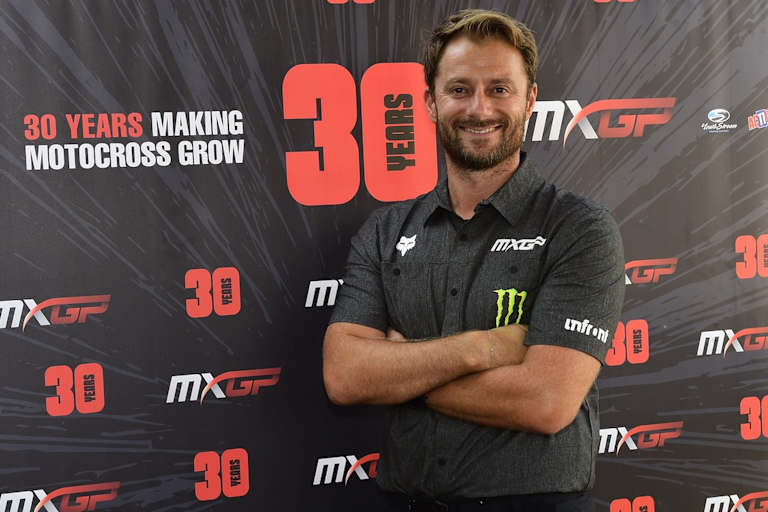
David Luongo feiert das 30-jährige Jubiläum der Vermarktung
Foto: Infront Moto Racing
David Luongo feiert das 30-jährige Jubiläum der Vermarktung
© Infront Moto Racing


At the Grand Prix in Lommel, the motorbikes on display were those with which some of the greatest champions had made motocross history. At the same time, the World Championship promoter looked back on another anniversary: 30 years ago, the centralised marketing of the Motocross World Championship began.
In 1996, Action Group acquired the global marketing and TV rights. This was followed by Youthstream and finally Infront Moto Racing. Over these three decades, it was not only the World Championship’s media presence that underwent a fundamental transformation. The paddocks, tracks, safety standards and the overall image were also standardised.
1996–2000: Action Group takes over
Until the mid-1990s, the Motocross World Championship consisted largely of independently organised Grands Prix. Each organiser was responsible for its own event and the respective TV production. Action Group changed this model. TV production was centralised and the look and feel of the World Championship was standardised. Podiums, advertising spaces and presentations increasingly followed a common concept. From 1999 onwards, the world champions were honoured at the FIM World Champions Awards in collaboration with the FIM. Fox Sports joined as a key international TV partner from 2000.
2001–2003: The brief Dorna interlude
In 2001, Dorna Off-Road took over marketing. This phase saw one of the most controversial reforms in the Motocross World Championship: the 125, 250 and 500 cc classes were held at joint events and, at times, reduced to just one round per class. The experiment did not last long. At the end of 2003, Dorna returned the rights to the Motocross World Championship and the Motocross of Nations. On 1 January 2004, Giuseppe Luongo’s Youthstream took over.
From 2004: A new era begins with Youthstream
With Youthstream, the structure of the World Championship also changed. The traditional 125, 250 and 500 cc classes became MX2, MX1 and MX3. Stefan Everts won the first MX1 World Championship title in 2004.
Four weeks ago, Aprilia headed into the summer break from Germany with a badly injured Marco Bezzecchi. The response came from the heart of British motor racing: ‘Together we are strong!’
At the same time, the Grand Prix environment was professionalised. The paddock, hospitality areas, team zones and media centre were increasingly standardised. The aim was for riders, teams, sponsors and the media to find comparable conditions at every Grand Prix. Women’s motocross was also given an international platform. The Women’s World Cup was established in 2005.
Pit lanes and VIP areas emerge
There were also significant changes along the track. Previously, mechanics would stand with their pit boards right at the track edge. With the introduction of the pit lane, a dedicated area was created for teams and mechanics, equipped with timing systems and live timing. At the same time, the hospitality facilities were expanded. This eventually led to the creation of the striking two-storey skybox behind the starting grid, complete with a restaurant, terrace and VIP areas.
Saturday became race day
A significant sporting change followed in 2009. Saturday was no longer to consist mainly of practice sessions. The qualifying race now determined the starting grid for Sunday. This meant that, for the first time, a Grand Prix weekend consisted of two full race days. The principle remains in place today, even though the format has been changed several times.
2011: Motocross enters the streaming era
In 2011, the championship launched its own streaming portal, MX-Life.tv. Fans could now follow the World Championship live online and watch races on demand afterwards. At the same time, work began on expanding the series’ own social media channels. This enabled the World Championship, for the first time, to communicate directly with its fans on a large scale, without having to rely exclusively on television and print media. In 2012, the MXGP Academy was launched, designed to support young riders and coaches in various countries.
2013: The Skybox arrives
The new Skybox was used for the first time at the 2013 Easter Grand Prix in Valkenswaard. The two-storey structure combined hospitality facilities, VIP boxes and the podium, and quickly became an integral part of the event’s visual identity. The first issue of MXGP Magazine was published that same year. A total of 145 issues were produced up to the final edition in March 2026. On the sporting front, Antonio Cairoli dominated at this time. In 2013, the Sicilian won his fifth consecutive title in the premier class and his seventh World Championship title overall.
2014: MX1 becomes MXGP
In 2014, the premier class was given its current name: MX1 became MXGP. Antonio Cairoli thus went down in history as the first MXGP World Champion. Developments also continued in the media sphere. MX-Life.tv became MXGP-TV, broadcasts were offered in HD, and the first official MXGP video game was released in collaboration with Milestone. On-board cameras also provided new perspectives, allowing viewers to experience the tracks from the riders’ point of view.
2015–2019: The World Championship expands
In the second half of the 2010s, the calendar became increasingly international. Grands Prix in Argentina, Indonesia, Asia and the USA were intended to establish the World Championship beyond its core European market. In 2016, Youthstream experimented with the SMX Riders’ Cup, a hybrid of motocross and supercross featuring official factory teams. The starting grids that are now a hallmark of the series also emerged during this phase. Following their first use at the SMX Cup, they were introduced to the World Championship in 2017.
2020–2022: World Championship and the pandemic
The COVID-19 pandemic presented a new challenge to the entire concept. To enable the World Championship to continue, several Grands Prix were sometimes held back-to-back at the same track. At the same time, MXGP-TV continued to grow in importance. Interviews, studio segments and behind-the-scenes features increasingly complemented the traditional race coverage. The issue of sustainability also came more into focus. The aim was to reduce waste, single-use materials, noise and emissions.
Since 2023: World Championship points are also up for grabs on Saturday
In 2023, the qualifying race was given even greater prominence. Since then, World Championship points have been awarded on Saturdays. The race for the best starting position has thus become an integral part of the title battle. The Paddock Show was also introduced in 2023. Riders and guests perform in front of the fans on Saturday evening. MXE was also introduced as a junior class for six- to eight-year-olds riding electric motorbikes.
From television to its own media network
By the mid-2020s, the MXGP channels on social media had collectively reached more than six million followers. Streaming, social media, in-house video productions and, finally, a dedicated podcast format complemented traditional TV marketing.
As a result, the business model has undergone a fundamental transformation over the course of 30 years: in 1996, the initial focus was on bringing the television coverage of the individual Grands Prix under one umbrella. Today, the World Championship promoter produces and distributes a large proportion of its content itself and reaches fans directly via numerous in-house channels. This is an achievement for which Infront Moto Racing deserves nothing but congratulations.
A 30-year journey through time at a glance
1996 – Action Group takes over marketing and TV rights
1997 – A unified brand identity for the Motocross World Championship is established
2001 – Dorna Off-Road takes over marketing
2004 – Youthstream takes over – the 125, 250 and 500 cc classes become MX2, MX1 and MX3
2005 – The Women’s Motocross World Cup is established
2009 – Qualifying races make Saturday the second day of racing
2011 – MX-Life.tv launches with live streaming and video-on-demand
2012 – Introduction of the MXGP Academy
2013 – Debut of the Skybox and launch of MXGP Magazine
2014 – MX1 becomes MXGP; MX-Life.tv becomes MXGP-TV
2017 – Introduction of the new starting grids
2020 – Youthstream becomes Infront Moto Racing
2023 – World Championship points are awarded for the first time in the Saturday qualifying race
2023 – Introduction of the Paddock Show and the MXE junior class
2025 – MXGP launches its own podcast series
2026 – Streaming and social media, with around 6 million followers, become key pillars
Seen already?
Don't miss out on any highlights: The Speedweek newsletter, sent out twice a week, delivers the latest news, exclusive commentary and all the important dates from the world of motorsports - directly into your inbox
Championship Standings
Full standings2026
2026
2025
2024
2023
Pos
Driver
Points
1

675
2

571
3

566
4

534
5

450
6

446
7

425
8

409
9

345
10

273
Events
All MXGP eventsPast MXGP of Czech Republic
 25.–26.07.2026
Past MXGP of Flanders
 01.–02.08.2026
Live
MXGP of Sweden
 15.–16.08.2026
Next up MXGP of The Netherlands
 22.–23.08.2026
MXGP of Turkey
 05.–06.09.2026

Past MXGP of Czech Republic
Past MXGP of Flanders
Live
MXGP of Sweden
Next up MXGP of The Netherlands
MXGP of Turkey
MXGP News
All news