6h Fuji: History and fascinating facts about the WEC race
The sixth race of the FIA WEC season is coming up. The venue is the Fuji circuit. It’s a home race for Toyota. The current WEC has been racing at Fuji since 2012. The only years it wasn’t held there were 2020 and 2021.
This article is an automatically generated English version. The
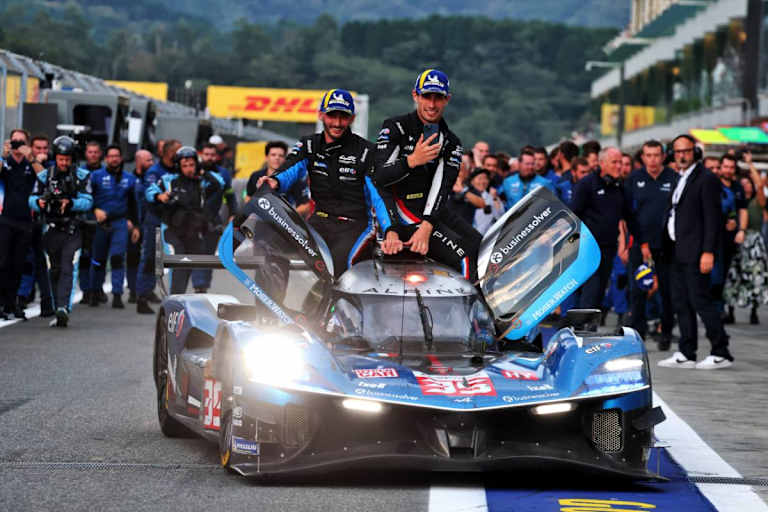
2025 siegte in Fuji der Alpine A424 von Chatin, Habsburg und Milesi
Foto: Moy / XPB Images
2025 siegte in Fuji der Alpine A424 von Chatin, Habsburg und Milesi
© Moy / XPB Images


The time has come: this coming Sunday (27 September 2026), the World Endurance Championship (FIA WEC) gets underway once again. The venue for the penultimate round of the 2026 season is the 4.563-kilometre circuit in Fuji, Japan (located approximately 100 km south-west of the capital, Tokyo), from where, in good weather, the famous ‘Mount Fuji’ can also be seen.
The circuit has a very distinctive layout. This is partly due to the ultra-long start/finish straight, which is over 1,475 metres in length. The section of the track that follows features a series of long, sweeping bends designed to generate aerodynamic downforce, before the very tight corners at the end of the lap demand a good mechanical set-up. The Fuji circuit was built in 1965. At that time, a steep bend was even constructed after the start/finish line, as the idea was to hold NASCAR-style races in Japan. Since 2000, the complex has been part of the Toyota empire.
Toyota always goes into the race weekend at Fuji as the favourite. This is evident, for example, from a look at the statistics. From 2012 to 2019, the FIA WEC made a stop at Fuji every year. The 2020 and 2021 rounds were cancelled due to the coronavirus pandemic. In the first three seasons, the Japanese works team achieved a hat-trick of victories. This was only broken in 2015 by the triumph of the Porsche trio Timo Bernhard, Mark Webber and Brendon Hartley. In 2016, 2017, 2018 and 2019, however, Toyota once again stood at the top of the podium.
The same was true in 2022 and 2023 – when there was a comfortable one-two finish on each occasion. In 2024, a Porsche 963 won the WEC race at Fuji. In 2025, Alpine secured its only WEC victory to date. For Toyota, the next victory is therefore almost a must. Furthermore, the TR010 Hybrid’s powertrain is manufactured not far from the circuit (at the Higashi-Fuji Technical Centre). As a result, many in-house staff will be watching the event from the venue itself.
The Hypercars, introduced in 2021, set a fastest lap of 1:27.794 minutes during their 2023 outing (Kobayashi in the Toyota during qualifying). This record still stands. The fastest LMP1 lap at Fuji dates back to 2015. Mark Webber set this time of 1:22.639 minutes. The best Formula 1 lap time dates back to 2008, when Ferrari driver Felipe Massa clocked 1:17.287 minutes in the second qualifying session. The fastest lap ever recorded at Fuji was set by the unforgettable Stefan Bellof. In a Porsche 956, he clocked a time of 1:10.02 minutes in 1983. However, a direct comparison with modern times is not entirely fair, as the circuit layout used at that time was only 4.360 kilometres long.
Topic of the week
Spanish Grand Prix at the new Madring: track – hit or miss?
The people of Madrid had set their sights high for their city’s first Formula 1 World Championship race since 1981. But have the high expectations for the new Madring mixed-circuit track really been met?
A very special sports car race took place at Fuji in November 1999. At that time, the Le Mans organiser, the ACO, was launching its global expansion plan. Much like the first ‘Petit Le Mans’ held in 1998 at Road Atlanta (which gave rise to the American Le Mans Series in 1999), the Fuji event was intended to gauge interest in an LMP series on the Asian market. Toyota fielded its TS020 and Nissan the open-wheel R391. Both pole position and the fastest lap went to the Toyota driven by Ukyo Katayama, Toshio Suzuki and Keiichi Tsuchiya. However, victory went to Nissan, driven by Érik Comas, Satoshi Motoyama and Masami Kageyama.
Seen already?
Don't miss out on any highlights: The Speedweek newsletter, sent out twice a week, delivers the latest news, exclusive commentary and all the important dates from the world of motorsports - directly into your inbox
Championship Standings
Full Standingsorg-location for [2026] 2026
2026
2025
2024
2023
Pos
Driver
Points
1

76
2

72
3
54
4
54
4
54
4
54
5
49
5

49
5
49
6

49
Highlight Videos
ServusTV Media Library
24. Sept. | 44:59 Min
Highlights: 8 Stunden von Suzuka
9. Juli | 45:00 Min

13. Juni | 45:00 Min
23. Apr. | 45:02 Min
Events
All WEC EventsPast Rolex 6 Hours of Sao Paulo
 10.–12.07.2026
Past Lone Star Le Mans
 04.–06.09.2026
Next up 6 Hours of Fuji
 25.–27.09.2026
6 Hours of Barcelona
16.–18.10.20266 Hours of Monza
06.–08.11.2026
Past Rolex 6 Hours of Sao Paulo
Past Lone Star Le Mans
Next up 6 Hours of Fuji
6 Hours of Barcelona
16.–18.10.20266 Hours of Monza
06.–08.11.2026
Le Mans News
All News





Newest Articles
All ArticlesNew New New New New New New New New