60 Years of MSC Teutschenthal: The 1990s – The Dawn of a New Era
Reunification presented society in eastern Germany with new challenges. MSC Teutschenthal seized the opportunities afforded by freedom and established itself as a fixture in the World Championship.
This article is an automatically generated English version. The
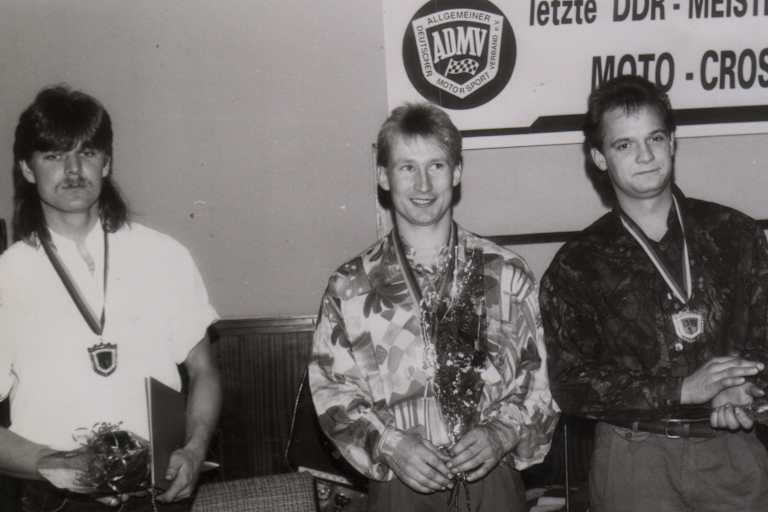
Der MSC Teutschenthal holt 1990 den letzten Mannschaftsmeister-Titel
Foto: Schadenberg
Der MSC Teutschenthal holt 1990 den letzten Mannschaftsmeister-Titel
© Schadenberg


1990 was the year of German reunification. On 1 July, the Deutschmark was introduced. This brought the population many freedoms, but also significant upheavals. In a very short space of time, the country’s entire economy had to be transformed from a planned economy to a market economy; state-owned enterprises were privatised, and many people were overwhelmed by the sudden change. This led to social upheaval: unemployment, an exodus of skilled workers and, particularly in central Germany, a massive decline in industry. Naturally, the motorsport club also had to contend with the consequences of these problems. Yet giving up was never an option for Joachim Jahnke’s team. The club recognised the opportunities arising from its newly gained freedom and seized them, without denying its own history. As a result, relations with Eastern European sports enthusiasts – particularly its Czech friends – were not only maintained but even further strengthened. In this way, the club also became a bridge-builder between East and West. David Luongo (CEO of World Championship series promoter Infront Moto Racing) also paid tribute to this in his anniversary message. More on that later. We return in our journey through time to the year 1990: exactly one week before the currency changeover from the GDR’s domestic currency, the Mark, to the freely convertible Deutschmark, on 24 June 1990, the 30th International Motocross took place in the Talkessel. For the first time since 1971, riders from West Germany competed in the Talkessel again.
The MC becomes the MSC
After 34 years as MC Teutschenthal, the club was renamed MSC Teutschenthal. Meanwhile, spectator numbers at the Talkessel continued to rise, and wooden grandstands were erected around the track for the spectators.
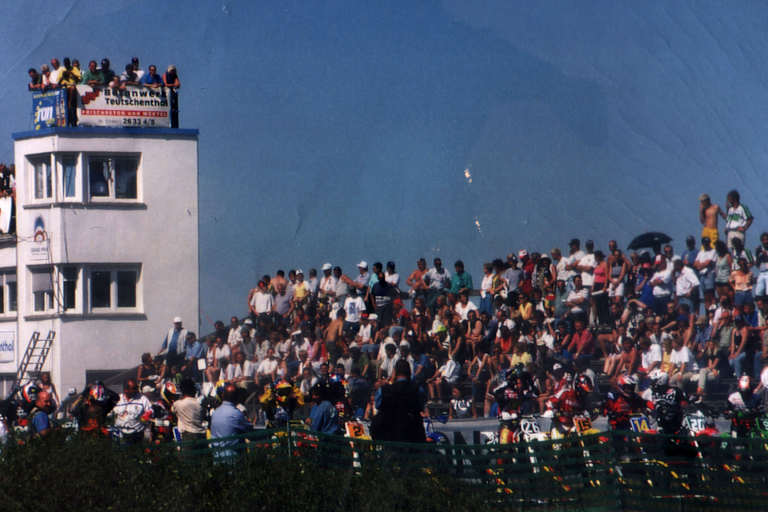
Anfang der 1990er Jahre wurden Holztribünen errichtet
Foto: copyright free
Anfang der 1990er Jahre wurden Holztribünen errichtet
© copyright free
International track licence
The world governing body, the FIM, was convinced of the club’s and the track’s potential right from the start. The valley basin was granted an international circuit licence, and members of the MSC underwent training to become technical stewards for World Championship events, as well over 300 motorbikes must pass technical scrutineering ahead of a Grand Prix weekend. From then on, the MSC Teutschenthal was able to draw on its own ranks for race directors, sports commissioners, race secretaries, track safety officers, and environmental and sustainability officers. To create escape routes and crossings, tunnels were dug beneath the jumps.
Torsten Wolff gewann 1994 im Talkessel
Foto: copyright free
Torsten Wolff gewann 1994 im Talkessel
© copyright free
Topic of the week
Crazy MotoGP hero? Jorge Martin as 2026 World Champion in Psychology
Many shook their heads – whether out of bewilderment, admiration or disapproval – when a badly injured Jorge Martin opened the throttle at Sepang and Losail. Martin’s message has got through.
Stunt show
As well as top-class sport, spectators in the valley basin were now also treated to an impressive show. Stuntman Jürgen Baumgarten leapt through a wall of fire and over numerous cars.
Teutschenthal becomes the last GDR team champion
In 1990, MSC Teutschenthal made history once again: their club riders Thomas Großer, Bernd Häußer and Hardy Schadenberg won the last GDR team championship in motocross. Construction and improvements continue around the track.
Rolf Dieffenbach: Completely thrilled by the valley basin
Rolf Dieffenbach, one of the best and best-known World Championship riders from the former Federal Republic of Germany, visited the Talkessel in 1991 and was more than surprised: “We were thrilled by Teutschenthal and the whole complex,” he explained decades later. “We’d never seen anything like it in the West.” On 30 June 1991, a European Championship round featuring a star-studded line-up took place at the Talkessel. Collin Dugmore emerged as a new crowd favourite in the international 250cc class at the Talkessel. And three-time world champion Paul Friedrichs also made a return to the Talkessel.
On the road to the World Championship: Inter-DM
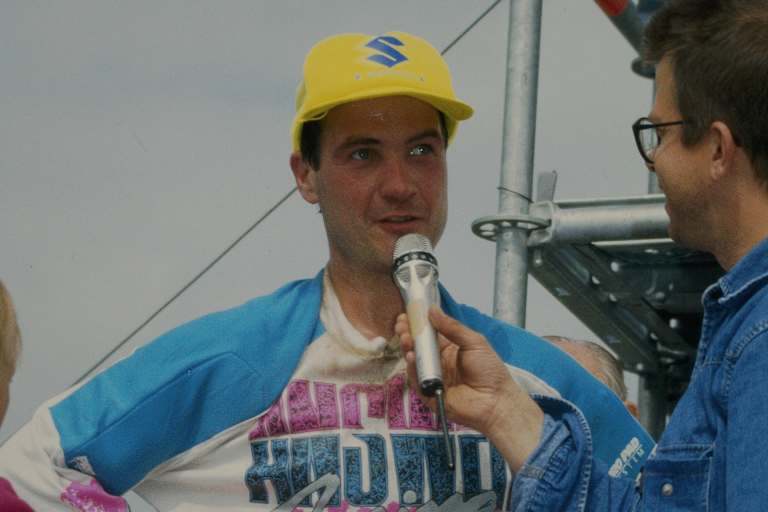
For MSC Teutschenthal, the route to the World Championship initially led via the Inter-DM, the forerunner of today’s ADAC MX Masters, in which several World Championship contenders were already competing. The German Suzuki rider Pit Beirer won and was celebrated by the crowd. With Jochen Jasinski, MSC Teutschenthal gained another prominent club rider.
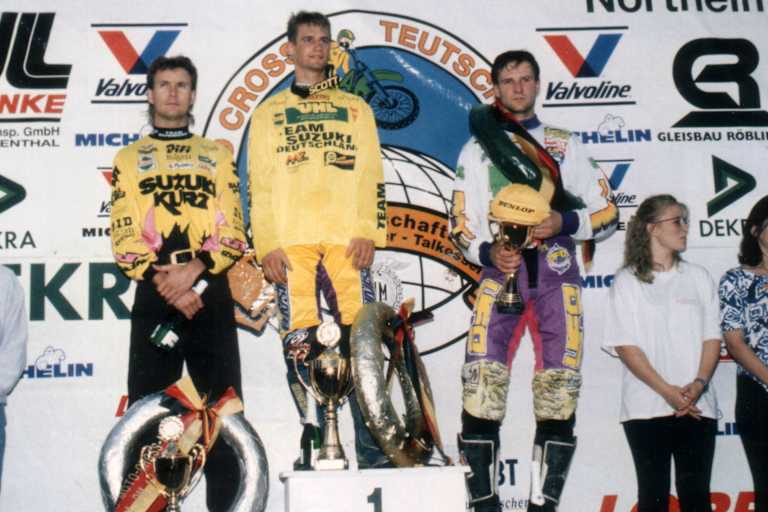
Pit Beirer gewann in den 1990er Jahren im Talkessel
Foto: MSC Teutschenthal
Pit Beirer gewann in den 1990er Jahren im Talkessel
© MSC Teutschenthal
The call from Geneva
February 1993: The FIM contacted the club from Geneva with a request to host a World Championship round again after 22 years. A replacement had to be found as quickly as possible for the South African Grand Prix, which was in doubt due to the political situation. MSC Teutschenthal did not hesitate and rose to the challenge. This meant the club was back in the ‘Champions League’ of motocross. On 20 June 1993, the world’s elite riders gathered once more in the valley basin, and before the start of the three heats, the world skydiving champions from Oppin made a landing. Belgian motocross star Joel Smets secured his first Grand Prix victory at this race. This race marked the dawn of the era of modern four-stroke engines. Subsequent history showed that Joel Smets was spot on back then – and remains so to this day.
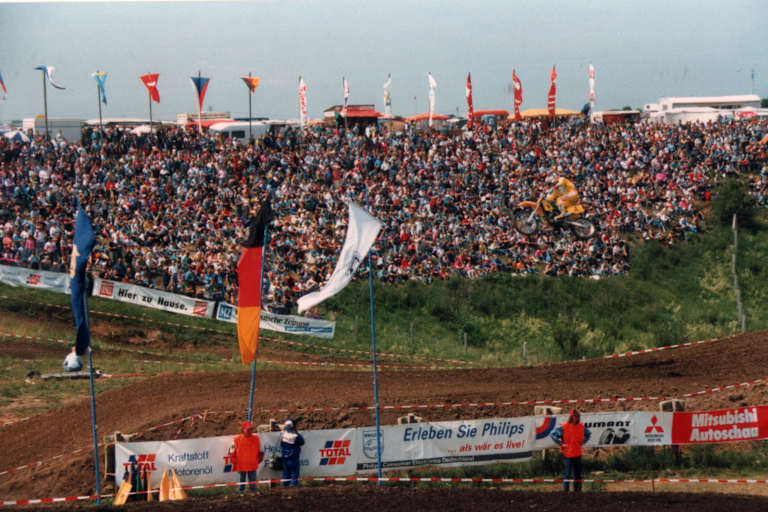
Joel Smets gewann 1993 vor einer gewaltigen Zuschauerkulisse
Foto: Thoralf Abgarjan
Joel Smets gewann 1993 vor einer gewaltigen Zuschauerkulisse
© Thoralf Abgarjan
Night Supercross Experiment
In 1994, there was another first at MSC Teutschenthal: on the Friday before the Inter DM race weekend, the first night Supercross under floodlights caused quite a stir. The Bulgarian Radoslaw Balinov, who lived and worked in Teutschenthal and competed for the club, made it onto the podium. However, supercross and motocross are not the same thing, and so the club subsequently refocused on its core competence – organising motocross races. Dietmar Lacher won the Inter-DM race and Torsten Wolff from Drehna triumphed once again in the 125cc class. The Inter-DM returned to the valley basin in 1995. Dutch rider Gert Jan van Doorn won, and the sidecar class was also part of the show once more.
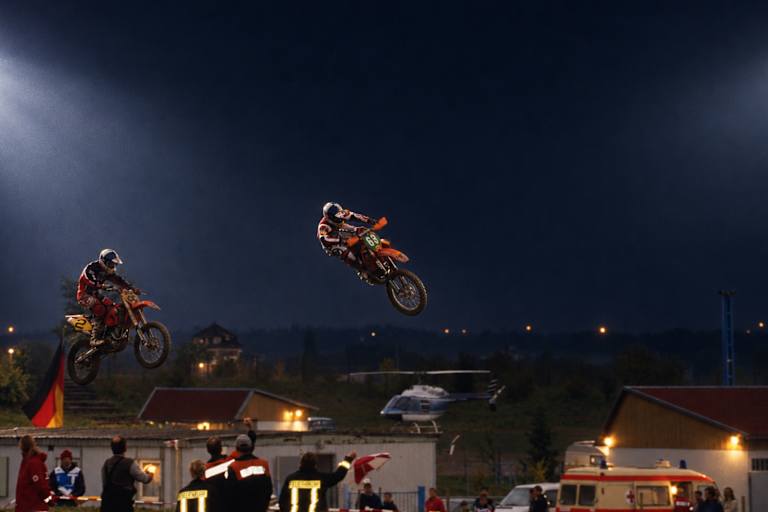
1994 wurde ein Nacht-Supercross unter Flutlicht organisiert
Foto: copyright free
1994 wurde ein Nacht-Supercross unter Flutlicht organisiert
© copyright free
1996: Another 250cc World Championship round and first US victory
On 14 April 1996, the Talkessel once again hosted a 250cc World Championship round. It was the second such event in the club’s history, following the one in 1971. Pit Beirer had finished fifth in the 250cc World Championship in 1995 and arrived at the Talkessel as one of the favourites for his home Grand Prix. However, things became hectic just before the start of the first race, as the starting gates failed to drop. The problem was, however, resolved in no time at all. For the first time in the history of the Talkessel, an American rider claimed victory in a race.
In 1996, Action Group, owned by Giuseppe Luongo, acquired the worldwide marketing rights from the FIM. From that point on, significantly higher standards were demanded of the paddock, the circuit and safety measures.
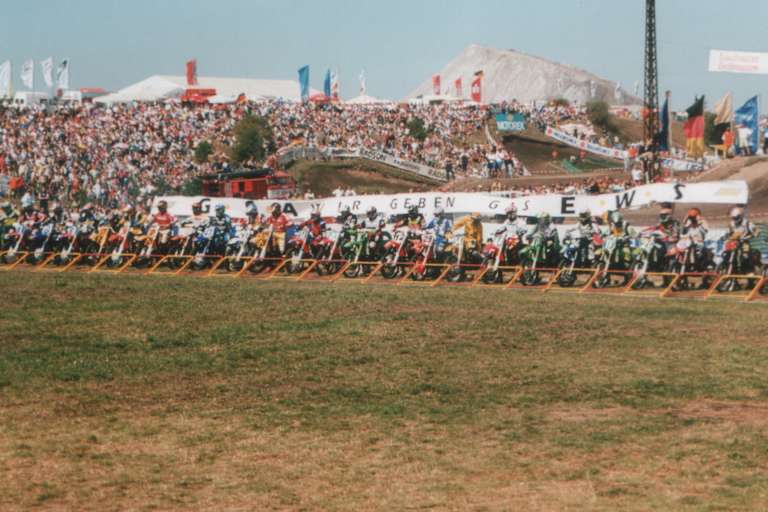
1998: Die Werbebanner wurden kurzerhand von Clubmitgliedern gehalten
Foto: copyright free
1998: Die Werbebanner wurden kurzerhand von Clubmitgliedern gehalten
© copyright free
Which venue in reunified Germany will host the World Championship?
1997: Across the whole of Germany, there are many clubs that are able and willing to host a Motocross World Championship: Bielstein, Gaildorf, Gerstetten, Goldbach, Holzgerlingen, Laubus-Eschbach, Northeim, Reil, Reisersberg, Reutlingen and Wächtersbach are all from the old federal states. From the new federal states, only the clubs from Hänchen and the Teutschenthal Motorsport Club came forward. Later, the MSC Fürstlich Drehna was added to the list. However, in the end, there could only be one host for a Motocross World Championship in reunified Germany, and the outcome was still completely open at that stage. In 1997, the valley basin once again hosted a round of the Inter-DM. In the paddock, the new multi-purpose building was erected to house the VIP area, club room, press centre and jury, as the next challenges were already on the horizon.
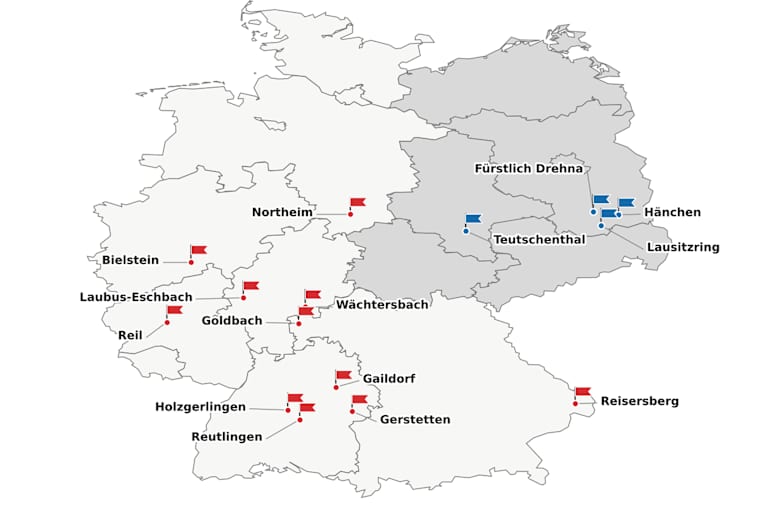
WM-Standorte in den 1990er Jahren im vereinigten Deutschland
Foto: Thoralf Abgarjan
WM-Standorte in den 1990er Jahren im vereinigten Deutschland
© Thoralf Abgarjan
1998: World Championship and a touch of Formula 1
1998: Ahead of the 250cc World Championship round, some riders complained about the advertising banners above the starting gates. But the money from the sponsor, EWS, was urgently needed. It was finally agreed to place the advertising banners behind the start line, and in the end both the riders and the sponsor were satisfied with this solution. A Ferris wheel next to the track created a fairground atmosphere, and when Pit Beirer took the lead in the first race, the crowd went wild. Pit Beirer fell back after suffering exhaust damage. The second race was characterised by an epic duel between the superstars Stefan Everts from Belgium and Sébastien Tortelli from France. Everts came out on top in the valley, but Tortelli went on to become world champion.
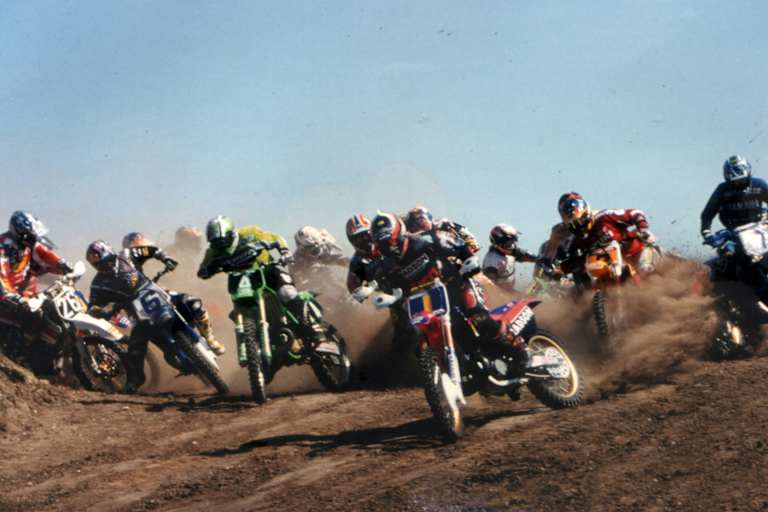
1998 kam es zum epischen Duell zwischen Everts (#1) und Tortelli (#4)
Foto: copyright free
1998 kam es zum epischen Duell zwischen Everts (#1) und Tortelli (#4)
© copyright free
MSC Teutschenthal establishes itself as a fixture
Construction work in the valley basin continued unabated and at full speed in 1999, and a prestigious winners’ podium was erected in preparation for the German Grand Prix in the 500cc class. Meanwhile, the sound of four-stroke engines dominated the 500cc class. The Swede Peter Johansson won, and club rider Hardy Schadenberg qualified for the championship races. Over the course of this decade, MSC Teutschenthal had established itself as a fixture in the Motocross World Championship, but standing still would mean falling behind. Even greater challenges lay ahead in the new millennium.
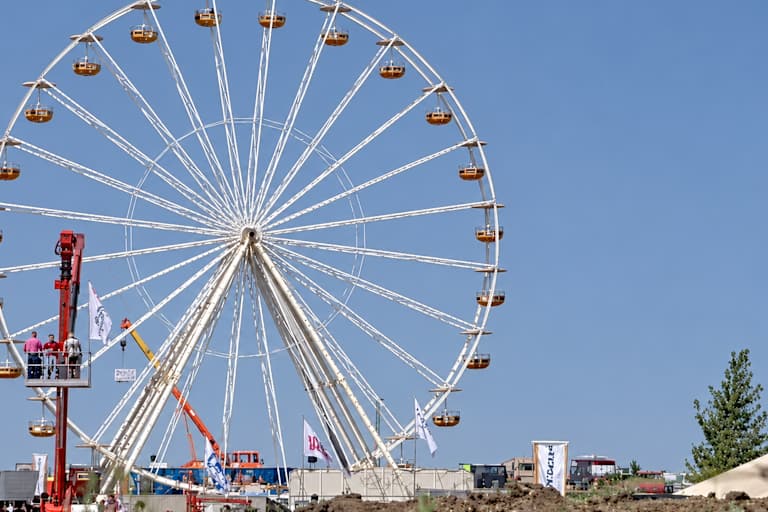
Das Riesenrad verbreitet Volksfeststimmung im Talkessel
Foto: Thoralf Abgarjan
Das Riesenrad verbreitet Volksfeststimmung im Talkessel
© Thoralf Abgarjan
Seen already?
Don't miss out on any highlights: The Speedweek newsletter, sent out twice a week, delivers the latest news, exclusive commentary and all the important dates from the world of motorsports - directly into your inbox
Motocross News
All News
Newest Articles
All ArticlesNew