Triumph’s Sport Triple goes into production: the Street Triple 798 has shed a fair bit of weight
With the Street Triple 798, Triumph emphasises its connection to the British manufacturer’s involvement in Moto2 and World Supersport. The result is the biggest leap forward in development to date for the British naked bike.
This article is an automatically generated English version. The
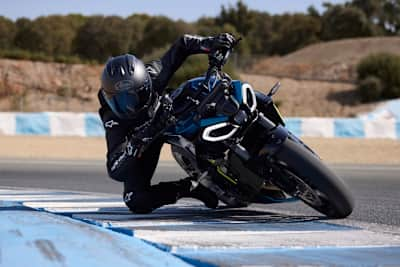
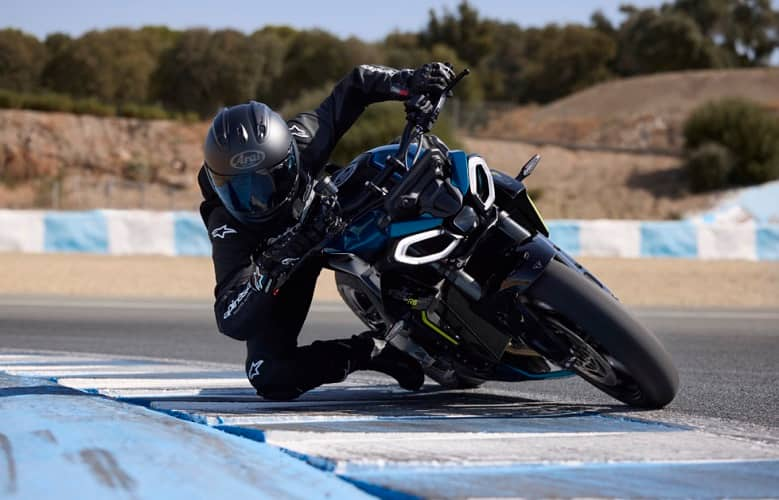
Triumph Street Triple 798: Nochmal deutlich sportlicher als die Vorgängerin
Foto: © Triumph Motorcycles
Triumph Street Triple 798: Nochmal deutlich sportlicher als die Vorgängerin
© © Triumph Motorcycles


Triumph had already announced this itself at the start of October: the British manufacturer is giving the Street Triple a complete overhaul for 2027. The first images had already been released, and now the first details are emerging. And as SPEEDWEEK.com reported months ago, the new generation of the three-cylinder roadster continues the direction set by its predecessors more consistently than ever before: In the past, the British manufacturer attempted to use the ‘Streety’ to appeal simultaneously to customers who wanted a naked bike suitable for everyday use and those seeking a dedicated streetfighter. Recently, however, the developers in Hinckley have been increasingly focusing on the sporty side of things. With the new 798 generation, the British manufacturer is taking this strategy a step further and clearly distinguishing the model from its in-house Trident 800.
According to Steve Sargent, the “link between the road and racing” is what sets the latest iteration of the Street Triple apart. The Briton is the product manager at Triumph. The use of the three-cylinder engine in the Moto2 series, with two million kilometres of racing under its belt, has “significantly influenced” the development of the new engine. Back in the summer, when the British manufacturer unveiled the engine for the upcoming Moto2 season, they were keen to emphasise that at Triumph, “the development of the Moto2 and production engines went hand in hand”.
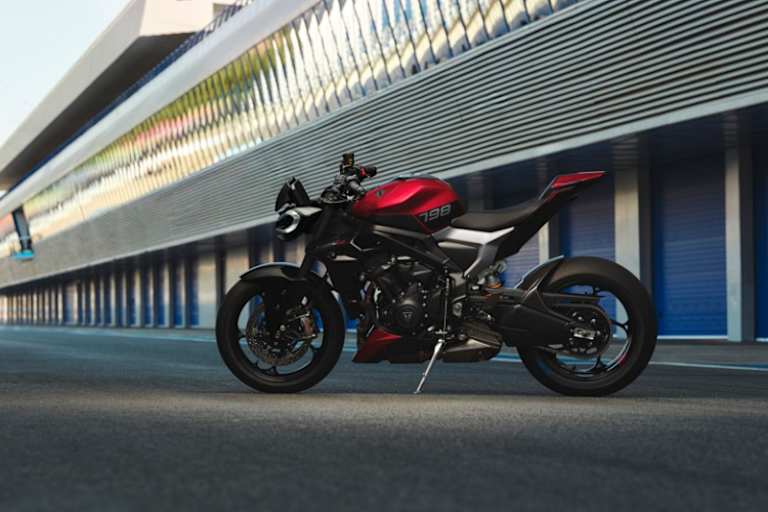
Nicht nur am Motor getüftelt: Neues Fahrwerk mit flinkeren Geometriedaten
Foto: © Triumph Motorcycles
Nicht nur am Motor getüftelt: Neues Fahrwerk mit flinkeren Geometriedaten
© © Triumph Motorcycles
The new engine boasts a displacement of 798 cc – not achieved simply by boring out the cylinder, but by increasing the stroke from 53.4 mm to 55.7 mm. The combustion chamber, which retains the same diameter, has been redesigned to accommodate larger valves, whilst compression has been increased. In addition, the intake and exhaust systems have been redesigned. More aggressive cam profiles open the valves faster and keep them open for longer. These changes are intended to improve gas flow across the entire rev range; the in-line three-cylinder engine is expected to respond more spontaneously and generate more power even at medium revs. This means it will now deliver 135 PS at 11,500 rpm, whilst 86 Nm of torque is available at 9,250 rpm. The previous generation of the Street Triple RS, with its 765 ccm engine, delivered 130 PS at 12,000 rpm and 80 Nm at 9,500 rpm in its most powerful version.
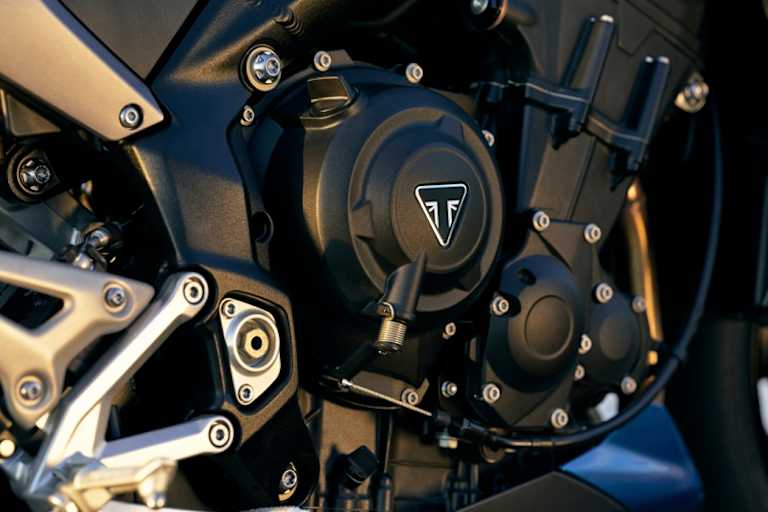
Kenner erblicken zahlreiche Neuteile am Reihendreizylinder
Foto: © Triumph Motorcycles
Kenner erblicken zahlreiche Neuteile am Reihendreizylinder
© © Triumph Motorcycles
Topic of the week
Crazy MotoGP hero? Jorge Martin as 2026 World Champion in Psychology
Many shook their heads – whether out of bewilderment, admiration or disapproval – when a badly injured Jorge Martin opened the throttle at Sepang and Losail. Martin’s message has got through.
“Every key component” has been redesigned compared to its predecessor, Triumph states. This includes a new gearbox, along with the crankcase, clutch and primary drive, as well as a new exhaust system.
The Street Triple’s backbone – the aluminium trellis frame – has been thoroughly redesigned. The subframe and the swingarm, made from extruded aluminium sections, are also completely new. Visually, this also bridges the gap with the Moto2 race prototypes, whilst serving a practical purpose: a new rear wheel guide was required to accommodate a wider rear tyre than on the previous generation. This is part of the suspension system, which features a 41 mm USD fork from Showa at the front and an Öhlins STX46 shock absorber at the rear – both of which are adjustable. The steering head angle is now set slightly steeper, the trail has been reduced by 4.4 mm to 92.5 mm, and the ground clearance has been increased. This is intended to allow for greater lean angles. Brembo Stylema brakes and Pirelli Diablo Supercorsa V3 tyres round off the package.
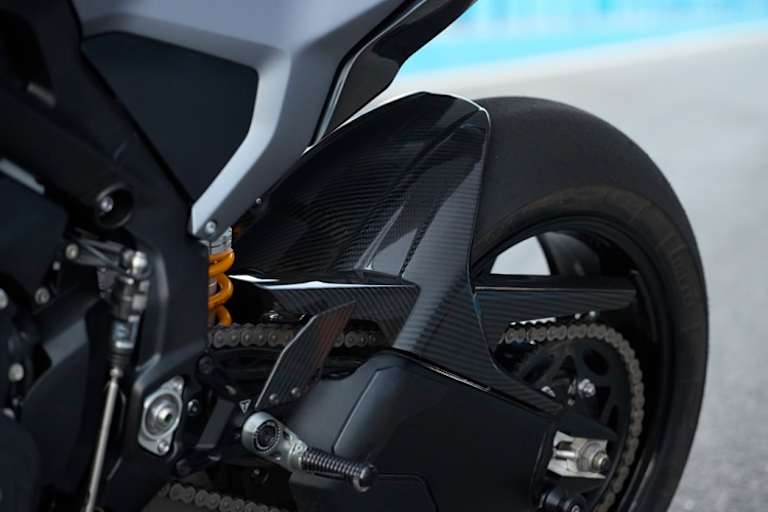
Nur das Beste: Neue Schwinge, breiter Hinterreifen, Öhlins TTX-Federbein
Foto: © Triumph Motorcycles
Nur das Beste: Neue Schwinge, breiter Hinterreifen, Öhlins TTX-Federbein
© © Triumph Motorcycles
All in all, the engineers from the Midlands have shaved 5 kg off the weight compared with the previous generation of the Street Triple RS; the figure rises to 6 kg when compared with the previous ‘R’ version. The Street Triple 798 weighs in at 183 kg ready to ride – a suitable technical basis for a potential future Daytona 798. This has not, of course, been officially confirmed yet.
Technically, the new naked bike represents just as significant a leap forward as it does stylistically: the design studio led by Rodolfo Frascoli is responsible for the design of the new ‘Streety’; the same studio also designed its predecessor, as well as numerous other British models from the recent past. The new lighting units are particularly striking, with the daytime running lights shaped in an arc to channel airflow to the air intakes fitted next to the fuel tank. The central projection lens itself features adaptive cornering lights. Triumph has spared no expense when it comes to the electronics either: there are seven riding modes, controlled via a 7-inch TFT display. With launch control and wheelie control, adjustable engine braking, cornering ABS and traction control, and various other features, the Street Triple is also state-of-the-art when it comes to control systems.
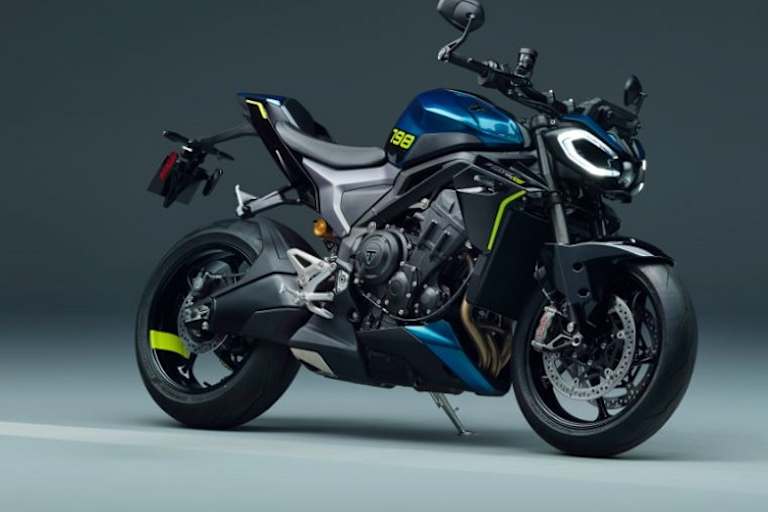
Die Streety 798 dürfte lästig werden – für Fahrer von Naked Big Bikes
Foto: Triumph Motorcycles
Die Streety 798 dürfte lästig werden – für Fahrer von Naked Big Bikes
© Triumph Motorcycles
The Street Triple 798 RS will arrive at dealerships in Germany in January, priced at €13,995. In Austria, the price is €15,995, whilst customers in Switzerland will need to pay CHF 14,495.
Seen already?
Don't miss out on any highlights: The Speedweek newsletter, sent out twice a week, delivers the latest news, exclusive commentary and all the important dates from the world of motorsports - directly into your inbox
Products News
All News


Newest Articles
All ArticlesNew New New New New New