
Swiss Moto and SAM: Switzerland’s largest motorcycling federations join forces
The Gordian knot has been cut: the Swiss Motorcycle Association (SAM) is to become a collective member of the national motorcycle federation Swiss Moto. The first step will be to raise the profile of grassroots motocross.
This article is an automatically generated English version. The

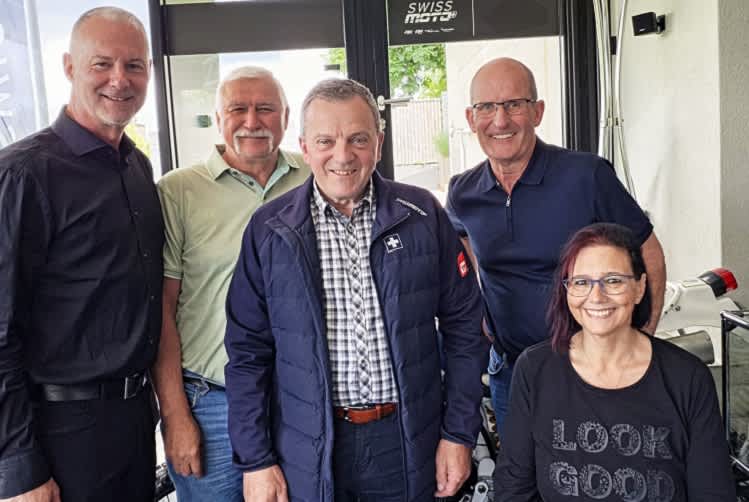
Enz, Claude Clément und Wobmann (Swiss Moto), Uhr und Gisela Hilfiker (SAM)
Foto: Swiss Moto/SAM
Enz, Claude Clément und Wobmann (Swiss Moto), Uhr und Gisela Hilfiker (SAM)
© Swiss Moto/SAM


It would go beyond the scope of this report to adequately explore all the nuances and twists and turns in the history of the Swiss motorcycling scene’s associations, so here is a brief summary: there are two associations in Switzerland that represent the interests of motorcyclists and organise motorbike races.
The predecessor of Swiss Moto, the Union Motocycliste Suisse, was founded in Geneva in 1914 and was led for many years by presidents from French-speaking Switzerland. Swiss Moto is a member of the Swiss Olympic umbrella organisation and is authorised to award the title of Swiss Champion in motorcycling within its racing series: motocross, supermoto, enduro, trial and road racing. Swiss Moto has around 16,000 members and 1,700 licensed motorcyclists, and is a member of the European and World governing bodies, which is why successful motorcyclists can continue their careers in European and World Championships. Swiss Moto is active at a political level and is carrying out pioneering work through its Women’s Commission, established in 2024.
The Swiss Automobile and Motorcyclists’ Association (SAM) was founded in 1927 in Weinfelden (Canton of Thurgau), has over 6,000 members, is primarily based in German-speaking Switzerland, and organises races in eight disciplines for 1,400 licensed riders; the motocross racing series in particular is very popular. By organising rides, safety training sessions and courses for touring riders, the SAM also caters for road motorcyclists and is involved in transport policy.
Within Swiss Olympic’s hierarchically structured sports funding system, Swiss Moto achieved an upgrade in 2024, which means, amongst other things, that Swiss Moto receives more funding but also has to deliver more. One of the conditions attached to the upgrade is the establishment of a national programme of grassroots competitions.
Had Swiss Moto now set about organising motocross races for grassroots athletes, it would probably have run into considerable difficulties: there are not an unlimited number of clubs and associations that can organise a motocross event, have a suitable venue and obtain the necessary official permits. They would have had to compete with the established SAM using parallel structures, which would ultimately have meant everyone lost out. Now, this Gordian knot has been cut by the presidents of the two federations, Walter Wobmann and Roger Uhr, with a joint stroke of the sword.
The SAM is to become a collective member of Swiss Moto. The SAM will remain a legally, organisationally and financially independent association with its own history, its sections, its members and its sporting activities. The existing, successful collaboration in the Supermoto, Women’s Motocross and Sidecar Motocross disciplines will continue. In addition, there will be a grassroots motocross championship comprising the SAM’s races and several others organised by cantonal federations in French-speaking Switzerland. At the end of the 2027 season, there will be a national final for the best amateur motocross riders, at which they will compete for official Swiss amateur motocross championship titles.
However, the scope of this new collaboration is intended to extend far beyond the sport itself. The Mobility Commission, which was launched back in 2024 by Swiss Moto and IG Motorrad Schweiz, will play a central role. With the involvement of the SAM, it is set to evolve into a link between motorcycling, individual motorbike mobility and political advocacy.
The motorcycling community faces challenges that must be addressed at a political level through strong, coordinated national advocacy. At stake are the preservation of training and competition opportunities, social acceptance, road safety, infrastructure, the legal framework and the equal treatment of motorised two-wheelers in transport policy and planning.
By pooling specialist expertise, networks and political resources, a new level of influence is created vis-à-vis authorities, political decision-makers, national institutions and other partners. This makes the associations attractive not only to motorcycling sports enthusiasts, but also to motorcyclists who use their motorbikes for touring or as a means of transport.
“The motorcycling community can achieve much more politically and socially if it joins forces,” says Walter Wobmann. “With this step, we are laying the groundwork to represent our shared interests more effectively at national level. This will benefit not only motorcycling as a sport, but the entire motorcycling community in Switzerland.”
“The SAM brings a long tradition, strong regional structures and extensive experience in grassroots sport to this collaboration,” explains Roger Uhr. “It was important to us to preserve our independence and our identity. The new model enables us to do just that, whilst at the same time opening up opportunities that we would find difficult to realise as individual federations.”
The architect of this collaboration is Rolf Enz, CEO of Swiss Moto. He looks even further into the future: “The vision is clear: a connected Swiss motorcycling landscape in which shared interests take centre stage. A community that uses its resources wisely, nurtures its young talent, strengthens its sport and joins forces to champion the future of motorcycling.”
Seen already?
Don't miss out on any highlights: The Speedweek newsletter, sent out twice a week, delivers the latest news, exclusive commentary and all the important dates from the world of motorsports - directly into your inbox
Motocross News
All News


Newest Articles
All ArticlesNew New New New New New


