
Official: The Moto3 revolution gets underway, with Yamaha set to deliver a complete package in 2028
Following the premier class, it is now Moto3’s turn: the new format for the smallest engine capacity category was officially unveiled at Assen. The new era will begin in 2028 with new standardised bikes from Yamaha.
This article is an automatically generated English version. The

Paolo Pavesio (Yamaha) verkündigte mit Carlos Ezpeleta die Moto3-Zukunft
Foto: Kuttruf
Paolo Pavesio (Yamaha) verkündigte mit Carlos Ezpeleta die Moto3-Zukunft
© Kuttruf


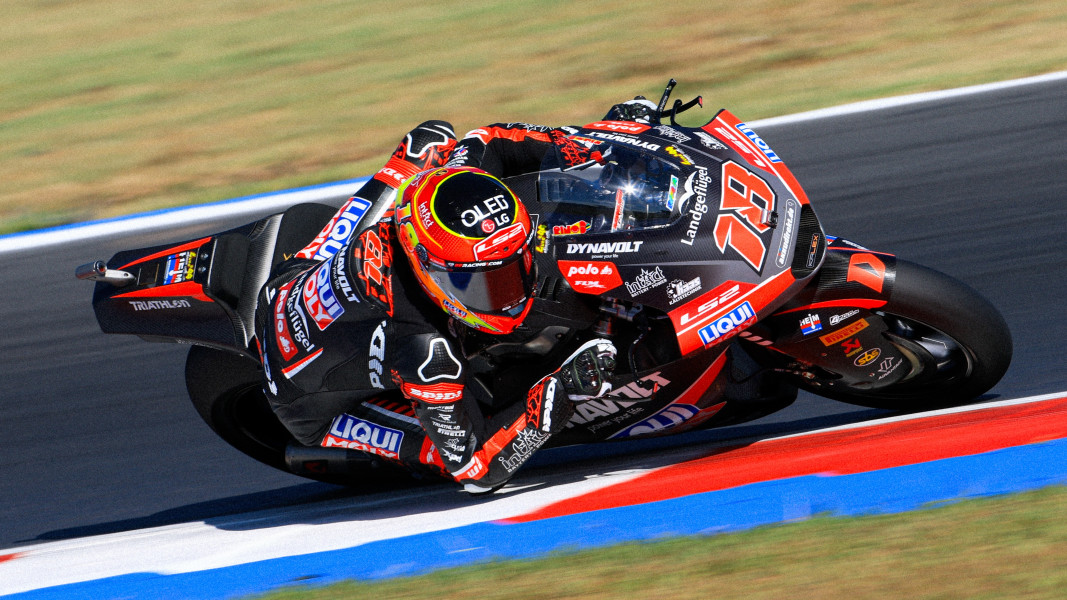
SPEEDWEEK.com has long been reporting on the impending revolution in the Grand Prix paddock – which is now official. One year after the start of the new MotoGP era, featuring only 850cc prototypes, the lower tier is being restructured. A joint press conference with MotoGP management, represented by Sporting Director Carlos Ezpeleta and Yamaha Racing Director Paolo Pavesio, marked the official launch of the new Moto3.
Instead of the delicate and expensive prototypes fitted with 250cc four-stroke single-cylinder engines, young riders will now be able to prove themselves on significantly larger, more powerful, but – first and foremost – considerably cheaper spec bikes designed for higher-level competition.
As SPEEDWEEK.com has reported on several occasions since September 2025,
Due to the long-standing rivalry between KTM and Honda for Moto3 supremacy, costs have spiralled out of control. Currently, a rolling chassis costs 100,000 euros. The leasing fees for the six engines per rider per year are largely paid for by MotoGP.
In order to restructure the system with a view to successfully and affordably promoting young talent, the decision was made to introduce a standardised motorcycle.
Topic of the week
Nicolo Bulega: Toprak’s successor will not fail in MotoGP
The Italian Nicolo Bulega is the first rider to have won the world title in both the Supersport and Superbike classes; from 2027, he will be racing in MotoGP. His performances this season are second to none.
TV Program
Carlos Ezpeleta at the press conference held in Assen: “We have agreed on a new six-year era for Moto3. This also applies to the Junior World Championship, which will follow suit in 2029. The new motorbikes should also be much better suited to today’s riders – including in terms of ergonomics. However, cost structure is also crucial; it should make it possible to put the new Moto3 on a much broader footing – whilst at the same time ensuring that, at the level of the GP rider field, it matches at least the performance of today’s Moto3.”
Ezpeleta on the specifications: “We are still at an early stage, but we are currently assuming a weight of 120 kilos with a power output of at least 95 PS. Below the GP rider field, it could be slightly less.”
This set the scene for Yamaha’s sporting director Pavesio, who emphasised the actual mission: “We are delighted to be part of this project and believe that we are in a position to help steer Moto3 towards its true purpose – to foster a broad base for young racing talent, including at national level. Our motorcycle is designed in such a way that we can manufacture it in series at a Yamaha factory, enabling us to offer it to a number of national championships whilst still remaining below the agreed cost limit.”
At the same time, Paolo Pavesio emphasised the sporting approach: “Even though the powertrain is based on a production engine, this is a pure racing motorbike developed by Yamaha Racing engineers. And even the engine itself has been optimised and made lighter through numerous measures. Adjustability, as is standard on a GP bike, will also be provided. We are planning an initial track test in September or October this year.”
Information was also provided on the business model. Whilst the Moto3 chassis of the future will be purchased by the teams, the power units will be supplied to the MotoGP group via a leasing model. This is intended to guarantee not only standardisation but also technical reliability and, consequently, operational safety.
Seen already?
Don't miss out on any highlights: The Speedweek newsletter, sent out twice a week, delivers the latest news, exclusive commentary and all the important dates from the world of motorsports - directly into your inbox
Highlight Videos
ServusTV Media Library
26. Sept. | 12:31 Min
22. Sept. | 3:57 Min
„Haben gezittert bis zur letzten Kurve"
20. Sept. | 4:01 Min
20. Sept. | 41:28 Min
Pedro Acosta: „Danke an alle Fans“
20. Sept. | 5:36 Min
20. Sept. | 3:52 Min
Quiles: „Es war toll, in Österreich zu fahren“
20. Sept. | 3:15 Min
Holgado & Alonso beantworten eure Fragen!
20. Sept. | 4:01 Min
Events
All Moto3 EventsPast San Marino Grand Prix Misano World Circuit Marco Simoncelli, Italien 11.–13.09.2026Past Motorrad Grand Prix von Österreich Red Bull Ring, Österreich 18.–20.09.2026Live
Japanese Grand Prix Twin Ring Motegi, Japan 02.–04.10.2026Next up Indonesia Grand Prix Mandalika International Street Circuit, Indonesien 09.–11.10.2026Australian Grand Prix Phillip Island Grand Prix Circuit, Australien 23.–25.10.2026

Past San Marino Grand Prix Misano World Circuit Marco Simoncelli, Italien 11.–13.09.2026Past Motorrad Grand Prix von Österreich Red Bull Ring, Österreich 18.–20.09.2026Live
Japanese Grand Prix Twin Ring Motegi, Japan 02.–04.10.2026Next up Indonesia Grand Prix Mandalika International Street Circuit, Indonesien 09.–11.10.2026Australian Grand Prix Phillip Island Grand Prix Circuit, Australien 23.–25.10.2026
MotoGP News
All News


Newest Articles
All ArticlesNew New New


