
Full steam ahead: KTM with revised MotoGP engines in Aragon
Following an investigation within the KTM MotoGP department, a request submitted to the manufacturers’ association and a lengthy waiting period, the RC16 engines have now been revised in accordance with FIM protocol ahead of the Aragon GP.
This article is an automatically generated English version. The

Werksfahrer Brad Binder auf der KTM RC16
Foto: Gold and Goose
Werksfahrer Brad Binder auf der KTM RC16
© Gold and Goose


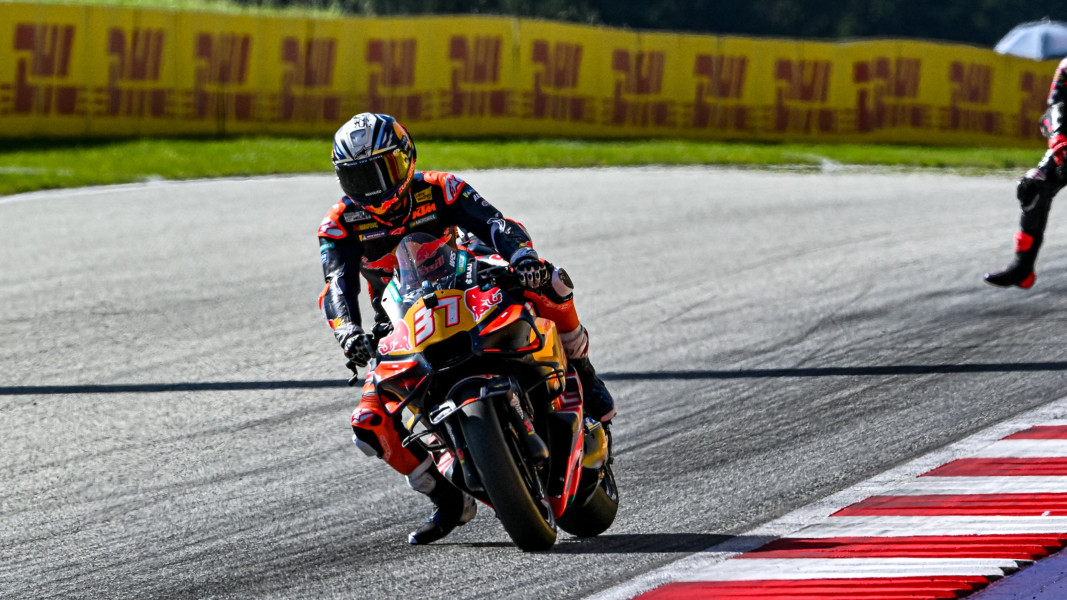
In the run-up to the final two races of the premier class in England, SPEEDWEEK.com had exclusively learnt that KTM’s request to the MotoGP Technical Commission to modify the RC16 engines would ultimately be granted. Specifically: KTM was granted permission to open the four-cylinder engines of MotoGP riders Acosta, Binder, Viñales and Bastianini – which had been sealed in accordance with the regulations – under controlled conditions.
The background to this was the spate of faults in the RC16’s powertrain, which had led to a series of engine failures affecting all riders on the Austrian prototype. Incidentally, the most high-profile failure on a 2026 MotoGP KTM had nothing to do with the problem that was only identified later. The cause of the power cut-out on Pedro Acosta’s bike – which led to the collision with Alex Márquez at Catalunya – was the standard electronic engine management system, not the engine itself.
Investigate, solve the problem, wait, review
It was only after an intensive technical examination of the RC16 engines that the racing department was able to identify the actual cause of the engine failures. Details have not been made public – partly due to the Technical Commission’s minutes – but it is clear that faulty, performance-critical mechanical components from a supplier caused serious difficulties for KTM and, consequently, for the Austrian manufacturer’s success-hungry MotoGP teams.

KTM RC16: Schnell, aber 2026 mit Problemen
Foto: Gold and Goose
KTM RC16: Schnell, aber 2026 mit Problemen
© Gold and Goose
Safety concerns quickly came to the fore. The only way to guarantee the operational safety of the homologated engines was to submit a request to replace the critical components. What is already a major undertaking for KTM Factory Racing takes on even greater proportions when viewed in the broader context. This is because, in order to ensure that the engines are overhauled under controlled conditions and documented accordingly, an entire commission must make the journey to Upper Austria.
Topic of the week
A stuttering start to the Bahrain Grand Prix: the FIA narrowly avoids a fiasco like the one in Indianapolis in 2005
Fans could hardly believe their eyes at what they witnessed at the Bahrain Grand Prix: cars crawling along, racing cars that simply came to a standstill. The FIA narrowly avoided a fiasco like the one at Indy in 2005.
TV Program
Correct, do not alter
It is crucial that the specification agreed for 2025 and 2026 and set out in the homologation documents is adhered to exactly; otherwise, penalties may be imposed for breaching the ‘Engine Freeze Agreement’ – ultimately leading to disqualification.
All manufacturers are familiar with the complex process involved in an unscheduled engine overhaul. It therefore came as no great surprise that the final go-ahead took longer than hoped for. The application was submitted in the hope of carrying out the engine repairs during the summer break. However, by the time the Manufacturers’ Association (MSMA) – which must give its approval unanimously – granted the go-ahead, the team was already heading back to Silverstone, and the planned schedule had to be revised.
It is now clear that KTM was able to use the two-week break following the races in the UK to replace the faulty engine components. In response to an enquiry from SPEEDWEEK.com, the racing department confirmed: “The engines were overhauled this week.”

Acosta-Attacke in Aragon?
Foto: Gold and Goose
Acosta-Attacke in Aragon?
© Gold and Goose
Following the technical work carried out in Munderfing, the team will therefore be back in action with engines in perfect working order – rather than with reduced top speed, as was the case recently. However, there was no question of any “throttling” in England either. Pedro Acosta was the best-placed KTM rider in fifth position, whilst his team-mate Brad Binder achieved the highest top speed of any MotoGP bike on his RC16 during the Grand Prix.
It remains to be seen how the overhaul will affect the results at MotorLand Aragón. There is no doubt that the successful completion of this major overhaul will have a positive effect on the morale of the riders and the team. The circuit near Alcañiz in north-eastern Spain features two challenging acceleration sections. At the end of the longest straight, the MotoGP bikes reach speeds of over 355 km/h.
Seen already?
Don't miss out on any highlights: The Speedweek newsletter, sent out twice a week, delivers the latest news, exclusive commentary and all the important dates from the world of motorsports - directly into your inbox
Highlight Videos
ServusTV Media Library
Ein Manöver entscheidet! WM-Kampf spitzt sich zu
4. Okt. | 4:18 Min
„Hat nicht gereicht, um Marc zu besiegen“
4. Okt. | 2:39 Min
4. Okt. | 15:04 Min
Moto2: Mega-Patzer von WM-Leader
4. Okt. | 1:29 Min
Finden Honda und Yamaha zurück zu alter Stärke?
4. Okt. | 3:46 Min
Hinterreifen löst sich förmlich auf!
3. Okt. | 1:35 Min
Track-Limits-Drama kurz vor Schluss!
3. Okt. | 5:15 Min
3. Okt. | 11:14 Min
MotoGP News
All News


Newest Articles
All ArticlesNew New New New New New New New New New


