Next step for the Street Triple 798: Triumph follows up with the Moto2 Edition
Shortly after the launch of the all-new RS variant, Triumph is expanding its Street Triple 798 range with the Moto2 Edition. It is said to be lighter and sportier, and a limited edition to boot. But that comes at a price.
This article is an automatically generated English version. The
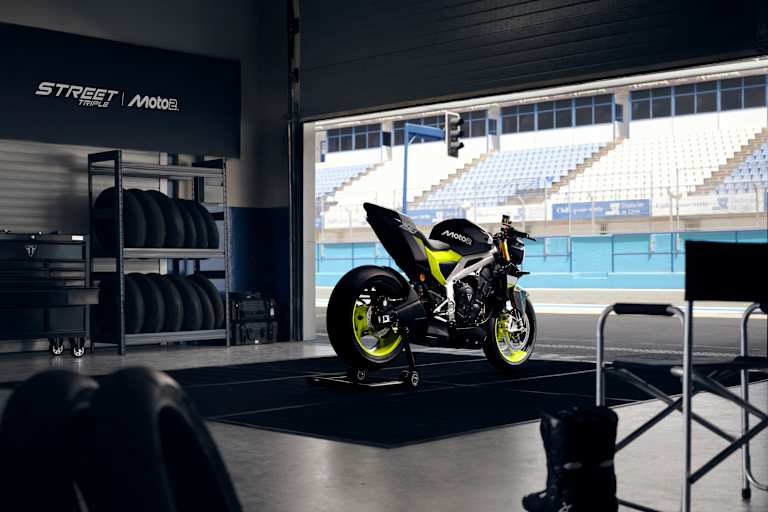
Die Triumph Street Triple 798 Moto2-Edition
Foto: Triumph Motorcycles
Die Triumph Street Triple 798 Moto2-Edition
© Triumph Motorcycles


When Triumph recently unveiled the Street Triple 798 to the public, the discerning observer would have noticed straight away: there’s still something missing! Whilst its predecessor, the Street Triple 765, was most recently available in the R, RS and RX variants, as well as the top-of-the-range Moto2 Edition, the British manufacturer initially limited itself to unveiling the RS variant – presumed to be the best-selling version – in this new edition. Just a few weeks after the Hinckley-based brand announced the technical specifications of its sportiest mass-market model in a second phase, the manufacturer unveiled the next step up on Thursday during the MotoGP World Championship season finale in Valencia: the Street Triple Moto2 Edition.
The British manufacturer regularly highlights the close relationship between its mid-range triple and the entry-level class of MotoGP. The competition engine, which will be in use until the end of the season on Sunday, was derived from the engine of the latest Street Triple generation; the two million kilometres it has clocked up in racing have ‘significantly influenced’ the new three-cylinder engine of the Street Triple 798. In any case, the development processes for the two new engines went ‘hand in hand’.
The British manufacturer celebrates this connection at every opportunity, and the Moto2 edition also relies on the engine from the Street Triple RS: This boasts the eponymous 798 cc displacement – achieved not simply by boring out the cylinder, but by increasing the stroke from 53.4 mm to 55.7 mm. The combustion chamber, which retains the same diameter, has been redesigned to accommodate larger valves, and the compression ratio has been increased compared with the previous generation. This means it will now deliver 135 PS at 11,500 rpm, whilst 86 Nm of torque is applied to the chain at 9,250 rpm – all just like the RS variant.
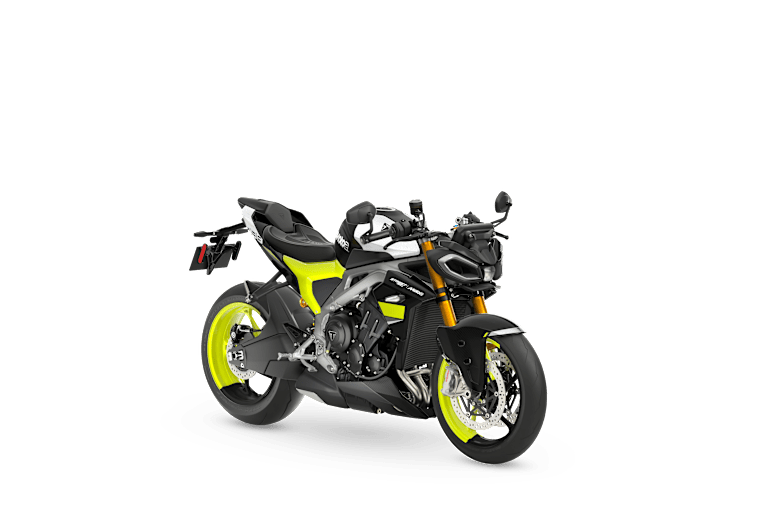
Die Triumph Street Triple 798 Moto2-Edition
Foto: Triumph Motorcycles
Die Triumph Street Triple 798 Moto2-Edition
© Triumph Motorcycles
The differences from the RS begin with the chassis: the front wheel maintains road contact with the aid of an Öhlins NIX30 fork. The Swedish manufacturer’s rear STX46 spring unit is shared by the Moto2 edition and the RS variant. The Brembo Stylema brake calipers on the RS’s front wheel are replaced by Brembo Hypure calipers. The bike also features bespoke ergonomics designed to emphasise its even stronger focus on sporty riding: Compared to its sister model, the footrests have been moved further back, and the motorbike is controlled via a classic clip-on handlebar. From the outside, the special edition is recognisable at first glance by its unique paintwork featuring bright yellow accents and lettering, which reference its connection to the motorsport series. On closer inspection, various carbon-fibre components, such as the swingarm guard and front wheel cover, replace parts that would otherwise be made of plastic. This is said to save 2 kilograms compared to the RS variant, bringing the kerb weight down to 181 kilograms. The Street Triple 798 RS, for its part, had already shed 5 kilos compared to its predecessor. The array of rider assistance systems includes Launch Control, wheelie control, lean-angle-sensitive traction and slide control, and the like – a package on a par with the Street Triple 798 RS.
Topic of the week
MotoGP Champion Marc Marquez: How he managed to defeat Aprilia
Marc Marquez made up a 102-point deficit in the 2026 MotoGP season. Aprilia had all the cards in its hand this year with Bezzecchi and Martin – and lost the title battle.
However, as you might expect, Triumph makes a difference when it comes to the price: the motorbike costs 16,995 euros in Germany, which is 3,000 more than the RS. In Switzerland, interested customers will need to pay 17,495 CHF, whilst in Austria, 18,995 euros must change hands before one can call a Street Triple 798 Moto2 Edition their own. In return, Triumph is emphasising exclusivity: production of this special edition is to be limited to a total of 1,000 units, with 500 each for the two available colour schemes. The first motorbikes are due to be delivered in May 2027, around four months after the standard version.
Seen already?
Don't miss out on any highlights: The Speedweek newsletter, sent out twice a week, delivers the latest news, exclusive commentary and all the important dates from the world of motorsports - directly into your inbox
Products News
All News
Newest Articles
All ArticlesNew New New New New New